

Archive position — measured, not model output
0 likes on Devpost
2,263 of the 7,850 archived projects have more likes, and 5,587 share exactly 0 — so this project's #5,221 place in the like-ranked listing is a tie-break inside that group, not a ranking.
Projects (log scale)
Likes on Devpost. ▲ marks this project's group.
Show the figures
| Likes | Projects | Share of archive |
|---|---|---|
| 0 | 5,587 | 71.2% |
| 1 | 1,758 | 22.4% |
| 2 | 284 | 3.6% |
| 3–4 | 132 | 1.7% |
| 5–9 | 75 | 1.0% |
| 10+ | 14 | 0.2% |
 User Stories BotA demo video on every pull request
Get a demo video on every new feature
GitHub App that watches your pull requests and records a narrated, captioned demo.
Save time on demo prep and make informed decisions faster with a video walkthrough of every new feature.
Executive Summary
Company: Mediscan AI
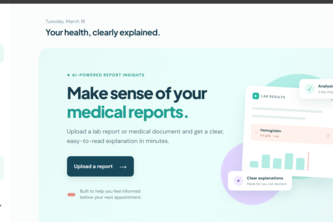
Self-reported purpose: A healthcare report analysis tool that translates complex medical reports into plain-language summaries using AI.
Key claim: To act as a translation layer between clinical language and everyday understanding, without replacing doctors or providing medical advice.
What changed: The project is a prototype built for the OpenAI 2026 hackathon, with no evidence of commercial traction or production deployment.
Single most important open question: Is there a viable path to production-grade healthcare AI that meets regulatory and safety requirements?
This analysis is based entirely on the self-reported description provided by the authors — no third-party verification, no archived data, no revenue or customer evidence. The project is presented as a hackathon prototype with no commercial history.
What The Product Actually Is
The description states that Mediscan AI is:
- A lightweight Java web application.
- Built with:
- Java HttpServer for backend functionality (local server, static file delivery, POST /api/analyze endpoint).
- HTML and CSS for frontend interface (semantic HTML, responsive grids, accessible labels).
- JavaScript for client-side behavior (drag-and-drop uploads, validation, rendering, notifications).
- A prototype, not a production product.
- Designed to analyze medical reports (PDFs or images) and return structured insights.
- The demo response is sample-based, not AI-generated in real-time.
- Includes:
- Plain-language summary
- Individual values with reference ranges
- Practical next steps
- A safety notice that the output is educational, not medical advice
Inference: The product is a proof-of-concept for a healthcare report analysis tool. It does not currently use real AI inference or OCR in production.
Positioning & Claim Evolution
The description states:
- The goal is to translate complex medical reports into plain language, helping users understand their results before seeing a doctor.
- It is not intended to replace doctors.
- It acts as a translation layer between clinical and consumer language.
- The tool emphasizes:
- Tone: calm, approachable
- Context: reference ranges, cautious explanations
- Safety: clear disclaimer, no diagnosis
Inference: The positioning is that of a consumer-facing educational tool, not a medical decision-support system. It is positioned as a complementary service to healthcare professionals.
Target Customer & ICP
The description states:
- The intended audience is people who receive medical reports and want to understand them better.
- Users are likely to be:
- Patients preparing for appointments
- Individuals seeking clarity on lab results or scans
Inference: The target customer is a health-conscious individual, not a healthcare provider or institution.
Not evidenced: No specific persona, segment, or use case beyond "patients" is described. No evidence of market research or user interviews.
Business Model & Pricing Evidence
The description states:
- It is a prototype.
- No pricing model is mentioned.
- The demo response is sample-based, not AI-generated.
- A production version would include:
- Secure authentication
- Encrypted file storage
- OCR/document extraction
- Clinically reviewed AI workflow
- Consent controls
Inference: There is no evidence of a business model or pricing structure. The project is presented as a non-commercial prototype, not a product for sale.
Technical & Delivery Signals
The description states:
- Built with:
- Java HttpServer
- HTML/CSS/JavaScript
- No external dependencies (dependency-free)
- Uses:
- Semantic HTML
- Responsive grids
- Accessible labels
- Drag-and-drop upload
- Client-side validation and rendering
- The demo returns sample insights, not real AI output.
- A production version would include:
- Secure authentication
- Encrypted storage
- OCR and document extraction
- Clinically reviewed workflows
Inference: The prototype is technically simple, but the authors acknowledge a path to more complex infrastructure. No evidence of current AI integration or scalability.
Traction & Maturity Signals
The description states:
- This is a hackathon submission (OpenAI 2026).
- It is a prototype, not a product in production.
- No revenue, customers, or adoption data are provided.
- The team size is 4 people.
Inference: There is no evidence of traction, commercial use, or customer feedback. The project is at the early prototype stage.
Competitive Context
The description states:
- No mention of competitors.
- The tool is positioned as a translation layer, not a diagnostic tool.
- It is designed to be complementary to healthcare professionals, not competitive with them.
Inference: No evidence of existing or direct competitors. The space may include AI-powered health tools, but no specific market analysis is provided.
Open Questions & Risks
The description states:
- The prototype does not use real AI inference, only sample data.
- It is a non-commercial hackathon project.
- The authors acknowledge:
- Balancing usefulness with medical safety
- Challenges in handling report formats (PDFs, images)
- Need for OCR, document validation, and clinical review
Open questions:
- No evidence of real AI or OCR capabilities.
- No commercial or regulatory compliance considerations mentioned.
- No evidence of user testing or feedback loops.
- No mention of data privacy or security in production.
Questions the description leaves open
- What is the plan for integrating real AI inference and OCR into the product?
- How will you handle medical liability and safety in a production environment?
- Are there any clinical partnerships or medical review processes planned?
- Is there a roadmap to move from prototype to commercial product?
- What are the regulatory considerations for healthcare data handling?
Overall Assessment
Not evidenced: No evidence of revenue, customers, traction, or a clear path to monetization.
Inference: This is a pre-product prototype, not an investment-ready company. It may have potential as a future product, but it currently lacks commercial viability or market validation.
The project is presented as a hackathon idea with educational intent, not a scalable business. The authors acknowledge the need for significant development to reach production readiness, including AI integration, security, and clinical review — none of which are evidenced in this description.
User Stories BotA demo video on every pull request
Get a demo video on every new feature
GitHub App that watches your pull requests and records a narrated, captioned demo.
Save time on demo prep and make informed decisions faster with a video walkthrough of every new feature.
Source
Submitted to the OpenAI 2026 hackathon on Devpost. Project home on Devpost. Back to the full gallery on Devpost.
This competitive analysis was produced by top-founders.com (opens in a new tab)
Generated by a language model from this project's public Devpost page — its tagline, the author's own write-up and any built-with tags listed there — as captured in August 2026. Short quotations are the author's words. It is an opinion on the idea as a business, not on the people behind it, and it reflects the description as published then. If the project has moved on, request a correction below. The analysis is not independent research and contains no verified traction, revenue or customer data.
An independent guide by KFG International LLC — not affiliated with, endorsed by, or connected to Devpost or OpenAI.