

Archive position — measured, not model output
0 likes on Devpost
2,263 of the 7,850 archived projects have more likes, and 5,587 share exactly 0 — so this project's #5,223 place in the like-ranked listing is a tie-break inside that group, not a ranking.
Projects (log scale)
Likes on Devpost. ▲ marks this project's group.
Show the figures
| Likes | Projects | Share of archive |
|---|---|---|
| 0 | 5,587 | 71.2% |
| 1 | 1,758 | 22.4% |
| 2 | 284 | 3.6% |
| 3–4 | 132 | 1.7% |
| 5–9 | 75 | 1.0% |
| 10+ | 14 | 0.2% |
 User Stories BotA demo video on every pull request
Get a demo video on every new feature
GitHub App that watches your pull requests and records a narrated, captioned demo.
Save time on demo prep and make informed decisions faster with a video walkthrough of every new feature.
Executive Summary
MediSync, as described by its authors, is a health companion app designed to bridge communication gaps between patients, caregivers and medical professionals. The project was built as part of the OpenAI 2026 hackathon and is self-reported as a solution for fragmented healthcare management, particularly around aging loved ones.
The core features outlined include:
- Family & Caregiver Sync
- Symptom Summarizer & Jargon Translator
- Digital Emergency Vault (SOS)
The description states that the team built this using a tech stack including Laravel, React, Node.js, PostgreSQL, and Supabase. It is presented as a prototype with no evidence of revenue, customers or traction.
Key commercial due-diligence read: The project appears to be an early-stage idea with strong positioning in a high-need market (elderly care and health data fragmentation), but there is no evidence of product-market fit, customer validation, or business traction. The most important open question is whether the team has validated demand from actual users or caregivers.
What The Product Actually Is
The description states that MediSync is a comprehensive health companion with three main pillars:
- Family & Caregiver Sync
- Symptom Summarizer & Jargon Translator
- Digital Emergency Vault (SOS)
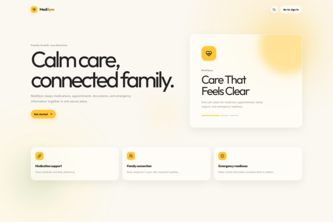
It is described as an app that allows children and caregivers to monitor parents' medications, appointments, and condition, while also translating symptoms into clinical summaries for doctors.
The authors note they integrated probabilistic modeling in the backend to structure symptom data into prioritized, clinically relevant summaries. They also built smart medication reminders based on how the body absorbs medication.
The app is said to be built with a front-end focused on accessibility, using clear typography and intuitive navigation for both younger caregivers and elderly patients.
Not evidenced: No information about actual functionality, user interface, or whether these features are fully implemented or tested.
Positioning & Claim Evolution
The authors state that MediSync was inspired by the stress of fragmented healthcare, especially when caring for aging loved ones. They claim it turns "anxiety into clarity" by bridging communication gaps between patients, families and medical professionals.
They describe the app as a solution to the lack of centralized health data management, aiming to improve doctor-patient interactions through better symptom reporting and emergency preparedness.
The positioning is framed around:
- Elderly care
- Family health coordination
- Clinical clarity in medical consultations
Inferred: The idea seems to evolve from a personal pain point (confusing doctor visits, lack of visibility into family health) into a product that attempts to solve it at scale. However, this evolution is not backed by any market research or user feedback.
Target Customer & ICP
The description states that MediSync targets:
- Adult children and caregivers managing the health of aging loved ones
- Patients who struggle to articulate symptoms during doctor visits
- Medical professionals, indirectly, through improved patient history
It is implied that the app is designed for users who are not tech-savvy, particularly elderly patients, which drives design decisions like high-contrast typography and simple navigation.
Not evidenced: No explicit segmentation of target personas, no data on user demographics or behavioral patterns. The description does not indicate whether the team has spoken to actual caregivers or patients.
Business Model & Pricing Evidence
The description does not provide any information about:
- Revenue model
- Pricing strategy
- Monetization approach
- Customer acquisition costs
- Unit economics
Not evidenced: There is no mention of how the product would be monetized, whether it’s free-to-use, subscription-based, or tied to healthcare providers.
Technical & Delivery Signals
The project was built during a hackathon and is described as a prototype. The tech stack includes:
- Front-end: React, Tailwind, HTML5, CSS3
- Back-end: Laravel, Node.js, PHP, PostgreSQL, Supabase
- Tools: Git, Vite, Composer, NPM
The authors note they focused on secure data syncing and real-time updates, as well as integrating probabilistic symptom summarization logic and smart medication reminders.
They also mention challenges in balancing simplicity with detail and structuring relational data for secure multi-user access.
Inferred: The technical approach suggests a focus on usability, security, and real-time data handling. However, no evidence of scalability, performance testing, or production deployment is provided.
Traction & Maturity Signals
The description states that this was a hackathon submission, and the authors do not provide any evidence of:
- Revenue
- Customers
- User adoption
- Product-market fit
- Iteration history
- Market validation
Not evidenced: There is no indication that the product has moved beyond prototype stage or been tested with real users.
Competitive Context
The description does not mention any existing competitors. It implies that there is a gap in the market for a centralized health data app, particularly one focused on family care and symptom translation.
Inferred: The space likely includes:
- Health tracking apps (e.g., Apple Health, Google Fit)
- Telehealth platforms
- Medical record management tools
However, no competitive analysis or differentiation strategy is provided by the authors.
Open Questions & Risks
- No traction or validation: The project is a hackathon submission with no evidence of real-world usage.
- Unproven market need: While the idea addresses a pain point, there's no data to confirm demand.
- Technical complexity without execution proof: Features like probabilistic symptom summarization and secure multi-user syncing are ambitious but untested in practice.
- Privacy & compliance risks: Handling medical data raises strict regulatory concerns (e.g., HIPAA) that are not addressed.
- Limited team size: Only 3 members, which may limit execution capacity for a complex product.
Questions the description leaves open
- Have you spoken to actual caregivers or patients about this problem? What did they say?
- How do you plan to validate demand before building beyond the prototype?
- What are your thoughts on regulatory compliance (e.g., HIPAA, GDPR) for handling medical data?
- Do you have any plans for monetization or customer acquisition?
- What is the timeline for moving from prototype to a production-ready product?
Overall Assessment
Not evidenced: There is no evidence of commercial viability, traction, or financials to support an investment or partnership decision.
The project appears to be a strong concept with high potential impact, but it remains at the idea/prototype stage. It has no demonstrated product-market fit, customer base, or revenue model.
Confidence level: Low — based entirely on self-reported claims and no external validation.
Assessment: This is an early-stage idea that may be worth exploring further if the team can demonstrate user validation and a clear path to product-market fit. However, as of now, it does not meet the criteria for investment or partnership consideration.
User Stories BotA demo video on every pull request
Get a demo video on every new feature
GitHub App that watches your pull requests and records a narrated, captioned demo.
Save time on demo prep and make informed decisions faster with a video walkthrough of every new feature.
Source
Submitted to the OpenAI 2026 hackathon on Devpost. Project home on Devpost. Back to the full gallery on Devpost.
This competitive analysis was produced by top-founders.com (opens in a new tab)
Generated by a language model from this project's public Devpost page — its tagline, the author's own write-up and any built-with tags listed there — as captured in August 2026. Short quotations are the author's words. It is an opinion on the idea as a business, not on the people behind it, and it reflects the description as published then. If the project has moved on, request a correction below. The analysis is not independent research and contains no verified traction, revenue or customer data.
An independent guide by KFG International LLC — not affiliated with, endorsed by, or connected to Devpost or OpenAI.