

Archive position — measured, not model output
0 likes on Devpost
2,263 of the 7,850 archived projects have more likes, and 5,587 share exactly 0 — so this project's #5,225 place in the like-ranked listing is a tie-break inside that group, not a ranking.
Projects (log scale)
Likes on Devpost. ▲ marks this project's group.
Show the figures
| Likes | Projects | Share of archive |
|---|---|---|
| 0 | 5,587 | 71.2% |
| 1 | 1,758 | 22.4% |
| 2 | 284 | 3.6% |
| 3–4 | 132 | 1.7% |
| 5–9 | 75 | 1.0% |
| 10+ | 14 | 0.2% |
 User Stories BotA demo video on every pull request
Get a demo video on every new feature
GitHub App that watches your pull requests and records a narrated, captioned demo.
Save time on demo prep and make informed decisions faster with a video walkthrough of every new feature.
Executive Summary
What the company appears to be
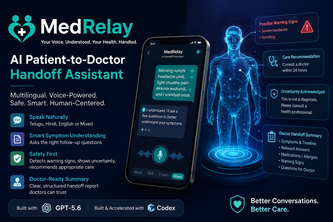
MedRelay is a self-reported AI-powered tool designed to help patients communicate symptoms more clearly to clinicians by converting unstructured symptom descriptions into structured handoff summaries. It is described as an assistant that supports communication between patient and doctor, not a diagnostic system.
What changed
The project was initially prototyped in Manus and later rebuilt during OpenAI Build Week using Codex and GPT-5.6. The core experience was extended with new features like voice interaction, structured outputs, uncertainty handling, and clinician review workflows.
Single most important open question
Is there evidence of real-world usage or clinical validation of the tool’s effectiveness in improving patient-doctor communication?
What The Product Actually Is
The description states that MedRelay is an AI-powered handoff assistant for medical consultations. It guides users through a conversation-driven symptom intake process, using text and voice inputs to generate structured summaries for clinicians.
- It can understand symptoms communicated via text and voice.
- It asks follow-up questions.
- It identifies urgent information requiring attention.
- It communicates uncertainty instead of guessing.
- It generates structured handoff summaries.
- It suggests the right type of specialist.
- It helps with doctor discovery and appointment booking.
- It provides dashboards for both patients and clinicians.
The model does not provide diagnosis or treatment; its role is to enhance communication before professional care.
Evidence All of this is self-reported by the author. No external validation, revenue data, or customer feedback are provided.
Positioning & Claim Evolution
The author positions MedRelay as an AI-powered assistant for patient-to-clinician handoffs, not a diagnostic tool.
Key claims:
- It helps close communication gaps between patients and doctors.
- It does not pretend to diagnose.
- It enhances preparation before professional care.
- It supports structured, safe, and clear communication.
The project evolved from a prototype in Manus to an application built with GPT-5.6 and Codex during OpenAI Build Week.
Evidence These are claims made by the author; no third-party confirmation or traction data is available.
Target Customer & ICP
The description states that MedRelay targets patients who struggle to communicate symptoms clearly, especially those who forget details, provide disorderly descriptions, or find it difficult to articulate what happened and when.
It also implies a secondary audience: clinicians who receive structured summaries from patients.
There is no explicit mention of specific demographics, age groups, or healthcare settings (e.g., primary care, emergency, telehealth).
Evidence Only self-reported customer positioning. No evidence of actual users, market segmentation, or buyer personas.
Business Model & Pricing Evidence
Not evidenced.
The description does not state anything about:
- How the product will be monetized.
- Whether it is free, subscription-based, or sold to institutions.
- Pricing models or revenue streams.
- Any partnerships or distribution channels.
Evidence No business model or pricing information provided.
Technical & Delivery Signals
MedRelay uses:
- Frontend: React, TypeScript, Three.js, Tailwind CSS
- Backend: Node.js, Express, tRPC, Drizzle ORM
- AI/ML Tools: GPT-5.6, Codex, Structured Outputs
- Features: Voice-enabled input, multi-turn conversation, uncertainty handling, clinician review states
The system is described as having:
- Schema-controlled responses.
- Predictable fields for rendering in dashboards.
- Safety boundaries and failover handling.
It was rebuilt from an existing Manus prototype using Codex to migrate and extend functionality.
Evidence Self-reported technical stack and architecture. No evidence of production deployment, scalability, or performance metrics.
Traction & Maturity Signals
Not evidenced.
The description does not include:
- Number of users.
- Customer adoption or retention data.
- Revenue figures.
- Product usage statistics.
- Clinical trials or user feedback from real-world testing.
It is described as a prototype that was extended during a hackathon and has no mention of ongoing development or deployment beyond the project submission.
Evidence No traction or maturity indicators are provided.
Competitive Context
Not evidenced.
The description does not:
- Identify competitors.
- Describe market size or competitive landscape.
- Mention how MedRelay differentiates from existing tools in symptom intake or clinical handoffs.
Evidence No competitive analysis or positioning relative to other tools is included.
Open Questions & Risks
Inferences based on self-reported information:
- Lack of clinical validation: The tool is described as a prototype built during a hackathon, with no evidence of real-world testing or clinical evaluation.
- Unclear safety and regulatory compliance: No mention of HIPAA, FDA, or other healthcare regulations.
- No monetization strategy: No indication of how the product will be sold or funded.
- Unproven user adoption: The project is not described as having users or being used in practice.
- Dependency on AI model quality: Reliance on GPT-5.6 and Codex without evidence of robustness or error handling.
Evidence All of these are inferred from the lack of real-world data, clinical validation, or business details.
Questions the description leaves open
- Has MedRelay been tested with actual patients or clinicians?
- What is the plan for integrating with existing healthcare systems or EHRs?
- How does the tool handle edge cases or ambiguous inputs?
- Are there any safety or compliance measures in place (e.g., HIPAA, data privacy)?
- Is there a roadmap for monetization or scaling beyond the prototype stage?
- What kind of feedback have you received from healthcare professionals?
- How is uncertainty communicated to users and clinicians?
- What are the limitations of GPT-5.6 in this context, and how are they mitigated?
Overall Assessment
Not evidenced.
There is no information about:
- Valuation or funding history.
- Investor interest or partnership opportunities.
- Strategic fit for potential partners or investors.
- Market readiness or commercial viability.
The project is described as a prototype built during a hackathon, with no evidence of traction, revenue, or market validation.
Evidence No investment or partnership signals are present in the description.
User Stories BotA demo video on every pull request
Get a demo video on every new feature
GitHub App that watches your pull requests and records a narrated, captioned demo.
Save time on demo prep and make informed decisions faster with a video walkthrough of every new feature.
Source
Submitted to the OpenAI 2026 hackathon on Devpost. Project home on Devpost. Back to the full gallery on Devpost.
This competitive analysis was produced by top-founders.com (opens in a new tab)
Generated by a language model from this project's public Devpost page — its tagline, the author's own write-up and any built-with tags listed there — as captured in August 2026. Short quotations are the author's words. It is an opinion on the idea as a business, not on the people behind it, and it reflects the description as published then. If the project has moved on, request a correction below. The analysis is not independent research and contains no verified traction, revenue or customer data.
An independent guide by KFG International LLC — not affiliated with, endorsed by, or connected to Devpost or OpenAI.