

Archive position — measured, not model output
1 like on Devpost
505 of the 7,850 archived projects have more likes, and 1,758 share exactly 1 — so this project's #1,291 place in the like-ranked listing is a tie-break inside that group, not a ranking.
Projects (log scale)
Likes on Devpost. ▲ marks this project's group.
Show the figures
| Likes | Projects | Share of archive |
|---|---|---|
| 0 | 5,587 | 71.2% |
| 1 | 1,758 | 22.4% |
| 2 | 284 | 3.6% |
| 3–4 | 132 | 1.7% |
| 5–9 | 75 | 1.0% |
| 10+ | 14 | 0.2% |
 User Stories BotA demo video on every pull request
Get a demo video on every new feature
GitHub App that watches your pull requests and records a narrated, captioned demo.
Save time on demo prep and make informed decisions faster with a video walkthrough of every new feature.
Executive Summary
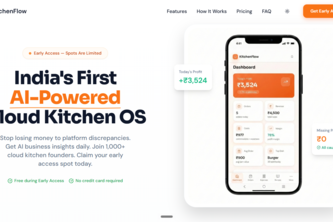
KitchenFlow is a self-reported B2B SaaS product for micro F&B operators in India, built by a non-coder using AI tools over 6 months. The product claims to automate payment reconciliation disputes and provide profit tracking. It is positioned as a low-cost solution with four pricing tiers ranging from ₹99 to ₹999/month. The author states the app is live and ready for early users, with plans to onboard 20 micro-restaurants next.
The single most important open question: Is there evidence of actual customer traction or revenue generation beyond the self-reported claims?
This analysis is based entirely on the self-reported project description provided by the author. No third-party verification, archived data, or independent sources are available. All statements should be treated as claims made by the author, not verified facts.
What The Product Actually Is
The description states that KitchenFlow is a "live B2B SaaS" for micro restaurants in India. It offers:
- Automated financial reconciliation
- Billing dispute tracking from start to finish
- Real profit visibility without manual effort
It is described as being built using AI tools (Claude Code, Lovable) and deployed on Vercel.
The author claims the product is live at: kitchen-profit-joy-jwqc.vercel.app
Inference: The product appears to be a web-based SaaS platform targeting small-scale food service operators in India. It is not evidenced whether this is a fully functional product or a prototype, nor if it has been used by any customers.
Positioning & Claim Evolution
The author positions KitchenFlow as:
- A lightweight, affordable solution for micro F&B businesses
- Designed specifically for owners who work 14-hour days and lose money
- An alternative to expensive, complex POS systems that ignore this segment
- Built with radical simplicity and affordability in mind
Key claims include:
- “Someone has to build something ridiculously simple and cheap just for them”
- “Price-sensitive customers don’t want more buttons. They want radical simplicity and radical affordability.”
- “In 2026 a non-coder can actually ship a real live SaaS product if they use AI properly.”
Inference: The positioning reflects an attempt to address a perceived gap in the market for low-cost, simple tools tailored to micro F&B operators. It is not evidenced whether these claims have been validated by actual users or market research.
Target Customer & ICP
The description states that KitchenFlow targets:
- Micro restaurants and cloud kitchens in India
- Owners who work 14-hour days
- People who lose money despite long hours
- Users who are frustrated with missing payments from Swiggy/Zomato
- Operators who lack visibility into real profits
It also mentions a specific niche version priced at ₹499/mo.
Inference: The target customer is defined as small-scale food service operators in India, particularly those using platforms like Swiggy or Zomato. There is no evidence of segmentation beyond this general description or validation of the ICP through interviews or surveys.
Business Model & Pricing Evidence
The author states that KitchenFlow has four pricing tiers:
- ₹99/mo (basics)
- ₹599/mo (growth tools + analytics)
- ₹999/mo (full operations system)
- ₹499/mo (special version for a specific niche)
The author claims:
- Unit economics were calculated
- Profit margins range from 37% to 73%
- The product can undercut competitors and still make money
Inference: Pricing is self-reported, with no evidence of actual sales or revenue data. There is no indication whether these tiers have been tested in the market or if any customers have paid for them.
Technical & Delivery Signals
The author states:
- Built entirely by a non-coder using AI tools (Claude Code, Lovable)
- Deployed on Vercel
- Built with Next.js, React, Tailwind, TypeScript, CSS
- The app is live and functional at kitchen-profit-joy-jwqc.vercel.app
The author also mentions:
- A demo video that got organic interest on LinkedIn
- 6 months of development time (Jan–July 2026)
- Learning how to prompt AI properly and debug through conversation
Inference: The technical delivery appears to be a web app built using AI-assisted tools. However, there is no evidence of code quality, scalability, or performance metrics. No mention of security, data handling, or infrastructure robustness.
Traction & Maturity Signals
The author states:
- Product is live and ready for early users
- Plans to onboard 20 micro-restaurants next
- Made a demo video that got organic interest on LinkedIn
- The product is “live now”
There is no evidence of:
- Actual paying customers
- Revenue or usage data
- Customer feedback or retention metrics
- Product adoption beyond the author’s own claims
Inference: There is no demonstrated traction or maturity. The only signal is that the app is live, but this does not imply user engagement or business success.
Competitive Context
The author states:
- Big POS and restaurant software completely ignore the micro segment
- Competitors are too expensive and too complicated
- Benchmarked 6 competitors and found gaps
No specific competitor names or market share data are provided.
Inference: The competitive landscape is described as dominated by high-cost, complex solutions that do not serve micro operators. However, no evidence of actual competitor analysis or market positioning exists beyond the author’s own claims.
Open Questions & Risks
- Unverified claims: All statements about product functionality, pricing, and business model are self-reported.
- No customer data: No evidence of real users, revenue, or adoption.
- Founder solo build: One-person team with no coding background raises questions about scalability, support, and long-term maintenance.
- AI dependency: Heavy reliance on AI tools for development may limit control over product evolution.
- Lack of traction signals: Product is live but lacks any measurable user engagement or feedback.
Inference: The lack of verified data makes it difficult to assess viability or risk. The project appears to be in a very early stage, with no evidence of commercial success or customer validation.
Questions the description leaves open
- What specific problems do you observe in the micro F&B segment that KitchenFlow solves?
- Have you conducted any interviews or surveys with potential users before building?
- How many of the 20 planned early users have you actually onboarded?
- Can you show actual usage data or customer feedback from those who’ve tried the product?
- What is your plan for scaling beyond the initial user base?
- How do you intend to maintain and improve the product given the lack of coding expertise?
- Are there any legal or compliance issues related to handling financial data in this space?
Overall Assessment
Not evidenced.
The description provides no information on:
- Revenue or profitability
- Customer acquisition or retention
- Market size or TAM
- Financial projections or burn rate
- Team experience or track record
- Any form of due diligence beyond the author’s own claims
This is a very early-stage project, likely in pre-product-market fit validation phase. The author has not provided any evidence of traction, revenue, or customer feedback.
Confidence level: Low — based on minimal self-reported evidence only.
User Stories BotA demo video on every pull request
Get a demo video on every new feature
GitHub App that watches your pull requests and records a narrated, captioned demo.
Save time on demo prep and make informed decisions faster with a video walkthrough of every new feature.
Source
Submitted to the OpenAI 2026 hackathon on Devpost. Project home on Devpost. Back to the full gallery on Devpost.
This competitive analysis was produced by top-founders.com (opens in a new tab)
Generated by a language model from this project's public Devpost page — its tagline, the author's own write-up and any built-with tags listed there — as captured in August 2026. Short quotations are the author's words. It is an opinion on the idea as a business, not on the people behind it, and it reflects the description as published then. If the project has moved on, request a correction below. The analysis is not independent research and contains no verified traction, revenue or customer data.
An independent guide by KFG International LLC — not affiliated with, endorsed by, or connected to Devpost or OpenAI.