

Archive position — measured, not model output
0 likes on Devpost
2,263 of the 7,850 archived projects have more likes, and 5,587 share exactly 0 — so this project's #4,807 place in the like-ranked listing is a tie-break inside that group, not a ranking.
Projects (log scale)
Likes on Devpost. ▲ marks this project's group.
Show the figures
| Likes | Projects | Share of archive |
|---|---|---|
| 0 | 5,587 | 71.2% |
| 1 | 1,758 | 22.4% |
| 2 | 284 | 3.6% |
| 3–4 | 132 | 1.7% |
| 5–9 | 75 | 1.0% |
| 10+ | 14 | 0.2% |
 User Stories BotA demo video on every pull request
Get a demo video on every new feature
GitHub App that watches your pull requests and records a narrated, captioned demo.
Save time on demo prep and make informed decisions faster with a video walkthrough of every new feature.
Executive Summary
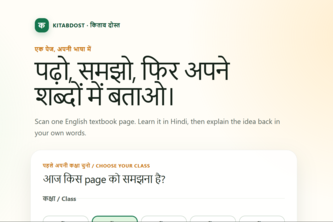
KitabDost is a self-reported educational tool designed to help class 6–10 students in India understand English textbook content by converting one page into a structured Hindi teach-back loop. The product uses AI (Gemini) for analysis and assessment, with speech recognition and synthesis for oral interaction, and local storage for privacy. It is built as a web app using Next.js and React.
The description states that the tool focuses on page-grounded oral teach-back and mastery card generation, not generic tutoring or chatbots. The author claims it supports Hindi-speaking learners and includes mechanisms to detect understanding levels, misconceptions, and suggest revisit actions.
Key commercial due-diligence question: Is there evidence of real student adoption or usage beyond the hackathon prototype?
The project is described as a single-person effort, built in a hackathon context. No revenue, customers, or traction data are provided. The author self-reports technical implementation but does not provide any external validation.
What The Product Actually Is
- The description states that KitabDost turns one English textbook page into a Hindi teach-back and mastery card.
- It supports:
- Upload or capture of a textbook page
- AI-generated learning objectives and Hindi explanation
- Oral teach-back with speech recognition (fallback to typed input)
- Concept-level understanding assessment (understanding, partial, misconception)
- Mastery card with revisit action
- The tool is not described as a generic chatbot or open-ended tutor.
- It uses:
- AI provider: Gemini
- Frontend: Next.js, React, TypeScript, Tailwind CSS
- Speech features: browser-native speech synthesis and recognition
- Storage: local storage only, no raw data retention
- Deployment: Vercel
- The tool is described as a web app built for mobile use with retry states for unreliable inputs.
Inference: The product appears to be a prototype or MVP, not a production-ready SaaS offering. It is focused on a specific educational loop and not scalable beyond its current scope.
Positioning & Claim Evolution
- The author claims the tool addresses a gap in learning: students may read English textbooks but struggle to explain ideas in their native language (Hindi).
- It is positioned as a learner-centred solution that focuses on demonstrating understanding, not just consuming content.
- The tool is described as not generic — it avoids open-ended chatbots or camera tutors.
Inference: The positioning reflects an attempt to differentiate from broad AI tutoring tools by focusing on structured, mastery-based feedback. This is a claim of specificity and pedagogical intent.
Target Customer & ICP
- The target customer is class 6–10 students in India.
- These learners are said to:
- Use English textbooks
- Understand Hindi more naturally at home
- Need help demonstrating understanding, not just reading
Inference: The ICP appears to be a narrow segment of Indian students with language barriers and a need for localized, structured learning feedback. No evidence of broader customer segments or personas.
Business Model & Pricing Evidence
- No pricing model or business model is described.
- The tool is built as a web app, not a subscription or SaaS product.
- It uses local storage and does not retain raw data, suggesting no monetization via data collection or analytics.
Inference: There is no evidence of a monetization strategy. The tool appears to be a prototype with no stated revenue path.
Technical & Delivery Signals
- Built using:
- Next.js, React, TypeScript, Tailwind CSS
- Gemini API for AI processing
- Browser-native speech recognition and synthesis
- Vercel for deployment
- Uses local storage only; no raw data retention.
- Includes retry states for unreliable inputs (e.g., blurry photos or voice recognition issues).
- Codex and GPT-5.6 were used during development, not in runtime.
Inference: The tool is built with modern web stack and has some resilience to technical limitations. However, it is a prototype, not a scalable product.
Traction & Maturity Signals
- No evidence of:
- Customers
- Revenue
- Usage metrics
- Product adoption beyond the hackathon
- Real-world testing or feedback loops
Inference: The tool is described as a hackathon prototype. There is no evidence of traction, product-market fit, or user engagement.
Competitive Context
- No competitive analysis or market positioning is provided.
- The author does not name competitors or describe the broader educational AI space.
- The tool is described as not generic, distinguishing itself from open-ended chatbots and camera tutors.
Inference: There is no evidence of awareness of existing tools in this space. The product appears to be a novel idea within the hackathon context, but not validated against competitors.
Open Questions & Risks
- No traction or user data — the tool is described as a prototype.
- Single-person team — raises questions about scalability and long-term development.
- No monetization strategy — no indication of how it would generate revenue.
- Limited scope — focused only on one page, Hindi, and oral teach-back.
- Dependency on AI provider (Gemini) — no mention of fallbacks or provider lock-in risks.
Inference: The tool is at a very early stage. Risks include lack of product-market fit, scalability issues, and unclear path to monetization.
Questions the description leaves open
- What real-world feedback have you received from students or teachers?
- How do you plan to scale beyond the single-person development team?
- Are there any plans for localization beyond Hindi?
- What is your roadmap for monetization or product evolution?
- Have you tested with actual textbook pages and students?
- How do you plan to handle provider reliability (e.g., Gemini API limits)?
- What are the key assumptions in your current design that might be wrong?
Overall Assessment
- Not evidenced — no data on traction, revenue, or customer validation.
- The tool is described as a hackathon prototype, not a product ready for investment or partnership.
- It is learner-centric, but lacks commercial signals.
Inference: At this stage, the project is more of an idea than a business. It may be worth exploring further if there are plans to test with real users and build out a scalable model. However, no evidence supports a commercial due-diligence read at this time.
User Stories BotA demo video on every pull request
Get a demo video on every new feature
GitHub App that watches your pull requests and records a narrated, captioned demo.
Save time on demo prep and make informed decisions faster with a video walkthrough of every new feature.
Source
Submitted to the OpenAI 2026 hackathon on Devpost. Project home on Devpost. Back to the full gallery on Devpost.
This competitive analysis was produced by top-founders.com (opens in a new tab)
Generated by a language model from this project's public Devpost page — its tagline, the author's own write-up and any built-with tags listed there — as captured in August 2026. Short quotations are the author's words. It is an opinion on the idea as a business, not on the people behind it, and it reflects the description as published then. If the project has moved on, request a correction below. The analysis is not independent research and contains no verified traction, revenue or customer data.
An independent guide by KFG International LLC — not affiliated with, endorsed by, or connected to Devpost or OpenAI.