

Archive position — measured, not model output
0 likes on Devpost
2,263 of the 7,850 archived projects have more likes, and 5,587 share exactly 0 — so this project's #4,809 place in the like-ranked listing is a tie-break inside that group, not a ranking.
Projects (log scale)
Likes on Devpost. ▲ marks this project's group.
Show the figures
| Likes | Projects | Share of archive |
|---|---|---|
| 0 | 5,587 | 71.2% |
| 1 | 1,758 | 22.4% |
| 2 | 284 | 3.6% |
| 3–4 | 132 | 1.7% |
| 5–9 | 75 | 1.0% |
| 10+ | 14 | 0.2% |
 User Stories BotA demo video on every pull request
Get a demo video on every new feature
GitHub App that watches your pull requests and records a narrated, captioned demo.
Save time on demo prep and make informed decisions faster with a video walkthrough of every new feature.
Executive Summary
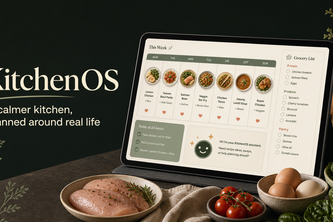
KitchenOS is a self-reported household meal-planning and inventory management tool built as a full-stack TypeScript application using Next.js and React. The author describes it as an AI-powered system that connects household profiles, allergies, routines, inventory, meal history, and planning in a human-reviewed workflow. It uses multiple specialized AI agents for tasks like recipe research and plan validation, with emphasis on deterministic checks, auditability, and user control.
The project is presented as a hackathon submission (Devpost entry), with no evidence of revenue, customers, or traction beyond the author's own description. The system is described as designed around human control, with agents proposing and explaining changes while users confirm meaningful modifications. It includes features like allergy warnings, grocery list generation, and multi-day meal planning.
The single most important open question is: What is the actual commercial viability of a household-focused AI kitchen assistant that requires human review at every step?
This analysis is based entirely on the self-reported project description provided by the author — no external verification or historical data available. The author states their own claims, but none are independently substantiated.
What The Product Actually Is
The description states that KitchenOS is a full-stack TypeScript application built with Next.js and React. It connects household profiles, allergies, meal routines, inventory, meal history, meal planning, recipe research, and grocery management.
It allows users to:
- Add inventory through text, voice, photos, receipts, or manual entry.
- Ask for multi-day meal plans.
- Review, accept, reject, remove, or refine individual meals.
- Plan different meals for different household members and occasions.
- Receive allergy warnings.
- See grocery needs derived from accepted plans and reduced by confirmed inventory.
- Confirm purchases with editable quantities before entering inventory.
The system is described as being organized around domain services for:
- Inventory and auditable inventory events
- Meal plans and meal approvals
- Shopping requirements and purchase confirmation
- Household profiles, meal routines, and safety context
- Agent workflows, retries, validation, and tracing
It uses multiple specialized agents in its planning workflow:
- An orchestrator that considers household context, inventory, history, and routines.
- Recipe researchers who validate candidates in parallel.
- Deterministic checks for structured concerns such as allergy conflicts, inventory coverage, and plan completeness.
The author notes they used Codex and GPT-5.6 throughout development to design architecture, implement application, build regression tests, debug agent failures, improve UX, and iterate on product experience.
Evidence: The description states all of this directly. No external corroboration or data provided.
Positioning & Claim Evolution
The author positions KitchenOS as a household conversation-style meal-planning tool that avoids rigid systems or spreadsheets. They describe it as helping people make decisions about what’s available, what needs to be bought, schedules, allergies, leftovers, and what the family has already eaten.
They claim it evolved beyond just generating meals into a "connected household operations loop" that:
- Understands the household
- Tracks what is in the kitchen
- Prepares plans around real constraints
- Validates recipes and safety conditions
- Lets users refine and approve
- Keeps grocery needs and inventory connected
The author also claims to have learned key lessons about agentic systems, including:
- Strong boundaries between agents
- Visibility of uncertainty
- Conversational AI UX with deterministic state transitions
Evidence: All these claims are self-reported by the author. No third-party validation or market positioning data provided.
Target Customer & ICP
The description states that KitchenOS is aimed at households managing multiple people, schedules, allergies, and inventory constraints. It supports:
- Multi-day meal planning
- Different meals for different household members
- Allergy warnings
- Individual routines (e.g., work/school)
- Grocery list generation based on confirmed inventory
It appears designed for users who want to optimize their kitchen operations through AI assistance but still maintain human control over key decisions.
The author mentions future features like:
- Per-person calendars and work/school routines
- Chat-based onboarding
- Household accounts with adult and child permissions
These suggest a focus on family or shared living environments where coordination is important.
Evidence: The description implies this target, but no explicit customer segmentation or persona data provided.
Business Model & Pricing Evidence
Not evidenced. The author does not describe any pricing model, monetization strategy, or business model.
Technical & Delivery Signals
The system is built as a full-stack TypeScript application using:
- Next.js
- React
- Node.js
- OpenAI API
- Codex / GPT-5.6
- JSON persistence
- Responsive design
- Typescript
It uses specialized agents for:
- Inventory and auditable events
- Meal plans and approvals
- Shopping requirements and purchase confirmation
- Household profiles, routines, and safety context
- Agent workflows, retries, validation, and tracing
The backend is structured around domain services and agent roles with explicit schemas, retries, validation gates, persistent run traces, error states, and human review before mutations.
Evidence: The description provides technical details directly from the author. No external delivery or infrastructure data available.
Traction & Maturity Signals
Not evidenced. There is no mention of revenue, customers, usage metrics, or product adoption beyond the author’s own account.
Competitive Context
Not evidenced. No information provided about competitors, market size, or competitive positioning.
Open Questions & Risks
- Unclear commercial viability: The system requires human review at every step and is described as a hackathon project — no evidence of scalability or monetization.
- High dependency on AI quality: Reliance on Codex/GPT-5.6 for core functionality raises questions about consistency, reliability, and cost in production.
- Limited scope for automation: The emphasis on human control may limit its appeal to users seeking fully automated solutions.
- No product-market fit evidence: No data or feedback from real users or early adopters.
- Single-founder project: With only one member listed (Alfredo Gomez), there is no indication of team capacity or scalability.
Inference: These risks stem from the lack of traction, revenue, and customer validation in the description.
Questions the description leaves open
- What specific problem are you solving that existing tools don’t address?
- How do you plan to scale beyond a single developer’s capacity?
- Have you tested this with real households? If so, what were the results?
- What is your path to monetization or revenue generation?
- How do you intend to handle data privacy and user trust in a household context?
- Are there any technical limitations that prevent full automation of the workflow?
- What are the key assumptions about user behavior and adoption?
Overall Assessment
Not evidenced. No financials, valuation, funding history, or partnership opportunities mentioned.
The description is entirely self-reported and unverified. It presents a concept with potential but lacks any evidence of traction, revenue, or customer validation. The project appears to be a hackathon submission with no indication of commercial viability or scalability beyond the author’s own use case.
Confidence level: Low — based on minimal evidence and high reliance on self-reporting.
User Stories BotA demo video on every pull request
Get a demo video on every new feature
GitHub App that watches your pull requests and records a narrated, captioned demo.
Save time on demo prep and make informed decisions faster with a video walkthrough of every new feature.
Source
Submitted to the OpenAI 2026 hackathon on Devpost. Project home on Devpost. Back to the full gallery on Devpost.
This competitive analysis was produced by top-founders.com (opens in a new tab)
Generated by a language model from this project's public Devpost page — its tagline, the author's own write-up and any built-with tags listed there — as captured in August 2026. Short quotations are the author's words. It is an opinion on the idea as a business, not on the people behind it, and it reflects the description as published then. If the project has moved on, request a correction below. The analysis is not independent research and contains no verified traction, revenue or customer data.
An independent guide by KFG International LLC — not affiliated with, endorsed by, or connected to Devpost or OpenAI.