

Archive position — measured, not model output
1 like on Devpost
505 of the 7,850 archived projects have more likes, and 1,758 share exactly 1 — so this project's #1,288 place in the like-ranked listing is a tie-break inside that group, not a ranking.
Projects (log scale)
Likes on Devpost. ▲ marks this project's group.
Show the figures
| Likes | Projects | Share of archive |
|---|---|---|
| 0 | 5,587 | 71.2% |
| 1 | 1,758 | 22.4% |
| 2 | 284 | 3.6% |
| 3–4 | 132 | 1.7% |
| 5–9 | 75 | 1.0% |
| 10+ | 14 | 0.2% |
 User Stories BotA demo video on every pull request
Get a demo video on every new feature
GitHub App that watches your pull requests and records a narrated, captioned demo.
Save time on demo prep and make informed decisions faster with a video walkthrough of every new feature.
Executive Summary
What the company appears to be
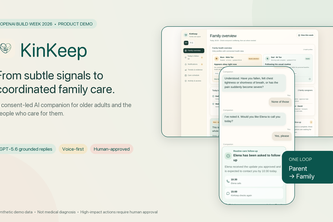
KinKeep is a self-reported prototype product designed to support family-based care for aging parents through a bilingual interface that combines weak health signals with conversational check-ins. It presents itself as an AI-assisted tool for detecting subtle changes in daily routines and health, prompting low-friction communication between parent and family members.
What changed
During the OpenAI Build Week hackathon, the author extended KinKeep from an early prototype to a more complete interactive demo loop involving both parent and family experiences. Key additions included structured care episodes, consent-based contact flows, WhatsApp handoffs, and expanded test coverage using Codex as an engineering partner.
The single most important open question
Is there evidence of traction or commercial viability beyond the author’s own demonstration? The description contains no data on users, revenue, adoption, or market validation — only a self-reported vision and prototype.
Note: This analysis is based entirely on the self-reported project description provided by the author. No external verification or historical data are available.
What The Product Actually Is
The description states that KinKeep provides two connected experiences:
- Parent experience: A bilingual companion interface where users can speak, type, or use suggested replies to report symptoms, meals, sleep, mood, and daily routines. It integrates optional health signals (e.g., wearable data) with conversation.
- Family experience: An explainable follow-up view showing:
- What changed relative to the person’s baseline;
- What was reported by the parent;
- Uncertainty in the situation;
- Three proportionate follow-up options;
- Which actions require human approval;
- Owners, deadlines, escalation conditions.
The system supports voice transcription and meal-photo understanding when OpenAI services are enabled. It also includes a simulated wandering-risk scenario and a WhatsApp handoff mechanism that requires user confirmation before sending a message.
Inference: The product is described as a prototype with synthetic data and demo-only features. No production infrastructure or real-world deployment is evidenced.
Positioning & Claim Evolution
The author positions KinKeep as:
- A health-connection layer for people who care about someone they cannot be with every day.
- Designed initially to support adult children caring for aging parents, but with a broader vision for partners, relatives, and close friends.
- Not a diagnostic tool or emergency service; it helps families understand what changed and decide how to respond.
During the OpenAI Build Week, KinKeep evolved from an early prototype into a more complete interactive demo loop. The author emphasizes:
- Combining weak signals rather than reacting to isolated numbers.
- Structuring interactions to explain why something changed and what should happen next.
- Maintaining a balance between natural conversation and structured care planning.
Inference: The positioning reflects a shift from a basic idea to a more defined UX flow, but the claims remain unvalidated by real-world usage or feedback.
Target Customer & ICP
The description states:
- The first use case is helping adult children support aging parents.
- The longer-term vision includes partners, relatives, and close friends living apart who want to stay connected around everyday wellbeing.
Not evidenced: No specific customer segments, personas, or market size data are provided. The author does not describe how they would identify or reach their target audience.
Business Model & Pricing Evidence
There is no evidence of pricing, monetization strategy, or business model in the description.
The author notes that:
- KinKeep is non-diagnostic and does not contact clinics or emergency services.
- No login is required for the demo.
- The demo uses synthetic data and simulated outcomes.
- Future steps include real integrations, production backends, and notification channels — but no mention of how these will be monetized.
Inference: The business model remains undefined. It appears to be a prototype with no clear path to revenue.
Technical & Delivery Signals
The project is built using:
- Frontend: Next.js, React, TypeScript, Tailwind CSS
- Backend/Deployment: Cloudflare Workers, OpenAI Sites, Vite
- AI Services: GPT-5.6 (for bilingual replies and multimodal understanding), speech-to-text (gpt-4o-mini-transcribe)
- Engineering Tools: Codex for implementation, refactoring, debugging, and testing
Key technical elements include:
- Typed CareEpisode and CareEscalation records stored in browser storage
- Synchronized parent/family views within the same browser profile
- Server-side configuration of WhatsApp contact numbers
- Bilingual interface (English/Simplified Chinese)
- Mobile preview support
- Automated test suite expanded from 3 to 12 tests
Inference: The technical stack suggests a lightweight, prototype-level solution. No evidence of production-grade scalability or cross-device synchronization.
Traction & Maturity Signals
There is no evidence of traction, adoption, or user engagement beyond the author’s own demonstration.
The demo includes:
- Live links to parent and family interfaces
- Simulated wearable data and follow-up outcomes
- A clear statement that all signals and outcomes are synthetic
- No mention of actual users, feedback loops, or iterative improvements
Absence of evidence: No data on customer acquisition, retention, usage metrics, or product-market fit.
Competitive Context
The author does not reference any competitors or existing solutions in the space.
There is no discussion of:
- Similar tools for family health monitoring
- Wearable health platforms
- AI-powered care coordination systems
- Existing chatbot or dashboard products targeting aging populations
Absence of evidence: No competitive landscape or differentiation strategy is described.
Open Questions & Risks
Several risks and open questions are evident from the description:
- No commercial traction: The product exists only as a prototype with no real-world usage or revenue.
- Unproven safety boundaries: While the author claims model output cannot invent evidence or bypass consent, this is not independently verified.
- Prototype-only architecture: The system uses browser storage and simulated data — not production-grade infrastructure.
- Unclear path to monetization: No business model or pricing strategy is described.
- Single-founder project: Only one team member (Elena Xiao) is listed, suggesting limited resources for scaling.
Inference: Without traction or validation, the risk of failure in transitioning from prototype to product is high.
Questions the description leaves open
- What specific problems are you solving for aging parents and their families?
- How do you plan to validate your assumptions with real users before launching?
- What are the key safety and privacy controls that prevent misuse or misinterpretation of health data?
- Are there any regulatory considerations or compliance requirements you anticipate in deploying this at scale?
- How will you build trust with users who may be hesitant about sharing personal health information?
- What is your go-to-market strategy for reaching families and caregivers?
- Have you considered how to integrate with existing healthcare systems or providers?
Note: These questions aim to probe beyond the self-reported claims into real-world applicability and scalability.
Overall Assessment
Not evidenced: There is no evidence of revenue, customers, traction, or financial performance.
The description indicates a conceptual prototype with strong design thinking around user experience and safety boundaries. However, it lacks any indication of:
- Market demand
- User testing
- Product-market fit
- Commercial viability
- Scalability
Inference: At this stage, KinKeep is a promising idea with potential, but not yet a viable investment or partnership opportunity without further development and validation.
User Stories BotA demo video on every pull request
Get a demo video on every new feature
GitHub App that watches your pull requests and records a narrated, captioned demo.
Save time on demo prep and make informed decisions faster with a video walkthrough of every new feature.
Source
Submitted to the OpenAI 2026 hackathon on Devpost. Project home on Devpost. Back to the full gallery on Devpost.
This competitive analysis was produced by top-founders.com (opens in a new tab)
Generated by a language model from this project's public Devpost page — its tagline, the author's own write-up and any built-with tags listed there — as captured in August 2026. Short quotations are the author's words. It is an opinion on the idea as a business, not on the people behind it, and it reflects the description as published then. If the project has moved on, request a correction below. The analysis is not independent research and contains no verified traction, revenue or customer data.
An independent guide by KFG International LLC — not affiliated with, endorsed by, or connected to Devpost or OpenAI.