

Archive position — measured, not model output
1 like on Devpost
505 of the 7,850 archived projects have more likes, and 1,758 share exactly 1 — so this project's #1,289 place in the like-ranked listing is a tie-break inside that group, not a ranking.
Projects (log scale)
Likes on Devpost. ▲ marks this project's group.
Show the figures
| Likes | Projects | Share of archive |
|---|---|---|
| 0 | 5,587 | 71.2% |
| 1 | 1,758 | 22.4% |
| 2 | 284 | 3.6% |
| 3–4 | 132 | 1.7% |
| 5–9 | 75 | 1.0% |
| 10+ | 14 | 0.2% |
 User Stories BotA demo video on every pull request
Get a demo video on every new feature
GitHub App that watches your pull requests and records a narrated, captioned demo.
Save time on demo prep and make informed decisions faster with a video walkthrough of every new feature.
Executive Summary
What the company appears to be: KioskOps is a self-reported Codex-based autonomous operations system for AI photo kiosks. The author states it enables natural-language operator requests that trigger governed recovery workflows, using evidence packs, playbook matching, and safety gates.
What changed: The project emerged from the founder's own field experience operating kiosks in Seoul and at enterprise events. It represents a shift from manual troubleshooting to AI-assisted but controlled recovery processes.
Single most important open question: Is there evidence of real-world kiosk operations or customer adoption that would validate the need for this system?
Analysis basis: This report is based entirely on the self-reported, unverified description provided by the project author. No third-party verification, traction data, revenue figures, or customer names are available.
What The Product Actually Is
The description states:
- KioskOps is a "Codex-based autonomous operations workflow" for AI photo kiosks.
- It allows operators to ask about kiosk health in natural language.
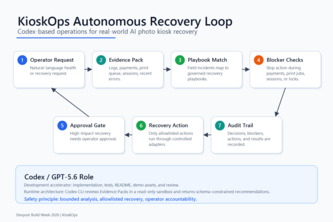
- It collects an "Evidence Pack", identifies incidents, matches recovery playbooks, checks blockers, and executes only approved actions.
- When no playbook matches, it uses Codex CLI as a bounded final-defense analyzer that reviews evidence in a read-only sandbox and returns schema-constrained recommendations.
Inference: The system appears to be a hybrid of manual operator input and AI-assisted decision-making with safety constraints. It is not a fully autonomous system but rather an AI-augmented recovery assistant.
Evidence strength: Evidenced from the author's own description.
Positioning & Claim Evolution
The description states:
- KioskOps was built to turn "manual recovery work into a Codex-based autonomous operations workflow."
- It is positioned as a solution for "repeated field problem" in kiosk operations.
- The author claims it connects "a real business problem to a concrete AI-native product."
Inference: The positioning evolved from solving a personal operational challenge (field kiosk failures) into a broader product narrative about AI-assisted kiosk management.
Evidence strength: Evidenced from the author's own description.
Target Customer & ICP
The description states:
- The system is designed for "kiosk managers" or operators.
- It was built based on experience operating kiosks in Seoul and at enterprise events.
- The target environment includes "public and enterprise environments."
Inference: The primary customer is likely kiosk operators or facility managers who oversee AI photo kiosks, particularly those in public or corporate settings.
Evidence strength: Evidenced from the author's own description.
Business Model & Pricing Evidence
The description does not state:
- Any pricing model
- Revenue streams
- Monetization strategy
- Customer acquisition approach
Finding: Not evidenced.
Evidence strength: Absence of evidence.
Technical & Delivery Signals
The description states:
- Built with: ai-photo-kiosk, automation, codex-cli, devops, evidence, ffmpeg, gpt-5.6, javascript, kiosk-operations, monitoring, openai-codex, playwright, python, recovery-playbooks, sqlite
- Uses GPT-5.6 through Codex for implementation support, reasoning, red-team critique, and verification.
- Implements a workflow with: operator request → intent routing → evidence collection → playbook matching → blocker checks → approval gates → recovery execution → audit trail.
Inference: The system is built around a structured, evidence-driven workflow that integrates AI tools (Codex/GPT-5.6) into a controlled operational chain.
Evidence strength: Evidenced from the author's own description.
Traction & Maturity Signals
The description does not state:
- Any revenue or customer base
- Product usage metrics
- Deployment in live kiosk fleets
- Adoption rate or feedback from users
- Product roadmap execution
Finding: Not evidenced.
Evidence strength: Absence of evidence.
Competitive Context
The description does not state:
- Any competitors
- Market size or landscape
- Existing solutions for kiosk operations
- Competitive advantages claimed
Finding: Not evidenced.
Evidence strength: Absence of evidence.
Open Questions & Risks
The description states:
- The main challenge was "balancing autonomy with safety."
- It is designed to avoid "blindly restarting services, interrupting active payments, losing customer sessions, or hiding failure behind vague automation."
- The system uses "allowlisted actions" and "blocker checks."
Inference: A key risk is that the system may be too constrained by safety measures to provide meaningful autonomy. Also, the lack of real-world deployment or feedback suggests unvalidated assumptions about operational needs.
Evidence strength: Evidenced from the author's own description.
Questions the description leaves open
- What specific kiosk failures have you observed in the field that this system addresses?
- Have you tested KioskOps with actual kiosk deployments or only in simulation?
- How do you plan to scale recovery playbooks across different kiosk types or environments?
- What are the key operational constraints or limitations of your current approach?
- Are there any known edge cases where the system might fail or misinterpret evidence?
Note: These questions are based on the self-reported description and are not validated.
Overall Assessment
The description states:
- The project is a "Build Week submission" to the OpenAI 2026 hackathon.
- It is intended to evolve into a "production-ready operations layer for AI photo kiosk fleets."
- The author plans to expand playbook coverage, add dashboards, and integrate monitoring.
Inference: This is an early-stage idea with potential but no demonstrated traction or commercial viability. The system appears conceptually sound but lacks evidence of real-world use, customer feedback, or product-market fit.
Evidence strength: Evidenced from the author's own description.
User Stories BotA demo video on every pull request
Get a demo video on every new feature
GitHub App that watches your pull requests and records a narrated, captioned demo.
Save time on demo prep and make informed decisions faster with a video walkthrough of every new feature.
Source
Submitted to the OpenAI 2026 hackathon on Devpost. Project home on Devpost. Back to the full gallery on Devpost.
This competitive analysis was produced by top-founders.com (opens in a new tab)
Generated by a language model from this project's public Devpost page — its tagline, the author's own write-up and any built-with tags listed there — as captured in August 2026. Short quotations are the author's words. It is an opinion on the idea as a business, not on the people behind it, and it reflects the description as published then. If the project has moved on, request a correction below. The analysis is not independent research and contains no verified traction, revenue or customer data.
An independent guide by KFG International LLC — not affiliated with, endorsed by, or connected to Devpost or OpenAI.