

Archive position — measured, not model output
0 likes on Devpost
2,263 of the 7,850 archived projects have more likes, and 5,587 share exactly 0 — so this project's #5,214 place in the like-ranked listing is a tie-break inside that group, not a ranking.
Projects (log scale)
Likes on Devpost. ▲ marks this project's group.
Show the figures
| Likes | Projects | Share of archive |
|---|---|---|
| 0 | 5,587 | 71.2% |
| 1 | 1,758 | 22.4% |
| 2 | 284 | 3.6% |
| 3–4 | 132 | 1.7% |
| 5–9 | 75 | 1.0% |
| 10+ | 14 | 0.2% |
 User Stories BotA demo video on every pull request
Get a demo video on every new feature
GitHub App that watches your pull requests and records a narrated, captioned demo.
Save time on demo prep and make informed decisions faster with a video walkthrough of every new feature.
Executive Summary
What the company appears to be
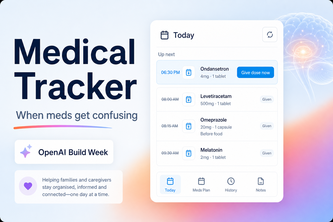
Medical Tracker is a self-reported, open-source web application built by one individual (Hamish Baxter) for families coordinating care for patients with complex medical needs like cancer. It allows caregivers to log medication, symptoms, emotions and general updates in a shared chronological timeline using Google Sheets as a backend.
What changed
The project evolved from a private family tool into an open-source product during a hackathon (Devpost submission). The author states that the initial version was functional within one day and refined over three days with family feedback before being adapted for public use.
Single most important open question — the commercial due-diligence read
Is there evidence of any traction, revenue or customer adoption beyond the author’s own family? The description makes no claims about users outside the founder's household or any monetization strategy.
What The Product Actually Is
The description states that Medical Tracker is a mobile-responsive web application designed for informal caregivers managing complex medical regimens. It enables:
- Recording when medication has been given
- Logging symptoms, behavior, emotions and care updates
- Reviewing a shared chronological timeline
- Editing or deleting entries after mistakes
- Viewing historical data over time
It connects via Google Apps Script to a Google Sheet, which serves as the backend without requiring a central database. The frontend is built in React.
The author notes it was built using AI tools including Codex and GPT-5.6 Sol, with assistance from an implementation partner (Codex) and product thinking partner (GPT).
Inferred: It is not a commercial SaaS offering but rather an open-source tool intended for personal or family deployment.
Positioning & Claim Evolution
The author positions Medical Tracker as a lightweight coordination tool for families managing complex care, particularly those with patients like cancer patients. The core value proposition is:
- A simple shared record that reduces reliance on phone calls or verbal handovers
- Designed to be fast and understandable under pressure
- Built without diagnostic or prescribing capabilities
The product evolved from a personal solution into an open-source project, with the author stating they “transformed something built for one family into an open-source project that other people can inspect, adapt and deploy.”
Inferred: The positioning has shifted from a private family tool to a reusable public resource, though there is no evidence of commercial intent or broader market traction.
Target Customer & ICP
The description states the target audience includes:
- Families coordinating care for individuals with complex medical needs (e.g., cancer patients)
- Informal caregivers, including those in different locations or countries
- People who need to track medication, symptoms and emotional changes
There is no evidence of segmentation beyond this general group. No specific personas, use cases or customer types are detailed.
Inferred: The ICP appears to be caregivers managing chronic or serious illness in a non-clinical setting — not healthcare providers or institutions.
Business Model & Pricing Evidence
The description states that Medical Tracker is open source, and the author mentions they “removed family-specific configuration” and documented how others can deploy their own version using Google Sheets and Apps Script.
There is no mention of any pricing model, monetization strategy, or paid features. The product is described as a tool for self-hosting rather than a hosted service.
Inferred: No business model is evident beyond the open-source sharing of code and documentation.
Technical & Delivery Signals
The project was built using:
- Frontend: React
- Backend: Google Apps Script connected to Google Sheets
- AI tools used: Codex, GPT-5.6 Sol
- Development approach: AI-assisted development with feedback loops from family members
The author reports that the first working version was ready in about one day, and it was iterated over three days based on real-world usage.
Inferred: The technical stack is minimal and self-hosted, which suggests low infrastructure costs but also limited scalability or enterprise-grade features.
Traction & Maturity Signals
The author states that the application was tested with family members actively providing care, and that it went unchanged for two months after initial refinement. However:
- There is no evidence of external users beyond the founder’s family
- No data on adoption, retention or usage frequency is provided
- No revenue, customer base or user metrics are mentioned
Inferred: The product shows early-stage maturity with internal validation but lacks any measurable traction.
Competitive Context
The description does not mention competitors or similar tools. It also does not state whether there are existing solutions for family-based care coordination or medication tracking.
Inferred: No competitive analysis is evident, and the author does not reference prior art or market positioning against other tools.
Open Questions & Risks
- No commercial traction: The only users mentioned are family members; no evidence of broader adoption.
- Open-source nature: While this may reduce costs, it implies no direct revenue model or customer lock-in.
- Limited functionality: The tool is described as a record-keeping system without analytics, reminders or clinical integration.
- Self-hosted architecture: Reliance on Google Sheets and Apps Script raises concerns about data privacy, scalability and long-term maintainability.
- No validation with healthcare professionals: The product explicitly avoids clinical decision-making but lacks input from clinicians.
Questions the description leaves open
- What is the actual user base beyond your family? Have others deployed this tool?
- Are there any plans to monetize or scale this beyond open-source sharing?
- How do you plan to address concerns around data privacy and security in a self-hosted model?
- Has anyone from the healthcare community reviewed or validated the product?
- What are the long-term maintenance challenges of relying on Google Sheets and Apps Script?
Overall Assessment
Not evidenced.
The description provides no information about revenue, customers, funding, or commercial viability. The project is presented as an open-source tool built by one person for personal use, with no indication of a scalable business model or market demand beyond the founder’s own experience.
Inferred: This is not a commercial opportunity at this stage; it is a prototype or personal project that may evolve into something more substantial in the future. Any investment or partnership would require further evidence of traction, product-market fit and scalability.
User Stories BotA demo video on every pull request
Get a demo video on every new feature
GitHub App that watches your pull requests and records a narrated, captioned demo.
Save time on demo prep and make informed decisions faster with a video walkthrough of every new feature.
Source
Submitted to the OpenAI 2026 hackathon on Devpost. Project home on Devpost. Back to the full gallery on Devpost.
This competitive analysis was produced by top-founders.com (opens in a new tab)
Generated by a language model from this project's public Devpost page — its tagline, the author's own write-up and any built-with tags listed there — as captured in August 2026. Short quotations are the author's words. It is an opinion on the idea as a business, not on the people behind it, and it reflects the description as published then. If the project has moved on, request a correction below. The analysis is not independent research and contains no verified traction, revenue or customer data.
An independent guide by KFG International LLC — not affiliated with, endorsed by, or connected to Devpost or OpenAI.