

Archive position — measured, not model output
0 likes on Devpost
2,263 of the 7,850 archived projects have more likes, and 5,587 share exactly 0 — so this project's #4,793 place in the like-ranked listing is a tie-break inside that group, not a ranking.
Projects (log scale)
Likes on Devpost. ▲ marks this project's group.
Show the figures
| Likes | Projects | Share of archive |
|---|---|---|
| 0 | 5,587 | 71.2% |
| 1 | 1,758 | 22.4% |
| 2 | 284 | 3.6% |
| 3–4 | 132 | 1.7% |
| 5–9 | 75 | 1.0% |
| 10+ | 14 | 0.2% |
 User Stories BotA demo video on every pull request
Get a demo video on every new feature
GitHub App that watches your pull requests and records a narrated, captioned demo.
Save time on demo prep and make informed decisions faster with a video walkthrough of every new feature.
Executive Summary
What the company appears to be
Ki'Diyan's Music Mix Analyzer is a browser-based audio analysis tool for amateur music producers. It analyzes uploaded audio files (WAV or MP3) locally in the browser, extracting technical features such as tonal balance and dynamics, then translates those into emotionally interpretable tendencies like warmth or urgency. The app allows users to select a creative intention and receive tailored listening experiments grounded in evidence.
What changed
The project is presented as an experimental tool built during a hackathon, with no prior commercial activity or user base described. It leverages AI (GPT-5.6) for interpretation but operates without server-side data transmission beyond a minimal ledger of measurements and user intentions.
Single most important open question
Is there evidence that this tool has traction or adoption among developing producers, or that it can be monetized in a sustainable way?
What The Product Actually Is
The description states that Ki'Diyan's Music Mix Analyzer is an application that:
- Accepts WAV or MP3 audio files for upload.
- Analyzes them locally in the browser using TypeScript and React/Vite.
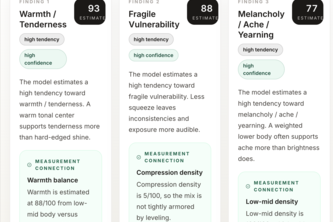
- Extracts technical features such as tonal balance, dynamics, compression density, stereo behavior, and low-mid presence.
- Translates these measurements into emotional tendencies (e.g., warmth, vulnerability, melancholy).
- Offers actionable A/B listening experiments based on user-selected creative intentions.
- Uses GPT-5.6 for optional structured interpretation, which receives only validated measurement data and the selected intention.
- Falls back to deterministic local rules if AI is unavailable.
Inference The tool appears to be a proof-of-concept or prototype built for a hackathon, not yet commercialized.
Positioning & Claim Evolution
The author claims that:
- The app helps developing producers understand what is happening technically in a mix and how those choices affect listener emotion.
- It avoids grading the mix, instead offering explanations rooted in evidence.
- It provides reversible listening experiments to guide creative decisions.
- It preserves privacy by not sending audio to external servers.
Inference The positioning emphasizes emotional relevance and user control over feedback, distinguishing itself from generic mixing tools or AI models that offer broad advice without context.
Target Customer & ICP
The description states:
- The intended audience is "developing producers" — amateur music creators.
- It targets independent artists who may not have access to experienced mix engineers.
Inference The core customer segment appears to be self-taught or emerging producers, likely with limited financial resources and a need for accessible feedback tools.
Business Model & Pricing Evidence
The description does not state:
- Any pricing model.
- Revenue streams.
- Monetization strategy.
- Customer acquisition costs.
- Subscription plans or one-time purchases.
Not evidenced.
Technical & Delivery Signals
The author states:
- Built with React and Vite, using browser-local audio decoding.
- Audio remains in page memory; no server-side processing occurs.
- Uses Codex for component building and refactoring.
- GPT-5.6 powers optional interpretation layer, but only receives extracted measurements and selected intention.
- Includes deterministic fallback logic when AI is unavailable.
- The app includes a bundled 30-second sample mix for immediate testing.
Inference The architecture prioritizes privacy and local processing, suggesting a lightweight, accessible delivery mechanism with minimal infrastructure needs.
Traction & Maturity Signals
The description states:
- This is a hackathon submission (OpenAI 2026).
- No mention of users, customers, or adoption metrics.
- No revenue data, funding rounds, or headcount mentioned.
- The app works end-to-end but lacks any indication of real-world usage.
Not evidenced.
Competitive Context
The description does not include:
- Any competitors listed.
- Market size or competitive landscape details.
- Comparison with existing tools in the audio analysis or music production space.
Not evidenced.
Open Questions & Risks
- No commercial traction: The tool is a hackathon project with no evidence of users, adoption, or revenue.
- AI dependency: While fallbacks exist, reliance on GPT-5.6 for interpretation introduces risk if access becomes limited or costly.
- Unclear monetization path: No indication of how the product would be sold or scaled.
- Privacy vs. utility tradeoff: The local-only approach may limit advanced features or scalability.
- Subjectivity of emotional mapping: Emotional interpretations are described as cautious and evidence-based, but this could lead to inconsistent or unhelpful outputs.
Questions the description leaves open
- What specific feedback have you received from amateur producers who tested the app?
- How do you plan to monetize this tool, given that it's currently a prototype?
- Have you considered how to scale beyond a single developer (Kied Fugaban)?
- What are your plans for integrating user-generated data or community features?
- Are there any technical limitations in the current architecture that would prevent expansion?
Overall Assessment
Not evidenced.
The project is presented as a hackathon prototype with no evidence of traction, revenue, or commercial viability. It lacks a defined business model and shows no signs of having moved beyond experimental development.
Given the self-reported nature of the description and absence of any third-party validation, this tool cannot be evaluated for investment or partnership potential at this stage. Any future value would depend on whether it evolves into a product with real-world usage and monetization strategies.
User Stories BotA demo video on every pull request
Get a demo video on every new feature
GitHub App that watches your pull requests and records a narrated, captioned demo.
Save time on demo prep and make informed decisions faster with a video walkthrough of every new feature.
Source
Submitted to the OpenAI 2026 hackathon on Devpost. Project home on Devpost. Back to the full gallery on Devpost.
This competitive analysis was produced by top-founders.com (opens in a new tab)
Generated by a language model from this project's public Devpost page — its tagline, the author's own write-up and any built-with tags listed there — as captured in August 2026. Short quotations are the author's words. It is an opinion on the idea as a business, not on the people behind it, and it reflects the description as published then. If the project has moved on, request a correction below. The analysis is not independent research and contains no verified traction, revenue or customer data.
An independent guide by KFG International LLC — not affiliated with, endorsed by, or connected to Devpost or OpenAI.