

Archive position — measured, not model output
1 like on Devpost
505 of the 7,850 archived projects have more likes, and 1,758 share exactly 1 — so this project's #869 place in the like-ranked listing is a tie-break inside that group, not a ranking.
Projects (log scale)
Likes on Devpost. ▲ marks this project's group.
Show the figures
| Likes | Projects | Share of archive |
|---|---|---|
| 0 | 5,587 | 71.2% |
| 1 | 1,758 | 22.4% |
| 2 | 284 | 3.6% |
| 3–4 | 132 | 1.7% |
| 5–9 | 75 | 1.0% |
| 10+ | 14 | 0.2% |
 User Stories BotA demo video on every pull request
Get a demo video on every new feature
GitHub App that watches your pull requests and records a narrated, captioned demo.
Save time on demo prep and make informed decisions faster with a video walkthrough of every new feature.
Executive Summary
What the company appears to be
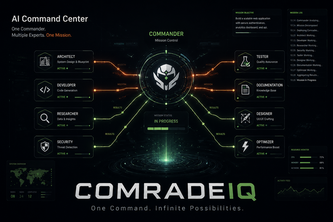
ComradeIQ is a self-reported AI orchestration tool that uses a Commander AI to coordinate specialized AI agents for complex tasks. It claims to execute workflows through a dependency-aware Directed Acyclic Graph (DAG), with real-time visibility into agent execution and outputs.
What changed
The project description indicates an evolution from typical "multi-agent" demos — which are described as theatrical or fake — toward a system that emphasizes truthfulness, provability, and real execution. It positions itself as a command center for AI tasks where each step is traceable and verifiable.
Single most important open question
Is there any evidence of actual usage, revenue, or customer traction beyond the author’s own description?
Note: This analysis is based solely on the self-reported project description provided by the caller. No external verification, historical data, or third-party sources are available. All claims are treated as stated by the author and not independently confirmed.
What The Product Actually Is
The description states that ComradeIQ is an AI command center where a Commander AI orchestrates specialized AI comrades to plan, execute, and merge complex tasks into one intelligent, high-quality result.
It supports several types of missions:
- Direct chat (quick questions)
- Document missions (READMEs, specs, reports)
- Presentation missions (downloadable PPTX in 4 themes)
- Research missions (with sourced, cited answers)
For coordination-heavy tasks, it builds an explicit dependency DAG and executes agents in sequence. Each agent waits for its upstream output and only activates when needed.
Key features include:
- Live agent graph showing real-time status
- Terminal-style ops log streaming events
- In-chat video embedding from YouTube
- Play chess with the Commander
- Shareable read-only permalinks
- Downloadable Markdown & PPTX artifacts
It uses Next.js, React, TypeScript, Groq (llama-3.3-70b), OpenAI-compatible API, and various libraries for state management, streaming, document generation, and chess logic.
Claim: The product executes workflows via a real DAG.
Evidence: The description states that it "builds an explicit dependency DAG" and "each specialist waits for its actual upstream output."
Inference: This implies a structured approach to task execution, not just parallelism or simulation.
Note: No evidence of actual deployment, usage, or performance metrics.
Positioning & Claim Evolution
The author positions ComradeIQ as an alternative to "theater" multi-agent demos — ones that simulate progress without real execution. The core claim is that every visible step must be provably true.
Key positioning elements:
- Honest dependency graph
- Real-time visibility into agent actions
- No fabricated artifacts or fake agents
- Provability and traceability of outputs
The project evolved from a hackathon submission to a vision of how "real production AI" should be built — emphasizing decomposition, role specialization, and explicit review stages.
Claim: ComradeIQ avoids theatrical shortcuts.
Evidence: The write-up explicitly says: “Resisting theatrical shortcuts... Making a multi-agent UI look impressive is easy; making every visible update trace to a real event... took discipline.”
Inference: This suggests a shift from demo-style systems toward more robust, production-ready UX.
Note: No evidence of prior versions or product evolution beyond this single submission.
Target Customer & ICP
The description does not clearly define target customers or personas. It describes use cases such as:
- Quick questions (chat)
- Document creation
- Research with citations
- Presentation decks
- Complex coordination tasks
It implies a user base that might include developers, researchers, technical writers, and project managers who need structured AI assistance for multi-step workflows.
Claim: The product targets users needing complex task orchestration.
Evidence: It supports document missions, research missions, and presentation decks, suggesting a professional or technical audience.
Inference: Likely users are those who want reliable, traceable AI outputs rather than generic chatbots.
Note: No evidence of specific customer segments, personas, or market validation.
Business Model & Pricing Evidence
There is no mention of pricing, monetization strategy, or business model in the description. The project appears to be a hackathon submission with no indication of commercial intent or revenue streams.
Claim: There is no stated business model.
Evidence: The write-up does not reference any pricing tiers, subscriptions, or monetization methods.
Inference: If this is intended for commercial use, it has not been described yet.
Note: No evidence of paid features, B2B or consumer targeting, or monetization plans.
Technical & Delivery Signals
The system is built using:
- Next.js 15 + React 19 + TypeScript
- Groq (llama-3.3-70b) via OpenAI-compatible API
- Dependency-aware orchestrator with DAG execution
- Server-Sent Events (SSE) for streaming updates
- PptxGenJS, chess.js, YouTube search/embed
- Zustand for client state, Vercel Blob for storage
It includes:
- Real-time agent graph and ops console
- Click-to-expand per-agent output
- Honest error handling and missing capability detection
- Lazy loading of heavy dependencies
Claim: The system uses a real DAG and structured routing.
Evidence: “A dependency-aware orchestrator — a real DAG, not cosmetic parallelism.”
Inference: This suggests a system designed for reliability and traceability over performance alone.
Note: No evidence of scalability, infrastructure, or production deployment details.
Traction & Maturity Signals
There is no evidence of traction, revenue, customers, or adoption beyond the author’s own description. The project was submitted to a hackathon (OpenAI 2026), and there are no references to usage statistics, user feedback, or product growth.
Claim: No traction or adoption data.
Evidence: The description explicitly states that no revenue, customer, or traction data is available beyond the author’s account.
Inference: This is likely a prototype or proof-of-concept, not a mature product.
Note: Absence of any metrics, user base, or market presence.
Competitive Context
The description does not provide information about competitors or competitive positioning. It focuses on what ComradeIQ does differently — namely, avoiding theatricality and ensuring truthfulness in execution.
Claim: No competitive landscape described.
Evidence: The write-up does not name any competing tools or platforms.
Inference: The author may be unaware of existing solutions or has not compared them.
Note: No evidence of market analysis or differentiation from other AI orchestration tools.
Open Questions & Risks
- Unproven commercial viability: No revenue, customers, or monetization strategy.
- Limited scope: Built as a hackathon project; no indication of long-term roadmap or scalability.
- Self-reported only: All claims are unverified and lack independent corroboration.
- No user feedback or testing: No evidence of real-world usage or iteration.
- Technical risk: The write-up mentions serverless bundling issues, suggesting potential instability.
Claim: Risk of commercial failure due to lack of traction.
Evidence: No evidence of users, revenue, or adoption.
Inference: Without external validation or product-market fit, the project may not transition into a viable business.
Note: The author’s own admission that this is a hackathon submission raises questions about intent and maturity.
Questions the description leaves open
- What is your plan for monetization and customer acquisition?
- Have you tested the system with real users or in production environments?
- How do you intend to scale beyond the current architecture?
- Are there any known limitations or edge cases in the DAG execution?
- What are your thoughts on integrating with existing AI platforms or APIs?
- Is there a roadmap for additional features beyond what’s described?
- How do you plan to handle errors or failures in agent workflows?
- Have you considered privacy or data governance implications of storing and processing user inputs?
Overall Assessment
Not evidenced.
Claim: No investment or partnership potential can be assessed.
Evidence: The description lacks any indication of traction, revenue, or commercial readiness.
Inference: Based on the lack of evidence for product-market fit, scalability, or business model, it is premature to assess investment or partnership viability.
Note: This appears to be a prototype or concept, not a developed product ready for investment.
User Stories BotA demo video on every pull request
Get a demo video on every new feature
GitHub App that watches your pull requests and records a narrated, captioned demo.
Save time on demo prep and make informed decisions faster with a video walkthrough of every new feature.
Source
Submitted to the OpenAI 2026 hackathon on Devpost. Project home on Devpost. Back to the full gallery on Devpost.
This competitive analysis was produced by top-founders.com (opens in a new tab)
Generated by a language model from this project's public Devpost page — its tagline, the author's own write-up and any built-with tags listed there — as captured in August 2026. Short quotations are the author's words. It is an opinion on the idea as a business, not on the people behind it, and it reflects the description as published then. If the project has moved on, request a correction below. The analysis is not independent research and contains no verified traction, revenue or customer data.
An independent guide by KFG International LLC — not affiliated with, endorsed by, or connected to Devpost or OpenAI.