

Archive position — measured, not model output
1 like on Devpost
505 of the 7,850 archived projects have more likes, and 1,758 share exactly 1 — so this project's #871 place in the like-ranked listing is a tie-break inside that group, not a ranking.
Projects (log scale)
Likes on Devpost. ▲ marks this project's group.
Show the figures
| Likes | Projects | Share of archive |
|---|---|---|
| 0 | 5,587 | 71.2% |
| 1 | 1,758 | 22.4% |
| 2 | 284 | 3.6% |
| 3–4 | 132 | 1.7% |
| 5–9 | 75 | 1.0% |
| 10+ | 14 | 0.2% |
 User Stories BotA demo video on every pull request
Get a demo video on every new feature
GitHub App that watches your pull requests and records a narrated, captioned demo.
Save time on demo prep and make informed decisions faster with a video walkthrough of every new feature.
Executive Summary
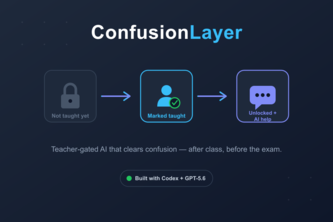
ConfusionLayer is an AI-powered school learning and operations platform, as described by its author. The product is self-reported to be a full-stack web application built with Vue, FastAPI, and other technologies, designed to help teachers detect student confusion early in the learning process. It includes features like concept mastery tracking, AI-generated explanations, quizzes, and teacher insights.
The description states that ConfusionLayer aims to give teachers earlier signals and clearer priorities without replacing them. It is positioned as an educational tool for students, teachers, and school owners, with a focus on curriculum structure, role-based access, and AI-driven forecasting of learning risks.
Key commercial due-diligence read
The author claims ConfusionLayer helps teachers act earlier on student confusion, but there is no evidence of revenue, customers, or traction. The product's positioning implies it targets the EdTech market, particularly in classroom-level learning support, but lacks any demonstration of adoption or monetization.
Single most important open question
Is there a viable path to customer acquisition and monetization that aligns with the described features and target users?
What The Product Actually Is
The description states that ConfusionLayer is an AI-powered school learning and operations platform, built as a full-stack web app. It includes:
- Student-facing features:
- Unlocked lesson concepts
- AI-generated explanations, examples, visuals, doubt support, quizzes, and teach-back grading
- Mastery tracking by concept
- Confusion Map to show weak areas
- Exam Outlook and Exam Practice for revision
- Timetable view based on classroom
- Teacher-facing features:
- Student Insights with strengths, weaknesses, mastery, and forecast risk
- Forecast Brief to predict upcoming concepts that may cause trouble
- Confusion Brief summarizing classroom-level misconceptions
- Classroom and curriculum tools
- School owner features:
- Workspace tools like members, roles, classrooms, parent linking, attendance, fees, HR, admissions, and timetables
The product is described as using a structured curriculum model with subjects, chapters, concepts, unlock states, and prerequisite relationships. AI is used for tutorials, doubt responses, quiz feedback, teach-back grading, forecast explanations, and curriculum cleanup from PDFs.
It runs on Docker on an Oracle VM, with HTTPS served through nginx, and is split into frontend, backend, and database services.
Inference The platform appears to be a multi-role system designed for classroom-level learning management, integrating AI with structured curriculum data.
Positioning & Claim Evolution
The author states that ConfusionLayer was inspired by the problem of teachers discovering confusion too late, and aims to help them act earlier using concept mastery, prerequisite gaps, and confusion risk tracking.
The positioning is that it is not meant to replace teachers but to give teachers earlier signals and clearer priorities. The goal is to make the product useful before failure happens, not only after.
It is described as a tool for:
- Teachers to see what students may struggle with before the next lesson
- Students to self-start topics solo or follow classroom pacing
- School owners to manage operations like attendance, fees, and timetables
Inference The positioning has evolved from a simple AI chatbot idea into a structured learning platform that integrates AI with curriculum and role-based access. It is positioned as an early-warning system for teachers, not a replacement.
Target Customer & ICP
The description identifies three main user groups:
- Students – who can self-start topics or follow classroom pacing
- Teachers – who get insights, forecasts, and confusion briefs
- School owners – who manage workspace features like members, roles, classrooms, attendance, fees, HR, admissions, and timetables
The author states that the platform is built for classroom-level learning support, with a focus on curriculum structure and teacher control.
Inference The ICP appears to be K-12 schools or educational institutions using structured curricula. The platform targets teachers as primary decision-makers, but also includes school administrators and students in its scope.
Business Model & Pricing Evidence
The description does not provide any information on pricing, monetization, or business model.
There is no mention of:
- Revenue streams
- Customer acquisition strategy
- Subscription tiers or pricing models
- Licensing or per-user costs
- Enterprise vs. individual use cases
Inference No evidence of a defined business model or pricing structure exists in the description.
Technical & Delivery Signals
The product is built as a full-stack web application, using:
- Frontend: Vue.js, Tailwind CSS
- Backend: FastAPI, Python, JWT, SQLAlchemy, Pydantic
- Database: PostgreSQL
- DevOps: Docker, nginx, Oracle VM
- AI tools: OpenAI, Codex
The author mentions that the app handles:
- Authentication
- Role-based access
- Curriculum and mastery tracking
- AI workflows
- PDF import and curriculum cleanup
It is described as running in production on a demo environment using Docker.
Inference The technical stack suggests a modern SaaS platform with structured data handling, role management, and AI integration. However, no evidence of scalability or performance metrics is provided.
Traction & Maturity Signals
The description states that ConfusionLayer was built as part of a hackathon submission (OpenAI 2026) and includes:
- Working authentication
- Role-based dashboards
- Classroom pacing
- Student progress tracking
- Teacher insights
- Forecast briefs
- Confusion briefs
- Curriculum import
- School operations
It is described as more than a prototype, with a demo experience that allows users to navigate from student learning to teacher analytics to school owner operations.
However, there is no evidence of:
- Real-world usage or adoption
- Customer feedback or testimonials
- Revenue or monetization
- Product-market fit validation
- Growth metrics
Inference The product appears to be a functional prototype, but lacks any traction or maturity signals beyond the hackathon demo.
Competitive Context
The description does not mention specific competitors or market positioning in relation to existing EdTech platforms.
It is implied that ConfusionLayer targets the classroom-level learning support space, where AI tools are increasingly used for personalization and early detection of student confusion.
Inference The competitive landscape includes other EdTech platforms focused on:
- Learning analytics
- AI-driven tutoring
- Classroom management
- Mastery-based learning
However, no direct comparison or differentiation is made in the description.
Open Questions & Risks
- No revenue or customer evidence: The product is described as a hackathon submission with no traction or monetization.
- Unproven market fit: No indication of whether teachers or schools would adopt it or find value in its features.
- AI integration risks: The description mentions AI challenges like generic answers, structured context, and safer PDF import — suggesting potential technical limitations.
- Limited team size: Only one team member (Ayush Patel) is listed, which may limit execution capacity.
- No pricing or business model: No clarity on how the product will be monetized or scaled.
Inference The product is in a very early stage and lacks commercial viability signals. Risks include unproven adoption, scalability issues, and lack of clear monetization.
Questions the description leaves open
- What specific classroom pain points are you solving, and how do you know teachers want this?
- How will you acquire customers — through schools, districts, or direct sales?
- What is your plan for scaling beyond a single developer?
- Have you tested the AI workflows with real students or teachers?
- What are your assumptions about pricing and monetization?
- How do you plan to integrate with existing school systems or LMS platforms?
- What is the timeline for moving from prototype to product-market fit?
Overall Assessment
The description states that ConfusionLayer is a self-reported hackathon project, not independently verified, and lacks evidence of revenue, customers, or traction.
It is described as an AI-powered learning platform with structured curriculum integration and role-based dashboards, but there is no indication of:
- Commercial adoption
- Product-market fit
- Monetization strategy
- Scalability
Inference At this stage, ConfusionLayer is a conceptual prototype, not a commercial product. It has potential in the EdTech space but lacks the evidence to support investment or partnership decisions.
Assessment Not evidenced for investment or partnership at this time. Requires further validation of market demand, traction, and business model before any strategic move can be considered.
User Stories BotA demo video on every pull request
Get a demo video on every new feature
GitHub App that watches your pull requests and records a narrated, captioned demo.
Save time on demo prep and make informed decisions faster with a video walkthrough of every new feature.
Source
Submitted to the OpenAI 2026 hackathon on Devpost. Project home on Devpost. Back to the full gallery on Devpost.
This competitive analysis was produced by top-founders.com (opens in a new tab)
Generated by a language model from this project's public Devpost page — its tagline, the author's own write-up and any built-with tags listed there — as captured in August 2026. Short quotations are the author's words. It is an opinion on the idea as a business, not on the people behind it, and it reflects the description as published then. If the project has moved on, request a correction below. The analysis is not independent research and contains no verified traction, revenue or customer data.
An independent guide by KFG International LLC — not affiliated with, endorsed by, or connected to Devpost or OpenAI.