

Archive position — measured, not model output
1 like on Devpost
505 of the 7,850 archived projects have more likes, and 1,758 share exactly 1 — so this project's #1,281 place in the like-ranked listing is a tie-break inside that group, not a ranking.
Projects (log scale)
Likes on Devpost. ▲ marks this project's group.
Show the figures
| Likes | Projects | Share of archive |
|---|---|---|
| 0 | 5,587 | 71.2% |
| 1 | 1,758 | 22.4% |
| 2 | 284 | 3.6% |
| 3–4 | 132 | 1.7% |
| 5–9 | 75 | 1.0% |
| 10+ | 14 | 0.2% |
 User Stories BotA demo video on every pull request
Get a demo video on every new feature
GitHub App that watches your pull requests and records a narrated, captioned demo.
Save time on demo prep and make informed decisions faster with a video walkthrough of every new feature.
Executive Summary
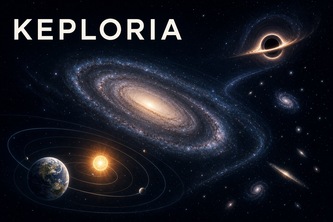
What the company appears to be: Keploria is a self-reported Windows desktop application for exploring astronomy in 3D, built using AI-assisted development tools (Codex/GPT-5.6). It presents a multi-scale visualization of the universe including Solar System, exoplanets, stars, galaxies, and black holes, with an emphasis on separating observed data from visual reconstructions.
What changed: The project evolved from an early version (0.3.1) to a more complex 0.18.7 release during Build Week, incorporating expanded universe maps, black-hole scenes, and improved testing infrastructure.
Single most important open question: Is there any evidence of user adoption, revenue, or traction beyond the author's own development efforts?
What The Product Actually Is
The description states that Keploria is a Windows x64 desktop application for exploring astronomy in 3D. It includes:
- A diagrammatic Solar System based on current date/time
- 4,736 star systems and 6,327 confirmed exoplanets available offline
- Four map modes: Nearby 3D, Milky Way, Local Group, and Nearby Universe
- 30 Local Group galaxies and 1,200 nearby galaxies within 30 megaparsecs
- Navigation from M87 galaxy to M87* black-hole scene
- Companion-orbit overlays for 18 binary black-hole systems
- Source information, evidence levels, and scientific limitations in object panels
- English and Korean interface support
The application uses different visual scales for different astronomical objects, separating scientific values from display values. It does not simulate every object in the universe or provide research-level precision.
Evidence: The author's own write-up describes these features in detail.
Inference: The product appears to be an educational tool focused on astronomy visualization rather than a commercial platform.
Positioning & Claim Evolution
The description states that Keploria was built to help people explore the universe instead of only reading about it or looking at separate images. It aims to bring together several scales of astronomical data in one explorable desktop application.
Key claims:
- "I wanted to build a tool that would let people explore the universe"
- "It is not meant to simulate every object in the universe or provide research-level precision"
- "Its purpose is to make astronomy easier to explore while being clear about which parts come from observations, catalog data, scientific models, or visual presentation choices"
The positioning evolved from a personal project inspired by science fiction into a tool designed for educational exploration.
Evidence: The author's own write-up and tagline.
Inference: This is positioned as an educational visualization tool rather than a commercial product. It emphasizes clarity about data sources over scientific accuracy.
Target Customer & ICP
The description states that Keploria is intended to help people explore astronomy, particularly those interested in understanding the size, structure, and variety of the universe.
It includes:
- Educational use cases (students, educators)
- General public interested in space science
- Users seeking interactive exploration of astronomical data
The author notes that it's not meant for research-level precision or navigation-grade orbital data.
Evidence: The author's own write-up.
Inference: The target audience likely includes students, educators, and amateur astronomy enthusiasts. No specific customer segments are identified beyond general interest in space science.
Business Model & Pricing Evidence
Not evidenced.
The description does not mention any pricing model, monetization strategy, or business model. It is described as a self-developed tool with no commercial intent stated.
Evidence: None provided.
Inference: Based on the author's own account, there appears to be no commercial business model in place.
Technical & Delivery Signals
The application was built using:
- Electron
- React
- TypeScript
- Three.js
- React Three Fiber
- Zustand
- Vite
- Electron Forge
Key technical details:
- Separates astronomy data, coordinate transformations, navigation state, 3D scenes, and interface components
- Mainly uses bundled data; only connects to network for optional exoplanet catalog refresh
- Includes 251 unit tests and 20 end-to-end tests
- Passes strict TypeScript checking
- Supports Windows x64 only
Evidence: The author's own write-up.
Inference: The technical stack suggests a modern desktop application built with web technologies. The focus on testing and packaging indicates some level of development maturity, though no production deployment or user feedback is mentioned.
Traction & Maturity Signals
Not evidenced.
There is no mention of:
- Users or customer base
- Revenue or monetization
- Downloads or usage metrics
- Customer feedback or engagement
- Product adoption beyond the author's own use
The project is described as a personal development effort with no external validation or traction data.
Evidence: None provided.
Inference: No evidence of traction, revenue, or customer adoption. The project appears to be a solo developer's effort without commercial deployment or user engagement.
Competitive Context
Not evidenced.
There is no mention of:
- Competitors in the astronomy visualization space
- Market positioning relative to existing tools
- Differentiation from similar products
- Industry benchmarks or standards
Evidence: None provided.
Inference: No competitive analysis or market context is provided. The author does not reference existing tools or platforms in this domain.
Open Questions & Risks
- Solo developer model: Only one team member (Chemster Park) is mentioned, which raises questions about scalability and long-term maintenance.
- No commercial traction: No evidence of users, revenue, or adoption beyond the author's own development efforts.
- Limited platform support: Currently only supports Windows x64, with macOS/Linux versions planned but not implemented.
- AI-assisted development risks: Reliance on Codex/GPT-5.6 for development raises questions about code quality control and maintainability.
- No monetization strategy: No indication of how the product would generate revenue or sustain itself commercially.
- Hardware testing limitations: Mainly validated on one Windows machine, with wider hardware testing needed.
Evidence: The author's own write-up.
Inference: These are significant risks for any commercial venture, particularly around scalability, sustainability, and market viability.
Questions the description leaves open
- What is the long-term vision for Keploria beyond the current scope?
- How do you plan to address the lack of cross-platform support (macOS, Linux)?
- What are your plans for monetization or commercial sustainability?
- How will you ensure code quality and maintainability given the AI-assisted development approach?
- Are there any legal or licensing considerations regarding third-party data sources?
- What is the timeline for addressing known technical limitations like GPU compatibility?
- How do you plan to validate the educational value of the application with students and educators?
- What are your plans for expanding beyond the current feature set?
Evidence: The author's own write-up.
Inference: These questions address key gaps in the self-reported information that would be important for commercial due diligence.
Overall Assessment
Not evidenced.
There is no evidence of:
- Funding rounds or investment history
- Valuation or financial metrics
- Partnership discussions or strategic interest
- Commercial viability or market opportunity
The project is described as a personal development effort with no indication of commercial potential or investor interest.
Evidence: None provided.
Inference: Based on the self-reported information, there is insufficient evidence to support an investment or partnership decision. The project appears to be a solo developer's educational tool without demonstrated commercial traction or market validation.
User Stories BotA demo video on every pull request
Get a demo video on every new feature
GitHub App that watches your pull requests and records a narrated, captioned demo.
Save time on demo prep and make informed decisions faster with a video walkthrough of every new feature.
Source
Submitted to the OpenAI 2026 hackathon on Devpost. Project home on Devpost. Back to the full gallery on Devpost.
This competitive analysis was produced by top-founders.com (opens in a new tab)
Generated by a language model from this project's public Devpost page — its tagline, the author's own write-up and any built-with tags listed there — as captured in August 2026. Short quotations are the author's words. It is an opinion on the idea as a business, not on the people behind it, and it reflects the description as published then. If the project has moved on, request a correction below. The analysis is not independent research and contains no verified traction, revenue or customer data.
An independent guide by KFG International LLC — not affiliated with, endorsed by, or connected to Devpost or OpenAI.