

Archive position — measured, not model output
1 like on Devpost
505 of the 7,850 archived projects have more likes, and 1,758 share exactly 1 — so this project's #1,283 place in the like-ranked listing is a tie-break inside that group, not a ranking.
Projects (log scale)
Likes on Devpost. ▲ marks this project's group.
Show the figures
| Likes | Projects | Share of archive |
|---|---|---|
| 0 | 5,587 | 71.2% |
| 1 | 1,758 | 22.4% |
| 2 | 284 | 3.6% |
| 3–4 | 132 | 1.7% |
| 5–9 | 75 | 1.0% |
| 10+ | 14 | 0.2% |
 User Stories BotA demo video on every pull request
Get a demo video on every new feature
GitHub App that watches your pull requests and records a narrated, captioned demo.
Save time on demo prep and make informed decisions faster with a video walkthrough of every new feature.
Executive Summary
KForge is a self-reported Windows desktop application designed as an AI engineering workbench to help developers safely evolve existing applications through guided edits, previews, and iterative collaboration. It is described as a local-first tool that allows users to manage project workspaces, configure AI providers, attach files to AI requests, and control AI-assisted changes. The author states it was developed over six months with incremental feature building and testing, using models such as GPT-5.4, GPT-5.5, GPT-5.6, Codex, Gemini, and Claude.
The project is currently in an early stage of development, with the core functionality around editing existing applications still described as experimental. The author emphasizes reliability as a key challenge, particularly in handling AI-generated outputs that may appear correct but are unusable or cause unintended changes.
Key commercial due-diligence question: What evidence exists that KForge’s approach to safe, iterative AI-assisted development addresses real pain points in developer workflows at scale?
What The Product Actually Is
The description states that KForge is a Windows desktop application built with React, JavaScript, Tauri 2, Rust, Node.js, and pnpm. It supports:
- Local project workspaces
- Starter project setup via guided workflow
- Visual direction and theme selection during build
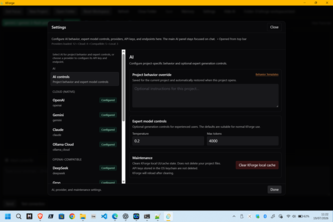
- Configuration of AI providers (OpenAI, Anthropic, Google Gemini, OpenRouter)
- Attachment of files to AI requests
- Terminal command execution within projects
- Use of a library of common terminal commands
- Git-friendly local development
- Review and control of AI-assisted changes
It is described as a local-first tool that keeps development local and Git-friendly.
The author notes that KForge does not independently build or manage projects; instead, the developer reviews suggestions, decides what to change, runs tests, checks behavior, and controls Git history and releases.
Inference: The product is a desktop-based AI-assisted development environment focused on managing and controlling AI interactions with code, particularly around editing existing applications.
Positioning & Claim Evolution
The author states that KForge was not created during OpenAI Build Week, but the week prompted documentation review and focus on its core challenge: reliable editing of existing applications.
The positioning is described as:
- A local-first desktop AI engineering workbench
- Designed to help developers safely evolve existing applications
- A tool that offers guided edits, previews, and iterative collaboration instead of one-shot code generation
- A system where the developer stays in control
The longer-term goal is not just to generate new apps but to make repeated AI-assisted changes to existing applications easy, error-free, and recoverable.
Inference: KForge positions itself as a tool for developers who want more control over AI-assisted coding workflows, especially when working with evolving codebases. It is framed as a solution to the problem of unreliable AI outputs in complex editing scenarios.
Target Customer & ICP
The description does not explicitly name target customers or define an Ideal Customer Profile (ICP). However, it implies:
- Primary users: Developers who work with existing applications and want to make controlled, iterative changes
- Use case: AI-assisted development workflows where reliability and control are important
- Context: Local-first, Git-friendly environments
Inference: The target customer is likely a developer or small team working on complex software projects, particularly those who value control over AI-generated code and want to avoid destructive edits.
Business Model & Pricing Evidence
There is no evidence in the description of any business model or pricing strategy. The project is described as a personal development effort, not yet commercialized.
Not evidenced
Technical & Delivery Signals
The product is built with:
- Frontend: React, JavaScript
- Backend/OS integration: Tauri 2, Rust, Node.js
- Package manager: pnpm
- AI providers supported: OpenAI, Anthropic, Google Gemini, OpenRouter
- Additional support: Groq, Mistral, local runtimes (Ollama, LM Studio), custom endpoints
The author mentions using models such as:
- GPT-5.4-mini, GPT-5.4, GPT-5.5, GPT-5.6
- Codex
- Gemini
- Claude
They also note that AI tools were used for architecture discussions, debugging, implementation guidance, UX refinement, documentation, and testing strategies.
Inference: The technical stack suggests a cross-platform desktop application with strong integration into local development environments, leveraging modern web and system-level technologies. It is built to support multiple AI providers and models, indicating flexibility in deployment.
Traction & Maturity Signals
The author states that KForge has been developed over approximately six months and was submitted to the OpenAI 2026 hackathon on Devpost.
It is described as:
- An early-stage project
- Not yet commercialized
- Features are implemented incrementally, with a focus on stability
- The core functionality for editing existing applications is still being stabilized and described as experimental
There is no evidence of revenue, customers, or adoption metrics beyond the author’s own development efforts.
Not evidenced
Competitive Context
The description does not mention any direct competitors. However, it implies KForge operates in a space related to:
- AI-assisted development tools
- Local-first desktop applications for developers
- Tools that manage and control AI interactions with code
It is positioned as an alternative to one-shot code generation tools by emphasizing guided edits, previews, and iterative collaboration.
Inference: KForge likely competes with or aligns with tools in the AI-assisted coding space such as GitHub Copilot, Tabnine, or other AI-powered IDE extensions. However, no specific competitive analysis is provided.
Open Questions & Risks
- No commercial traction or revenue: The project is described as a personal effort without any evidence of monetization or customer base.
- Early-stage development: Features are still experimental and not fully stable.
- Single-founder team: Only one member (kami ilmane) is listed, which may limit scalability and execution capacity.
- Limited scope: The tool is currently Windows-only and focused on local development workflows.
- Unclear path to product-market fit: No evidence of user feedback or market validation beyond the author’s own experience.
Questions the description leaves open
- What specific problems in current AI-assisted development workflows does KForge aim to solve?
- How do you plan to validate that your solution addresses real developer needs at scale?
- Are there any early adopters or users who have provided feedback on the product?
- What are the key technical challenges still being worked on for reliable editing of existing applications?
- How do you intend to expand beyond Windows and support other platforms?
- What is your roadmap for monetization, if any?
Overall Assessment
Not evidenced
The project description does not provide sufficient evidence to assess whether KForge has commercial viability or investment potential. It is described as an early-stage personal development effort with no revenue, customers, or traction data.
The author’s claims about reliability and iterative editing are self-reported and unverified. While the concept aligns with trends in AI-assisted development, there is no indication that it has yet proven its value in real-world use cases.
Confidence level: Low — based on minimal evidence of product-market fit, traction, or commercialization.
User Stories BotA demo video on every pull request
Get a demo video on every new feature
GitHub App that watches your pull requests and records a narrated, captioned demo.
Save time on demo prep and make informed decisions faster with a video walkthrough of every new feature.
Source
Submitted to the OpenAI 2026 hackathon on Devpost. Project home on Devpost. Back to the full gallery on Devpost.
This competitive analysis was produced by top-founders.com (opens in a new tab)
Generated by a language model from this project's public Devpost page — its tagline, the author's own write-up and any built-with tags listed there — as captured in August 2026. Short quotations are the author's words. It is an opinion on the idea as a business, not on the people behind it, and it reflects the description as published then. If the project has moved on, request a correction below. The analysis is not independent research and contains no verified traction, revenue or customer data.
An independent guide by KFG International LLC — not affiliated with, endorsed by, or connected to Devpost or OpenAI.