

Archive position — measured, not model output
1 like on Devpost
505 of the 7,850 archived projects have more likes, and 1,758 share exactly 1 — so this project's #1,282 place in the like-ranked listing is a tie-break inside that group, not a ranking.
Projects (log scale)
Likes on Devpost. ▲ marks this project's group.
Show the figures
| Likes | Projects | Share of archive |
|---|---|---|
| 0 | 5,587 | 71.2% |
| 1 | 1,758 | 22.4% |
| 2 | 284 | 3.6% |
| 3–4 | 132 | 1.7% |
| 5–9 | 75 | 1.0% |
| 10+ | 14 | 0.2% |
 User Stories BotA demo video on every pull request
Get a demo video on every new feature
GitHub App that watches your pull requests and records a narrated, captioned demo.
Save time on demo prep and make informed decisions faster with a video walkthrough of every new feature.
Executive Summary
What the company appears to be
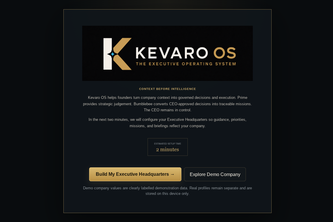
Kevaro OS is described as an executive operating system for founders, designed to help a single founder manage strategy, execution, and institutional knowledge using AI-assisted roles—Prime (strategy) and Bumblebee (execution)—with human CEO control preserved throughout.
What changed
The author entered Build Week without software development experience. They describe transforming a founder's problem into a working prototype using Codex and AI tools, emphasizing clarity in decision-making, governance, and institutional knowledge preservation.
Single most important open question
Is there evidence of real-world traction or usage beyond the prototype, or any indication that the system has been tested with actual founders in practice?
What The Product Actually Is
The description states that Kevaro OS is “The Executive Operating System for founders.” It includes:
- An Executive Intelligence Profile where a founder enters company context (business model, stage, objectives, challenges).
- Two defined AI roles:
- Prime, Chief Strategy & Intelligence Officer, which uses GPT-5.6 to analyze directives, strategic fit, risks, evidence, and uncertainty.
- Bumblebee, Chief Operations & Integration Officer, which converts CEO-approved decisions into missions with ownership, dependencies, and completion records.
- A governed workflow:
CEO Directive → Prime Review → CEO Approval → Bumblebee Execution → Mission Control → Knowledge Vault → Executive Briefing
- Features such as:
- Morning Executive Briefing
- CEO Focus Mode
- Plain-language Executive Mentor
- Adaptive company profiles
- Missing-information controls
- Demonstration vs. real-profile separation
- Responsive desktop and mobile experiences
- Fallback behavior when live model analysis is unavailable
Not evidenced: No information on whether the system has been used by actual founders, how many users it supports, or if any real decisions have been made through it.
Positioning & Claim Evolution
The author claims Kevaro OS helps a founder “move from company context to governed intelligence, human-approved execution and preserved institutional knowledge.”
It is positioned as:
- A system that brings clarity to decision-making.
- Not a replacement for the founder but a tool to enhance their control.
- Designed around the idea of human-in-the-loop governance, where AI supports but does not replace human judgment.
The evolution of this claim appears to be from a personal founder problem to a prototype solution, with no evidence of prior market validation or product-market fit.
Inferred: The positioning reflects an attempt to address the fragmentation and lack of clarity in early-stage startup decision-making, especially for solo founders.
Target Customer & ICP
The description states that Kevaro OS is intended for founders, particularly those running “early-stage projects” who struggle with:
- Scattered decisions
- Loss of reasoning behind ideas
- Execution without clear approval
- Disappearing lessons when priorities shift
It is described as useful for someone who wants to run a company with the clarity of an executive team, even if they are still a team of one.
Not evidenced: No specific customer segments, personas, or usage data beyond the author’s own experience. No indication of whether it targets solo founders, small teams, or larger startups.
Business Model & Pricing Evidence
The description does not provide any information on:
- Revenue model
- Pricing structure
- Monetization strategy
- Customer acquisition plans
- Whether there are paid features or tiers
Not evidenced: No evidence of a business model or pricing mechanism beyond the prototype’s self-contained nature.
Technical & Delivery Signals
The system is built using:
- Codex
- GPT-5.6
- OpenAI Responses API
- OpenAI Sites
- React
- TypeScript
- Responsive CSS
- Cloudflare Workers
- Browser local storage
It uses a server-side configuration to protect credentials and send company context to GPT-5.6.
Key technical features include:
- Structured output from Prime (recommendation, rationale, evidence, unknowns, risk)
- Separation of demonstration and real profiles
- Truth labels for evidence, uncertainty, and unverified information
- Fallback behavior when live analysis is unavailable
Inferred: The system shows some thoughtful design around AI integration and authority boundaries.
Not evidenced: No information on scalability, security, or production deployment beyond the prototype.
Traction & Maturity Signals
The description states that Kevaro OS was built during a Build Week hackathon, and the author emphasizes:
- That it is a working prototype
- That it includes a seven-step company onboarding process
- That it has been tested manually on Chromebook and phone
- That it was developed iteratively through testing and correction
However, there is no evidence of:
- Real-world usage or adoption
- Customer feedback or testimonials
- Any revenue or monetization
- Product maturity beyond the prototype stage
Not evidenced: No signs of traction, user base, or market validation.
Competitive Context
The description does not mention any competitors. It focuses on the unique positioning of Kevaro OS as a system that:
- Combines AI strategy and execution under human control
- Preserves institutional knowledge
- Offers a governed workflow
Not evidenced: No competitive analysis, no mention of similar tools or platforms.
Open Questions & Risks
- Prototype-only status: The product is described only as a prototype built during a hackathon.
- No real-world usage: There is no evidence that the system has been used by actual founders or in production.
- Unverified AI integration: While GPT-5.6 is mentioned, there is no clarity on how it’s integrated or whether it's truly live or simulated.
- Founder-centric design: The system assumes a single-founder context, which may limit its applicability to teams or larger organizations.
- Lack of business model: No indication of how the product would be monetized or scaled.
Inferred: The risk is high that Kevaro OS remains a concept rather than a viable commercial offering.
Questions the description leaves open
- What specific problems do you observe in your own decision-making process, and how does Kevaro OS address them?
- Have you tested the system with other founders or early users? If so, what feedback did you get?
- How is the AI integration (especially GPT-5.6) secured and controlled to prevent unauthorized access or misuse?
- What are your plans for scaling beyond the current prototype? Are there any technical or operational barriers?
- Do you have a clear roadmap for monetization, and how do you plan to reach potential users?
Overall Assessment
Self-reported only. No independent verification.
Kevaro OS is presented as an innovative concept that addresses a real pain point for solo founders: the lack of clarity in decision-making and execution. However, it remains a prototype, built during a hackathon, with no evidence of traction, revenue, or customer adoption.
The system shows promise in its design and integration of AI with governance principles, but lacks:
- Real-world usage
- Business model clarity
- Market validation
- Scalability indicators
Assessment: Not ready for investment or partnership at this stage. The idea is compelling, but the execution remains unproven. Further development and testing with real users are needed before any commercial viability can be assessed.
User Stories BotA demo video on every pull request
Get a demo video on every new feature
GitHub App that watches your pull requests and records a narrated, captioned demo.
Save time on demo prep and make informed decisions faster with a video walkthrough of every new feature.
Source
Submitted to the OpenAI 2026 hackathon on Devpost. Project home on Devpost. Back to the full gallery on Devpost.
This competitive analysis was produced by top-founders.com (opens in a new tab)
Generated by a language model from this project's public Devpost page — its tagline, the author's own write-up and any built-with tags listed there — as captured in August 2026. Short quotations are the author's words. It is an opinion on the idea as a business, not on the people behind it, and it reflects the description as published then. If the project has moved on, request a correction below. The analysis is not independent research and contains no verified traction, revenue or customer data.
An independent guide by KFG International LLC — not affiliated with, endorsed by, or connected to Devpost or OpenAI.