

Archive position — measured, not model output
0 likes on Devpost
2,263 of the 7,850 archived projects have more likes, and 5,587 share exactly 0 — so this project's #4,722 place in the like-ranked listing is a tie-break inside that group, not a ranking.
Projects (log scale)
Likes on Devpost. ▲ marks this project's group.
Show the figures
| Likes | Projects | Share of archive |
|---|---|---|
| 0 | 5,587 | 71.2% |
| 1 | 1,758 | 22.4% |
| 2 | 284 | 3.6% |
| 3–4 | 132 | 1.7% |
| 5–9 | 75 | 1.0% |
| 10+ | 14 | 0.2% |
 User Stories BotA demo video on every pull request
Get a demo video on every new feature
GitHub App that watches your pull requests and records a narrated, captioned demo.
Save time on demo prep and make informed decisions faster with a video walkthrough of every new feature.
Executive Summary
What the company appears to be
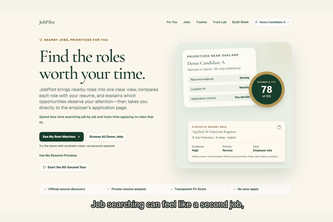
JobPilot is a self-reported AI-powered job-matching tool designed for job seekers. It claims to help users identify roles worth pursuing by analyzing candidate profiles against job descriptions using local semantic models and deterministic scoring. The system provides verified strengths, attention areas, required vs preferred qualifications, an auditable Fit Score, and an application strategy — all without auto-applying or collecting private data.
What changed
The author states that the project evolved from early versions that emphasized scores to a model focused on evidence-first analysis. It also introduced a Score Receipt system for reproducibility and tamper-detection, and separated AI reasoning from scoring to maintain trust boundaries.
Single most important open question
Is there any evidence of real-world usage or adoption beyond the author’s own directional usability study?
What The Product Actually Is
The description states that JobPilot is a job-matching tool for job seekers. It claims to:
- Analyze candidate profiles against job descriptions using local semantic models (Gemma 4 12B)
- Provide verified strengths, attention areas, and meaningful gaps
- Offer a deterministic AI Fit score based on evidence
- Generate an application strategy supported by the candidate’s actual evidence
- Produce a Score Receipt that independently reproduces the fit score
- Include a private application tracker
- Have a Trust Lab explaining system boundaries
The product does not auto-apply to jobs or submit applications. It is described as a tool for decision-making and planning, not execution.
Evidence The author’s own write-up and project description.
Confidence Low — this is self-reported functionality with no independent verification of actual performance or usage.
Positioning & Claim Evolution
The author states that JobPilot was repositioned from an emphasis on scores to a focus on evidence. Early versions prioritized the Fit Score, but were redesigned around:
- Strong Evidence
- Attention Areas
- Application Strategy
This shift reflects an evolution in positioning toward transparency and accountability.
Evidence The project write-up.
Confidence Low — this is a self-reported claim of repositioning, not evidence of market traction or user feedback.
Target Customer & ICP
The description states that JobPilot is for job seekers. It is designed to help them:
- Identify roles worth pursuing
- Understand why they match or don’t match a role
- Make informed decisions about applying
- Plan their application strategy based on real evidence
It does not target employers, recruiters, or hiring managers.
Evidence The project write-up and tagline.
Confidence Low — no data on actual users or customer segments beyond the author’s own use case.
Business Model & Pricing Evidence
The description states that JobPilot is a self-contained tool for job seekers. It does not mention:
- Any pricing model
- Revenue streams
- Subscription plans
- Freemium vs paid tiers
- Monetization strategy
It also explicitly says the public demo uses synthetic data and no OpenAI API requests are made at runtime.
Evidence The project write-up.
Confidence Very low — no evidence of a business model or pricing structure.
Technical & Delivery Signals
The author states that JobPilot is built using:
- Local semantic analysis with Gemma 4 12B
- Deterministic scoring via AI Fit V2.2
- Score Receipts for verification and tamper detection
- GPT-5.6 for application strategy (separate from scoring)
- Frontend: React, Next.js, Tailwind CSS, TypeScript
- Backend: Node.js, Playwright, Vercel
- Testing: Vitest, Webpack, Jest-like tools
It is described as deployed on Vercel with synthetic data in the public demo.
Evidence The project write-up and technology tags.
Confidence Medium — technical architecture is detailed but not independently validated.
Traction & Maturity Signals
The description states:
- A directional usability study with 5 participants
- 132 passing tests
- 0 lint errors or warnings
- 0 production dependency vulnerabilities
- Clean-clone builds, responsive layout checks, and privacy scans were performed
- Public demo uses synthetic data and cached analyses
- No real-world applications or user feedback beyond the author’s own study
There is no evidence of:
- Real users or customers
- Revenue or monetization
- Product adoption or retention metrics
- Scaling or growth indicators
Evidence The project write-up.
Confidence Very low — only self-reported internal validation and a small usability test.
Competitive Context
The description does not mention any competitors. It does not reference:
- Other job-matching tools
- AI-powered resume analyzers
- Job search platforms or marketplaces
- Similar tools in the developer tooling or SaaS space
Evidence The project write-up.
Confidence Very low — no competitive analysis or positioning against existing tools.
Open Questions & Risks
- No real-world usage or adoption: Only a small usability study is reported.
- Unverified claims: All functionality and performance are self-reported.
- No revenue or monetization model: No indication of how the product will be monetized.
- No third-party validation: The system has not been independently audited or tested.
- Limited scope: The public demo uses synthetic data, not real job listings or resumes.
- Unproven trust signals: While Score Receipts are described, their effectiveness in practice is unverified.
Evidence Project write-up and self-reporting.
Confidence Medium — risks are inferred from lack of evidence rather than direct observation.
Questions the description leaves open
- What specific job search platforms or tools do you see as competitors?
- How do you plan to validate the accuracy of your semantic model in real-world use cases?
- What is your roadmap for monetization and scaling beyond the current demo?
- Can you provide more details on how the Score Receipt system works in practice?
- Have you considered privacy implications of local processing vs cloud-based models?
- How do you plan to expand beyond the current synthetic data approach?
Overall Assessment
Not evidenced.
There is no evidence of traction, revenue, customers, or adoption beyond the author’s own self-assessment and small usability study.
The project is described as a prototype or proof-of-concept with no indication of commercial viability or market readiness.
Confidence Very low — this is not a product in a commercial phase, but rather an early-stage idea or hackathon submission.
User Stories BotA demo video on every pull request
Get a demo video on every new feature
GitHub App that watches your pull requests and records a narrated, captioned demo.
Save time on demo prep and make informed decisions faster with a video walkthrough of every new feature.
Source
Submitted to the OpenAI 2026 hackathon on Devpost. Project home on Devpost. Back to the full gallery on Devpost.
This competitive analysis was produced by top-founders.com (opens in a new tab)
Generated by a language model from this project's public Devpost page — its tagline, the author's own write-up and any built-with tags listed there — as captured in August 2026. Short quotations are the author's words. It is an opinion on the idea as a business, not on the people behind it, and it reflects the description as published then. If the project has moved on, request a correction below. The analysis is not independent research and contains no verified traction, revenue or customer data.
An independent guide by KFG International LLC — not affiliated with, endorsed by, or connected to Devpost or OpenAI.