

Archive position — measured, not model output
0 likes on Devpost
2,263 of the 7,850 archived projects have more likes, and 5,587 share exactly 0 — so this project's #4,720 place in the like-ranked listing is a tie-break inside that group, not a ranking.
Projects (log scale)
Likes on Devpost. ▲ marks this project's group.
Show the figures
| Likes | Projects | Share of archive |
|---|---|---|
| 0 | 5,587 | 71.2% |
| 1 | 1,758 | 22.4% |
| 2 | 284 | 3.6% |
| 3–4 | 132 | 1.7% |
| 5–9 | 75 | 1.0% |
| 10+ | 14 | 0.2% |
 User Stories BotA demo video on every pull request
Get a demo video on every new feature
GitHub App that watches your pull requests and records a narrated, captioned demo.
Save time on demo prep and make informed decisions faster with a video walkthrough of every new feature.
Executive Summary
What the company appears to be
JobAuto Studio is a self-reported local Python/FastAPI application that automates job application workflows for candidates. It integrates with Chrome and Codex (presumably OpenAI's GPT-based system) to help users tailor resumes, analyze ATS fit, and submit applications in an authenticated browser session.
What changed
The project was submitted as part of the OpenAI 2026 hackathon. The author describes it as a candidate-controlled tool that makes job application processes visible and inspectable, rather than opaque or black-box.
Single most important open question
Is there any evidence of actual usage, traction, or revenue beyond the demo? The description is entirely self-reported and lacks any data on adoption, customers, or monetization.
What The Product Actually Is
The description states that JobAuto Studio is a local Python and FastAPI application. It uses:
- Codex (presumably GPT-5.6) for understanding job offers, mapping candidate evidence, generating documents, and executing browser automation.
- A Chrome extension to execute approved application packets in the user’s authenticated session.
- Pydantic models to define contracts between components.
- Filesystem storage for immutable profiles, job descriptions, generated artifacts, and receipts.
- An Excel tracker for campaign reporting.
It is described as a candidate-controlled workflow, where users define their facts and adaptation freedoms, and Codex performs contextual work while maintaining deterministic checks (e.g., PDF compilation, hash verification).
Inference The tool appears to be a prototype or proof-of-concept built for a hackathon, not yet a commercial product.
Positioning & Claim Evolution
The author states that existing tools usually automate one fragment and hide decisions, whereas JobAuto Studio aims to make the entire process visible and candidate-controlled. It positions itself as an alternative to opaque ATS-optimized resume writers or generic automation tools.
It also claims to be:
- A reusable workflow.
- Not a black-box tool.
- Designed to allow inspection of every step, including agent events, warnings, file hashes, and application status.
Inference The positioning is focused on transparency and control for job seekers, not on scalability or enterprise adoption. It reflects a niche use case within the job-hunting ecosystem.
Target Customer & ICP
The description states that JobAuto Studio is built for candidates applying to jobs, particularly those who:
- Want to avoid repetitive tasks like copying CVs, re-entering information, and guessing ATS keywords.
- Prefer a candidate-controlled process.
- Value inspectability of the automation steps.
It does not explicitly state whether it targets:
- Job seekers in specific industries or roles.
- Freelancers, full-time employees, or recent graduates.
- Users with technical knowledge (given its local Python/FastAPI architecture).
Inference The ICP seems to be tech-savvy job seekers who are interested in transparency and control over their application process.
Business Model & Pricing Evidence
The description does not state:
- Whether the tool is free, paid, or monetized.
- What pricing model (if any) exists.
- Whether there are plans for monetization or a commercial version.
It only describes the local installation and self-hosted workflow, with no mention of SaaS, subscriptions, or marketplace elements.
Inference No evidence of a business model or pricing structure is provided. The tool appears to be a prototype or personal project.
Technical & Delivery Signals
The system is built using:
- Python
- FastAPI
- Pydantic models
- Codex (GPT-based)
- Chrome extension
- LaTeX CV support
- Excel tracker for reporting
It uses a separation of concerns between:
- Agentic decisions (understanding roles, selecting evidence, adapting narrative).
- Deterministic guarantees (PDF compilation, hash verification, document integrity).
The system is described as:
- Local, not cloud-based.
- Immutable storage of profiles and artifacts.
- Hash-verified submission packets.
Inference The architecture suggests a developer-focused prototype with strong emphasis on control and auditability. It’s not designed for mass adoption or enterprise use.
Traction & Maturity Signals
The description states:
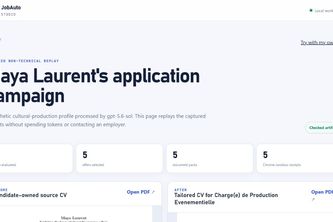
- A demo synthetic campaign evaluated 9 offers, selected 5 applications, generated 10 one-page PDFs, ran 5 independent reviews, and persisted 5 verified receipts.
- The demo shows source-versus-tailored documents, ATS evidence, agent traces, and artifact hashes.
However, there is no evidence of:
- Real-world usage or adoption.
- Customer base or user feedback.
- Revenue or monetization.
- Product maturity beyond a hackathon prototype.
Inference Traction is limited to a demo or prototype, with no data on real users or product performance in the wild.
Competitive Context
The description does not mention:
- Direct competitors.
- Market size or landscape.
- How it compares to existing ATS optimization tools, job portals, or resume builders.
It implies that current tools are opaque and fragmented, but does not name any specific alternatives.
Inference The competitive context is unclear. It may be positioned against generic resume writers or ATS tools, but no direct comparison or market positioning is evident.
Open Questions & Risks
- No revenue or traction data: The tool is described only as a hackathon project with no evidence of monetization or adoption.
- Local-only architecture: Not scalable or suitable for mass distribution without significant rework.
- Unproven user base: No customers, feedback, or usage metrics are provided.
- Self-reported claims: All descriptions are unverified and lack independent corroboration.
- Limited scope: The tool is built for a specific workflow and does not appear to be designed for broader use cases.
Inference The project is in an early stage with no commercial viability or traction. It may be a prototype or personal tool, not a scalable business.
Questions the description leaves open
- What is the actual user base or adoption rate beyond the demo?
- Are there any plans to monetize or scale this beyond a local Python application?
- How does it handle edge cases in ATS matching or browser automation?
- Is there any feedback from users on the workflow or usability?
- What are the technical limitations of running this locally, and how might they be addressed for wider use?
Overall Assessment
Not evidenced.
The description is entirely self-reported and lacks any data on:
- Revenue
- Customers
- Traction
- Market size
- Product maturity
- Commercial viability
It describes a hackathon prototype, not a product in the market.
Confidence: Low.
This is a candidate-controlled job automation tool built for personal or limited use, with no evidence of commercial traction or scalability. It may be an early-stage idea or proof-of-concept, but there is no indication it has moved beyond that stage.
User Stories BotA demo video on every pull request
Get a demo video on every new feature
GitHub App that watches your pull requests and records a narrated, captioned demo.
Save time on demo prep and make informed decisions faster with a video walkthrough of every new feature.
Source
Submitted to the OpenAI 2026 hackathon on Devpost. Project home on Devpost. Back to the full gallery on Devpost.
This competitive analysis was produced by top-founders.com (opens in a new tab)
Generated by a language model from this project's public Devpost page — its tagline, the author's own write-up and any built-with tags listed there — as captured in August 2026. Short quotations are the author's words. It is an opinion on the idea as a business, not on the people behind it, and it reflects the description as published then. If the project has moved on, request a correction below. The analysis is not independent research and contains no verified traction, revenue or customer data.
An independent guide by KFG International LLC — not affiliated with, endorsed by, or connected to Devpost or OpenAI.