

Archive position — measured, not model output
0 likes on Devpost
2,263 of the 7,850 archived projects have more likes, and 5,587 share exactly 0 — so this project's #4,695 place in the like-ranked listing is a tie-break inside that group, not a ranking.
Projects (log scale)
Likes on Devpost. ▲ marks this project's group.
Show the figures
| Likes | Projects | Share of archive |
|---|---|---|
| 0 | 5,587 | 71.2% |
| 1 | 1,758 | 22.4% |
| 2 | 284 | 3.6% |
| 3–4 | 132 | 1.7% |
| 5–9 | 75 | 1.0% |
| 10+ | 14 | 0.2% |
 User Stories BotA demo video on every pull request
Get a demo video on every new feature
GitHub App that watches your pull requests and records a narrated, captioned demo.
Save time on demo prep and make informed decisions faster with a video walkthrough of every new feature.
Executive Summary
Jaga - The AI Scam Circuit Breaker is a self-reported multilingual scam detection system designed to help older adults and families assess suspicious calls and messages through voice, Telegram, and web interfaces before money leaves the account. It was built as part of an OpenAI 2026 hackathon submission by two team members (Nigel Tan, Nathan Hor), with no evidence of revenue, customers or traction beyond a third-place finish in a local hackathon.
The product is described as a "pause button between pressure and payment", aiming to interrupt emotional manipulation tactics used in scams. It uses AI for analysis across three interfaces: web, Telegram bot, and a physical voice companion (ESP32-S3). The system claims to support Bahasa Malaysia, English, Manglish, Mandarin, and Tamil.
Key commercial due-diligence question
Does Jaga have any evidence of user adoption or impact beyond the hackathon context?
What The Product Actually Is
The description states that Jaga is a multilingual scam safety system delivered through three accessible interfaces:
- A web application where users paste suspicious messages for risk assessment.
- A Telegram bot (@jagaguardianbot) that users or family members can forward suspicious content to.
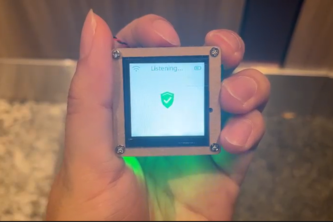
- A physical voice companion based on ESP32-S3, activated by a button press.
All three interfaces use shared AI analysis logic and follow consistent safety principles:
- Never request passwords, PINs, or OTPs.
- Encourage users to pause, avoid transferring money, verify through official channels, and contact response centers if needed.
The system is described as built using Next.js, React, TypeScript, Vercel, OpenRouter (GPT 5.6 Luna Model), Groq, Agora RTC, ElevenLabs, and embedded firmware for the physical device.
Inference: The product appears to be a proof-of-concept prototype rather than a production-ready service, given its origin in a hackathon and lack of evidence for deployment or scaling beyond the team's own testing.
Positioning & Claim Evolution
The author claims that Jaga is designed to be a pause button between pressure and payment, interrupting emotional manipulation tactics used by scammers. It positions itself as an accessible second opinion tool for vulnerable groups — particularly older adults, lower-income households, and people with low digital confidence.
It also states that it helps users understand warning signs in plain language and recommends safe human actions instead of autonomous decisions.
Inference: The positioning evolved from a general scam detection idea to a specific focus on intervening at the critical moment before financial loss occurs, emphasizing emotional pressure rather than just technical fraud identification.
Target Customer & ICP
The description states that Jaga is intended for:
- Older adults
- Lower-income households
- People with lower digital confidence
It also mentions families and caregivers who may intervene on behalf of vulnerable users.
The system supports multilingual communication styles including Bahasa Malaysia, English, Manglish, Mandarin, and Tamil to accommodate diverse user needs in Malaysia.
Inference: The target customer segment is defined by vulnerability to scam tactics and limited access or comfort with digital tools. However, there is no evidence of actual customer data or segmentation beyond self-reporting.
Business Model & Pricing Evidence
There is no evidence provided about how Jaga intends to generate revenue or whether it has a pricing model.
The description focuses on the technical architecture and safety workflow but does not mention monetization strategies, subscription plans, partnerships with banks or telecoms, or any commercial arrangements.
Inference: The business model remains undefined in the self-reported materials. It is unclear if Jaga will be offered free of charge, sold as a service, or integrated into existing platforms.
Technical & Delivery Signals
Jaga is built using:
- Web stack: Next.js, React, TypeScript, Tailwind CSS, Vercel
- AI backend: OpenRouter (GPT 5.6 Luna Model), Groq, offline keyword detector
- Telegram integration: Authenticated webhook with commands like /start, /help, /privacy
- Voice interface: Agora RTC, ElevenLabs text-to-speech
- Physical device: ESP32-S3 microcontroller with 16 MB flash and 8 MB PSRAM
The system uses a resilient provider chain:
- Primary AI analysis via OpenRouter
- Secondary support from Groq (speech-to-text)
- Offline fallback for zero-configuration resilience
It includes safeguards such as:
- Structured output validation
- Bounded risk scores (0–100)
- Malformed response handling
- Prompt injection protection
- Credential request prevention
Inference: The technical implementation shows a deliberate effort toward robustness and responsible AI use. However, the lack of production deployment or scalability data limits confidence in delivery readiness.
Traction & Maturity Signals
The only evidence of traction is:
- Third-place finish at the Codex Community Hackathon Kuala Lumpur 2026
- A working prototype across web, Telegram, and physical hardware
- Early validation from external judges
There is no mention of:
- Users or customers
- Revenue or monetization
- Product usage metrics
- Market testing or pilot programs
- Any form of commercial adoption or distribution
Inference: The product exists as a prototype but has not demonstrated real-world traction or maturity beyond the hackathon context.
Competitive Context
The description does not reference direct competitors. However, it mentions existing services such as:
- Bank hotlines
- Semak Mule
- Malaysia’s National Scam Response Centre
These are described as important but insufficient — suggesting a gap in the market for an accessible, multilingual, real-time scam assessment tool that can be used before money leaves the account.
Inference: Jaga appears to address a niche within the broader anti-scam ecosystem, targeting underserved populations who lack access to traditional support channels. No clear competitive landscape is described.
Open Questions & Risks
- No revenue or customer data: The product has no demonstrated commercial traction.
- Prototype-only status: Built for a hackathon; no evidence of production deployment or scaling.
- Unverified impact claims: The description makes strong assertions about emotional pressure and scam interruption without measurable outcomes.
- Limited language support: Only five languages are mentioned, with no indication of how well they’re supported in practice.
- Hardware limitations: Initial hardware issues (touchscreen unreliability) were resolved but suggest potential scalability concerns.
- No explicit partnership or distribution strategy: No mention of banks, telecoms, or NGOs as potential partners.
Inference: The product is unproven in real-world usage and lacks any commercial viability indicators. It may be a promising concept but has not yet demonstrated value creation.
Questions the description leaves open
- What specific user feedback did you gather during the hackathon or any informal testing?
- How do you plan to validate the accuracy of your scam detection across different languages and dialects?
- Have you conducted any usability studies with older adults or caregivers?
- Is there a roadmap for transitioning from prototype to scalable product?
- What are your plans for integrating with official scam response resources or financial institutions?
- How will you ensure responsible AI practices in production, especially around model confidence and output validation?
- Do you have any early adopters or pilot participants lined up beyond the hackathon?
Overall Assessment
Not evidenced — The description provides no information about revenue, customers, traction, or financial performance.
The product is described as a proof-of-concept prototype, built for a hackathon with no indication of commercial viability or scalability. While it addresses a real problem (scam prevention for vulnerable users), there is no evidence of adoption, impact, or monetization strategy.
Confidence level: Low. This is a self-reported concept with limited external validation and no demonstrated path to market traction or profitability.
Assessment: Not ready for investment or partnership at this stage. Further due diligence would require evidence of user testing, pilot programs, or early commercial engagement.
User Stories BotA demo video on every pull request
Get a demo video on every new feature
GitHub App that watches your pull requests and records a narrated, captioned demo.
Save time on demo prep and make informed decisions faster with a video walkthrough of every new feature.
Source
Submitted to the OpenAI 2026 hackathon on Devpost. Project home on Devpost. Back to the full gallery on Devpost.
This competitive analysis was produced by top-founders.com (opens in a new tab)
Generated by a language model from this project's public Devpost page — its tagline, the author's own write-up and any built-with tags listed there — as captured in August 2026. Short quotations are the author's words. It is an opinion on the idea as a business, not on the people behind it, and it reflects the description as published then. If the project has moved on, request a correction below. The analysis is not independent research and contains no verified traction, revenue or customer data.
An independent guide by KFG International LLC — not affiliated with, endorsed by, or connected to Devpost or OpenAI.