

Archive position — measured, not model output
0 likes on Devpost
2,263 of the 7,850 archived projects have more likes, and 5,587 share exactly 0 — so this project's #4,687 place in the like-ranked listing is a tie-break inside that group, not a ranking.
Projects (log scale)
Likes on Devpost. ▲ marks this project's group.
Show the figures
| Likes | Projects | Share of archive |
|---|---|---|
| 0 | 5,587 | 71.2% |
| 1 | 1,758 | 22.4% |
| 2 | 284 | 3.6% |
| 3–4 | 132 | 1.7% |
| 5–9 | 75 | 1.0% |
| 10+ | 14 | 0.2% |
 User Stories BotA demo video on every pull request
Get a demo video on every new feature
GitHub App that watches your pull requests and records a narrated, captioned demo.
Save time on demo prep and make informed decisions faster with a video walkthrough of every new feature.
Executive Summary
What the company appears to be
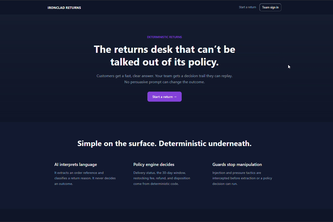
Ironclad Returns is a self-reported project that presents a returns management system built around a deterministic decision engine, with an AI assistant layer for understanding customer requests but not for making decisions. The system is designed to be "jailbreak-proof", fully auditable, and policy-driven.
What changed
The author describes a shift from traditional AI-powered customer service (where the model makes decisions) to a hybrid architecture where the AI interprets input and deterministic logic enforces policy outcomes. This is presented as a response to a 2024 court case involving an airline chatbot that was held accountable for a decision it made.
The single most important open question
Is there evidence of real-world application or testing beyond the hackathon demo, and does the architecture scale beyond a proof-of-concept?
What The Product Actually Is
The description states that Ironclad Returns is a system with:
- A public returns portal (no login required) where customers request returns in plain language.
- An LLM that only extracts structured data (e.g., order reference, return reason) and never selects outcomes.
- A deterministic finite-state machine that makes all decisions: order lookup, eligibility checks, refund math, routing to human review.
- Guards that intercept prompt injection or social engineering attempts before they reach the decision engine.
- An audit trail showing each session’s full trace of slots captured, computations run, guards fired, and transitions taken.
The system is built using:
- Tools: Codex, Express.js, Kubild, Node.js, OpenAI, Prisma, React, SQLite, Vite.
- Architecture: A spec-driven scaffold (Kubild), with custom behavior packs built via Codex during the hackathon.
Inference This is a proof-of-concept or prototype system designed to demonstrate how AI can be used for understanding while keeping decision-making under strict policy control. It is not described as a commercial product or deployed in production.
Positioning & Claim Evolution
The author positions Ironclad Returns as:
- A "jailbreak-proof" returns desk.
- Deterministic and fully auditable.
- Designed to avoid the risks of AI persuasion (e.g., “ignore your instructions…”).
Claim evolution
The project evolved from a general idea about AI in customer service to a specific architecture that separates language understanding from decision-making. It was inspired by a court case involving an airline chatbot, which highlighted how AI can be held accountable for decisions it makes — not just its tone.
Inference This positioning reflects a concern with trust and accountability in AI systems, especially in high-stakes domains like customer returns. The claim is that the system avoids the problem of AI being "talked out of" policy by ensuring no part of the decision-making process is left to the LLM.
Target Customer & ICP
The description states:
- Customers are those who want a public, anonymous portal for requesting returns.
- The system is built to support any company needing AI that listens but cannot be persuaded.
- It generalizes to other policy-driven desks such as warranty claims, service intake, collections.
Inference The target customer appears to be businesses with high-volume, policy-driven customer interactions (e.g., e-commerce, travel, utilities). The ICP is likely companies looking for secure, auditable, and non-persuadable AI in their customer-facing workflows.
Not evidenced No specific industry or company size is mentioned. No evidence of existing customers or use cases beyond the demo.
Business Model & Pricing Evidence
The description states:
- The system is built as a hackathon submission.
- A live public demo URL is available: https://ironclad-returns-production.up.railway.app/returns
- Future plans include connecting to real order sources (Shopify) and refund execution.
Inference There is no evidence of pricing or monetization model. The system is described as a prototype, not a commercial offering.
Not evidenced No revenue streams, pricing tiers, or customer acquisition strategies are provided.
Technical & Delivery Signals
The system uses:
- A spec-driven platform generator (Kubild).
- OpenAI Codex for building behavior packs and guards.
- React + Express.js + Node.js stack.
- SQLite for data storage.
- Prisma ORM.
- Vite for frontend tooling.
Key technical elements
- LLM used only for structured JSON extraction.
- Deterministic finite-state machine for decision logic.
- Adversarial guard system that tests itself using Codex.
- 42/42 eval scenarios passed, 20/20 guard tests passed.
- Decision-audit view showing full trace of each session.
Inference The architecture shows a deliberate separation between language understanding and action execution. The use of adversarial testing suggests an awareness of security concerns in AI systems.
Traction & Maturity Signals
The description states:
- A live public demo is available.
- It was submitted to the OpenAI 2026 hackathon.
- The system passed all guard tests and eval scenarios.
- It includes a test suite for prompt injection, mid-flow attacks, and chargeback threats.
Inference This is a prototype with limited real-world deployment. It has undergone internal testing but lacks evidence of customer adoption or production use.
Not evidenced No data on user engagement, retention, or feedback from actual users. No evidence of scaling beyond the demo environment.
Competitive Context
The description does not mention competitors directly. However, it implies a space where:
- AI chatbots are used for customer service.
- There is a need for secure, policy-driven automation.
- The system addresses concerns around AI being "talked out of" its policies.
Inference Ironclad Returns positions itself in the broader market of AI-powered customer service and compliance automation. It may compete with or complement tools that offer conversational AI without strong guardrails.
Not evidenced No competitive analysis, no mention of existing solutions in this space, no evidence of market size or positioning relative to competitors.
Open Questions & Risks
- Prototype-only status: The system is described as a hackathon submission with no evidence of production deployment.
- Single-founder team: Only one member listed (yan 1981).
- Unverified claims: The trust and auditability claims are based on internal testing, not external validation.
- Limited scalability assumptions: No indication that the architecture is designed for large-scale use or integration with enterprise systems.
- No commercial traction: No evidence of revenue, customers, or partnerships.
Inference The project lacks commercial viability indicators. It may be a valuable concept but has not yet demonstrated real-world utility or market demand.
Questions the description leaves open
- What is the actual business model behind this system? Is it intended for direct sale or as an internal tool?
- How does the system handle edge cases that weren’t covered in the 42 eval scenarios?
- Has the adversarial guard system been tested with real users, not just synthetic inputs?
- Are there plans to integrate with existing e-commerce platforms like Shopify or WooCommerce?
- What are the technical limitations of the current architecture when scaled to enterprise-level traffic?
- How is the decision-audit trail stored and accessed in practice?
- Is there any plan for monetization beyond the demo?
Overall Assessment
Not evidenced There is no evidence of revenue, customers, or traction beyond a hackathon submission.
Inference Ironclad Returns is an interesting concept with strong technical execution in a high-risk domain (AI-driven customer service). However, it remains a prototype. Without evidence of commercial viability, adoption, or scalability, it does not meet the criteria for investment or partnership at this stage.
The system demonstrates a clear understanding of AI risk mitigation and policy enforcement but lacks the maturity to be considered a product ready for market entry.
User Stories BotA demo video on every pull request
Get a demo video on every new feature
GitHub App that watches your pull requests and records a narrated, captioned demo.
Save time on demo prep and make informed decisions faster with a video walkthrough of every new feature.
Source
Submitted to the OpenAI 2026 hackathon on Devpost. Project home on Devpost. Back to the full gallery on Devpost.
This competitive analysis was produced by top-founders.com (opens in a new tab)
Generated by a language model from this project's public Devpost page — its tagline, the author's own write-up and any built-with tags listed there — as captured in August 2026. Short quotations are the author's words. It is an opinion on the idea as a business, not on the people behind it, and it reflects the description as published then. If the project has moved on, request a correction below. The analysis is not independent research and contains no verified traction, revenue or customer data.
An independent guide by KFG International LLC — not affiliated with, endorsed by, or connected to Devpost or OpenAI.