

Archive position — measured, not model output
1 like on Devpost
505 of the 7,850 archived projects have more likes, and 1,758 share exactly 1 — so this project's #763 place in the like-ranked listing is a tie-break inside that group, not a ranking.
Projects (log scale)
Likes on Devpost. ▲ marks this project's group.
Show the figures
| Likes | Projects | Share of archive |
|---|---|---|
| 0 | 5,587 | 71.2% |
| 1 | 1,758 | 22.4% |
| 2 | 284 | 3.6% |
| 3–4 | 132 | 1.7% |
| 5–9 | 75 | 1.0% |
| 10+ | 14 | 0.2% |
 User Stories BotA demo video on every pull request
Get a demo video on every new feature
GitHub App that watches your pull requests and records a narrated, captioned demo.
Save time on demo prep and make informed decisions faster with a video walkthrough of every new feature.
Executive Summary
Company: carebridge-concept
Self-reported basis only — this analysis is based entirely on the author's own description, as supplied in the Devpost submission. No external verification or historical data are available.
What it appears to be: A prototype communication tool for healthcare coordination, built using generative AI (GPT-5.6) and WebRTC, designed to reduce repetition and improve information sharing during medical emergencies. It is not a diagnostic or treatment system.
What changed: The author describes an evolution from a personal experience with fragmented care communication to a conceptual prototype that explores how AI can support coordination workflows without making clinical decisions.
Single most important open question: Does the described workflow actually solve a real, recurring problem in healthcare coordination, and is there evidence of user need or interest beyond the prototype?
What The Product Actually Is
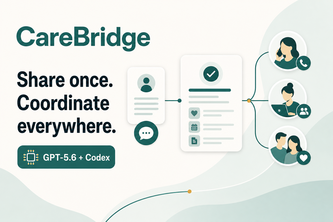
The description states that CareBridge is a communication assistant using GPT-5.6 to organize user input into an editable “Care Brief.” It supports voice and text input, synchronizes information across roles (caller, coordinator, family), and uses WebRTC for media sharing.
Key technical elements:
- Built with TypeScript, React, Vite, OpenAI Sites
- Uses OpenAI Responses API with JSON Schema to enforce structured output
- Browser-native speech recognition and WebRTC mesh communication
- BroadcastChannel for state synchronization in a multi-tab demo
Not evidenced: The product is described as a prototype only. No production system, real users, or live data are mentioned.
Positioning & Claim Evolution
The author states that CareBridge is not intended to replace existing services like #8000 or #7119 in Japan. Instead, it targets the “before and after” of those calls — specifically, how information is repeated and shared across multiple parties during a care journey.
It positions itself as a tool for communication coordination, not diagnosis or treatment.
Key claims:
- AI is used only to organize what users say, not to make decisions.
- All generated content must be reviewed and confirmed by the user.
- The system prevents GPT from inferring or inventing facts.
- It supports multilingual input (Japanese/English) and video/audio communication.
Inference: The positioning suggests a focus on reducing cognitive load during stressful situations, but no evidence of market validation or user feedback is provided.
Target Customer & ICP
The description implies that CareBridge targets:
- Callers in medical emergencies
- Healthcare coordinators
- Family members involved in care coordination
It is designed for use in stressful, time-sensitive situations, where repeated explanations are common.
Not evidenced: No specific customer segments, personas, or user interviews are described. The target audience is inferred from the problem statement but not validated.
Business Model & Pricing Evidence
The description does not mention any business model, pricing, monetization strategy, or revenue streams.
Not evidenced: No indication of how this would be sold, who pays, or whether it’s a SaaS, freemium, or public service model.
Technical & Delivery Signals
- Built with modern web stack: TypeScript, React, Vite, Cloudflare Workers-compatible backend
- Uses OpenAI API via Responses API with strict schema enforcement
- Implements browser-based WebRTC for media communication
- Uses Codex for development support (planning, coding, debugging)
- Designed to be privacy-conscious and use only fictional data in demo
Inference: The prototype is built with a clear focus on user experience and safety, but no evidence of scalability or production-grade infrastructure is provided.
Traction & Maturity Signals
The project is described as a hackathon submission, not a product in the market. It includes:
- A working demo
- A complete workflow from input to shared care brief
- Multi-role WebRTC simulation
- Bilingual interface
Not evidenced: No customers, usage data, or adoption metrics are mentioned. The prototype is not described as being used in real-world settings.
Competitive Context
The description mentions existing Japanese healthcare consultation services like #8000 and #7119, but does not compare CareBridge to other tools or platforms in the market.
Not evidenced: No competitive analysis, no mention of similar tools, no indication of how this would differ from or complement existing solutions.
Open Questions & Risks
- No real-world testing or user feedback — all evidence is self-reported and from a prototype.
- AI safety boundaries are described as design principles, but not validated in practice.
- No commercial or operational roadmap beyond future directions.
- Prototype is browser-based, multi-tab only — no indication of how it would scale or be deployed in production.
- No mention of legal, regulatory, or privacy compliance considerations for healthcare use.
Questions the description leaves open
- What specific problems in care coordination have you observed outside of the prototype?
- How do you plan to validate the workflow with actual users (e.g., caregivers, coordinators)?
- What are your thoughts on integrating real hospital data and ensuring compliance with healthcare regulations?
- How would you handle consent management and audit logs in a production system?
- What is your view on the long-term viability of using GPT-5.6 for structured communication without clinical inference?
Overall Assessment
Not evidenced: No financials, traction, or commercial readiness are provided.
Confidence level: Low — this is a self-reported prototype with no evidence of market demand, revenue, or adoption.
Assessment: The idea shows potential in addressing communication inefficiencies in healthcare coordination. However, the lack of real-world use cases, user feedback, or business model makes it difficult to assess commercial viability at this stage. It may be an early-stage concept worth exploring further with stakeholders in healthcare and AI development.
User Stories BotA demo video on every pull request
Get a demo video on every new feature
GitHub App that watches your pull requests and records a narrated, captioned demo.
Save time on demo prep and make informed decisions faster with a video walkthrough of every new feature.
Source
Submitted to the OpenAI 2026 hackathon on Devpost. Project home on Devpost. Back to the full gallery on Devpost.
This competitive analysis was produced by top-founders.com (opens in a new tab)
Generated by a language model from this project's public Devpost page — its tagline, the author's own write-up and any built-with tags listed there — as captured in August 2026. Short quotations are the author's words. It is an opinion on the idea as a business, not on the people behind it, and it reflects the description as published then. If the project has moved on, request a correction below. The analysis is not independent research and contains no verified traction, revenue or customer data.
An independent guide by KFG International LLC — not affiliated with, endorsed by, or connected to Devpost or OpenAI.