

Archive position — measured, not model output
1 like on Devpost
505 of the 7,850 archived projects have more likes, and 1,758 share exactly 1 — so this project's #764 place in the like-ranked listing is a tie-break inside that group, not a ranking.
Projects (log scale)
Likes on Devpost. ▲ marks this project's group.
Show the figures
| Likes | Projects | Share of archive |
|---|---|---|
| 0 | 5,587 | 71.2% |
| 1 | 1,758 | 22.4% |
| 2 | 284 | 3.6% |
| 3–4 | 132 | 1.7% |
| 5–9 | 75 | 1.0% |
| 10+ | 14 | 0.2% |
 User Stories BotA demo video on every pull request
Get a demo video on every new feature
GitHub App that watches your pull requests and records a narrated, captioned demo.
Save time on demo prep and make informed decisions faster with a video walkthrough of every new feature.
Executive Summary
Project: Career Compass
Source: Self-reported submission to the OpenAI 2026 hackathon on Devpost
Analysis basis: The description provided by the author only — no external verification, no archived history, no third-party corroboration
Career Compass is described as a personalized career guidance platform that aims to match students’ interests and strengths with actionable 90-day roadmaps. It was built as a hackathon project by a single developer using AI tools and frontend technologies. The description does not contain evidence of revenue, customers, traction, or business model details.
Key open question: Is this a prototype or proof-of-concept, or is there an intention to build a scalable product?
There is no evidence of commercial activity, user adoption, or monetization strategy. The project appears to be in early development and lacks any demonstration of market validation or product-market fit.
What The Product Actually Is
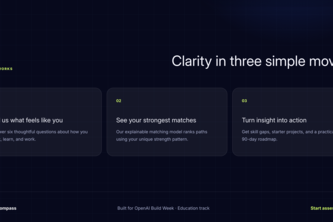
The description states that Career Compass is “a personalized career guidance platform that turns students’ interests and strengths into career matches and an actionable 90-day roadmap.”
- Claimed function: Match student interests and strengths to potential career paths.
- Claimed output: An actionable 90-day roadmap.
- Technology stack: Built with React, TypeScript, Tailwind, Vite, Cloudflare, and AI tools like GPT-5.6 and Codex.
Inference: The platform likely uses AI to analyze user input (interests, strengths) and generate career recommendations and roadmaps. However, the description does not specify how this is implemented or whether it includes any form of data processing, user interface, or backend logic beyond a frontend prototype.
Positioning & Claim Evolution
The author describes Career Compass as a platform that helps students navigate their career paths by aligning personal interests with potential careers and offering structured next steps.
- Positioning: A tool for student career guidance.
- Evolution of claims: The project is described as a “personalized” solution, suggesting it aims to tailor advice to individual users. It also implies a time-bound roadmap (90 days), which may indicate a focus on short-term planning or actionable steps.
Not evidenced: No information about prior versions, iterations, or how the platform evolved from an idea to this version.
Target Customer & ICP
The description states that Career Compass is intended for students, who are described as users whose interests and strengths are to be matched with career paths.
- Target customer: Students (likely high school or college-level).
- ICP inference: Likely early-stage career seekers, possibly in STEM or general education contexts.
Not evidenced: No data on student demographics, educational levels, or specific use cases. No evidence of segmentation or targeting beyond “students.”
Business Model & Pricing Evidence
There is no mention of pricing, monetization, or business model in the description.
- Claimed business model: Not stated.
- Pricing evidence: None provided.
Inference: If this is a prototype or MVP, it may not yet have a defined revenue path. The project was submitted to a hackathon, suggesting it may be exploratory rather than commercial.
Technical & Delivery Signals
The project was built using the following technologies:
- Frontend: React, TypeScript, Tailwind, HTML5, CSS3, JavaScript
- Backend/Infrastructure: Cloudflare
- AI tools: GPT-5.6, Codex, Vinext
- Development environment: Vite
- Delivery signal: The project is a frontend application built with modern web technologies.
- AI integration: The use of GPT and Codex suggests that AI may be used for content generation or user interaction.
Not evidenced: No information on how the AI tools are integrated, whether there is backend logic, or if data is stored or processed beyond the frontend.
Traction & Maturity Signals
The project was submitted to a hackathon (OpenAI 2026), and the team size is listed as one person.
- Traction: Not evidenced.
- Maturity: The project appears to be in early development, likely a prototype or MVP.
- User adoption: Not evidenced.
Inference: As a hackathon submission, it may not have been tested with real users or validated in the market. There is no evidence of user feedback, iterations, or product-market fit.
Competitive Context
No information is provided about competitors or how Career Compass compares to existing solutions in the career guidance space.
- Competitive landscape: Not evidenced.
- Differentiation claims: Not stated.
Inference: If this is a new idea, it may be entering a crowded market of career guidance tools, but there is no evidence of competitive analysis or positioning.
Open Questions & Risks
- Single developer team: The project was built by one person, which raises questions about scalability and long-term maintenance.
- Hackathon prototype: Likely not tested with real users or validated in the market.
- No monetization strategy: No indication of how the platform would generate revenue.
- Unverified AI integration: Use of GPT-5.6 and Codex is mentioned, but no details on how these are used or integrated.
Questions the description leaves open
- What specific problem does Career Compass solve for students?
- How is the AI (GPT/Codex) integrated into the platform?
- Is there any user testing or feedback from students yet?
- What is the intended business model and monetization strategy?
- Are there plans to expand beyond the current prototype?
- How does Career Compass differentiate itself from existing career guidance tools?
Overall Assessment
Not evidenced: No information on valuation, funding, or commercial traction.
- Investment potential: Not evident.
- Partnership opportunity: Not evident.
- Next steps: If this is a prototype, it may be worth exploring for incubation or early-stage support. However, no evidence of product-market fit or scalability exists at this stage.
Confidence level: Low — based on thin self-reported evidence only.
User Stories BotA demo video on every pull request
Get a demo video on every new feature
GitHub App that watches your pull requests and records a narrated, captioned demo.
Save time on demo prep and make informed decisions faster with a video walkthrough of every new feature.
Source
Submitted to the OpenAI 2026 hackathon on Devpost. Project home on Devpost. Back to the full gallery on Devpost.
This competitive analysis was produced by top-founders.com (opens in a new tab)
Generated by a language model from this project's public Devpost page — its tagline and any built-with tags listed there, since the author published no write-up — as captured in August 2026. Short quotations are the author's words. It is an opinion on the idea as a business, not on the people behind it, and it reflects the description as published then. If the project has moved on, request a correction below. The analysis is not independent research and contains no verified traction, revenue or customer data.
An independent guide by KFG International LLC — not affiliated with, endorsed by, or connected to Devpost or OpenAI.