

Archive position — measured, not model output
1 like on Devpost
505 of the 7,850 archived projects have more likes, and 1,758 share exactly 1 — so this project's #766 place in the like-ranked listing is a tie-break inside that group, not a ranking.
Projects (log scale)
Likes on Devpost. ▲ marks this project's group.
Show the figures
| Likes | Projects | Share of archive |
|---|---|---|
| 0 | 5,587 | 71.2% |
| 1 | 1,758 | 22.4% |
| 2 | 284 | 3.6% |
| 3–4 | 132 | 1.7% |
| 5–9 | 75 | 1.0% |
| 10+ | 14 | 0.2% |
 User Stories BotA demo video on every pull request
Get a demo video on every new feature
GitHub App that watches your pull requests and records a narrated, captioned demo.
Save time on demo prep and make informed decisions faster with a video walkthrough of every new feature.
Executive Summary
Company: CareerMutual
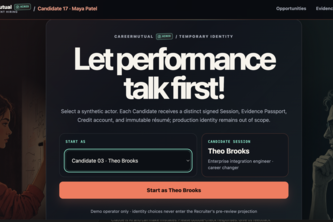
Self-reported basis: The description is entirely self-reported and unverified, as per grounding rules. No third-party corroboration or historical data exists for this analysis.
What the company appears to be: A prototype hiring platform that attempts to shift evaluation from résumés to actual work samples, using AI to match candidates to roles and analyze submissions in a blind, sealed process.
What changed: The product description indicates an evolution from a "Build Week dream" into a prototype with a defined architecture and workflow, including AI integration and privacy controls.
Single most important open question: Does the platform’s core premise — that work samples should be evaluated before résumés — actually improve hiring outcomes or reduce bias in practice?
What The Product Actually Is
The description states that CareerMutual is a mutual-intent, blind-answer-first hiring system. It operates as follows:
- A recruiter publishes a JobPost with:
- Hard requirements
- A sealed Critical Challenge
- Review criteria
- An AI disclosure policy
- A limited number of reusable review slots
- Candidates are only asked to complete work after a review slot is committed by a named recruiter, and before seeing any résumé.
- The system uses:
- GPT-5.6 for:
- Matching references from an optional private Evidence Passport
- Analyzing submissions against sealed criteria
- Producing source-linked findings (GOOD_ANSWER or BAD_ANSWER)
- A server-timed workspace where candidates answer challenges using rich text, voice, files, and a disclosed GPT-5.6 assistant
- GPT-5.6 for:
- The decision remains human:
- A positive review authorizes the pre-consented résumé snapshot
- Any other outcome keeps the résumé sealed
- A completed review releases the slot to the next candidate
Inference: The system is designed to reduce bias from résumé-first selection by prioritizing actual work before labels.
Not evidenced: No revenue, customers, or adoption data.
Positioning & Claim Evolution
The description states that CareerMutual was built in response to the "résumé false negative" problem, where candidates with strong ability but ordinary backgrounds are denied interviews due to lack of polish or prestige signals.
It positions itself as a platform that:
- Evaluates what you can do, not what you’ve been
- Shifts hiring from résumé-first to work-first
- Uses AI to match and analyze, but keeps final decisions human
Inference: The platform is attempting to solve a perceived systemic bias in hiring by changing the order of evaluation.
Not evidenced: No claims about traction, impact or market validation.
Target Customer & ICP
The description identifies two main personas:
- Recruiters:
- Publish JobPosts with sealed challenges
- Commit reusable review slots
- Review anonymous answers via GPT-5.6 analysis
- Make final hiring decisions
- Candidates:
- Use optional private Evidence Passport
- Complete sealed Critical Challenges
- Submit work in a timed, server-timed workspace
- Consent to résumé reveal only after positive review
Inference: The platform targets both job seekers and recruiters in a B2B context, with focus on reducing résumé-based bias.
Not evidenced: No data on customer segments, usage patterns, or adoption.
Business Model & Pricing Evidence
The description does not state:
- How the platform monetizes
- What pricing model it uses (if any)
- Whether it charges recruiters, candidates, or both
- If there are paid features or tiers
Not evidenced: No business model or pricing information provided.
Technical & Delivery Signals
The system is built with:
- Next.js (frontend)
- TypeScript
- PostgreSQL 16
- S3-compatible storage
- GPT-5.6 via OpenAI API
- Codex for development and rule enforcement
Key technical features include:
- Immutable submissions
- Separation of concerns between candidate and recruiter views
- Strict Structured Outputs from GPT-5.6
- Privacy controls across data projections, transactions, and storage
- Four bounded AI jobs: discovery, matching, assistant, analysis
Inference: The platform is built with strong engineering discipline and privacy-by-design principles.
Not evidenced: No production deployment, scalability metrics, or performance data.
Traction & Maturity Signals
The description states:
- It’s a prototype built in a few days
- It has passed a 30-case LIVE evaluation
- It includes a synthetic corpus of 27 JobPosts, 7 candidates, multimodal challenges, and real journeys
- The demo shows both positive and negative outcomes
Not evidenced: No live users, revenue, or adoption data.
Inference: The product is in early prototype stage with internal validation but no external traction.
Competitive Context
The description does not mention:
- Direct competitors
- Market size or positioning
- How it compares to existing hiring platforms (e.g., LinkedIn, Indeed, AngelList, etc.)
Not evidenced: No competitive analysis or market positioning data.
Open Questions & Risks
- Prototype-only status: The platform is described as a prototype with no live users or revenue.
- AI dependency: Heavy reliance on GPT-5.6 raises questions about:
- Model accuracy and consistency
- Risk of hallucination or misalignment
- Privacy and trust: While privacy controls are detailed, the system still relies on human judgment, which may not scale.
- Scalability concerns: The model is used in a limited number of bounded jobs; unclear how it would scale to real-world use.
- No monetization strategy: No indication of how the platform will generate revenue.
Inference: The product is technically ambitious but lacks commercial viability or market traction.
Not evidenced: No data on user feedback, adoption, or financials.
Questions the description leaves open
- What are the key assumptions about user behavior and hiring bias that this platform is built on?
- How does the platform plan to scale beyond a prototype with synthetic data?
- What are the legal and ethical implications of using AI in the evaluation process, especially around fairness and model accountability?
- Is there any plan for pilot testing with real recruiters or candidates?
- How will the platform handle edge cases like technical failures, model outages, or user errors?
- What is the long-term vision for monetization and product development?
Overall Assessment
Not evidenced: No financials, traction, or market data to support an investment or partnership decision.
Inference: The platform shows strong technical execution and a compelling idea around bias reduction in hiring. However, it is currently in a very early prototype stage, with no evidence of revenue, customers, or real-world adoption. It may be a promising concept for further development but lacks the commercial maturity to warrant investment or partnership at this time.
Confidence level: Low — based on self-reported prototype description only.
User Stories BotA demo video on every pull request
Get a demo video on every new feature
GitHub App that watches your pull requests and records a narrated, captioned demo.
Save time on demo prep and make informed decisions faster with a video walkthrough of every new feature.
Source
Submitted to the OpenAI 2026 hackathon on Devpost. Project home on Devpost. Back to the full gallery on Devpost.
This competitive analysis was produced by top-founders.com (opens in a new tab)
Generated by a language model from this project's public Devpost page — its tagline, the author's own write-up and any built-with tags listed there — as captured in August 2026. Short quotations are the author's words. It is an opinion on the idea as a business, not on the people behind it, and it reflects the description as published then. If the project has moved on, request a correction below. The analysis is not independent research and contains no verified traction, revenue or customer data.
An independent guide by KFG International LLC — not affiliated with, endorsed by, or connected to Devpost or OpenAI.