

Archive position — measured, not model output
0 likes on Devpost
2,263 of the 7,850 archived projects have more likes, and 5,587 share exactly 0 — so this project's #4,692 place in the like-ranked listing is a tie-break inside that group, not a ranking.
Projects (log scale)
Likes on Devpost. ▲ marks this project's group.
Show the figures
| Likes | Projects | Share of archive |
|---|---|---|
| 0 | 5,587 | 71.2% |
| 1 | 1,758 | 22.4% |
| 2 | 284 | 3.6% |
| 3–4 | 132 | 1.7% |
| 5–9 | 75 | 1.0% |
| 10+ | 14 | 0.2% |
 User Stories BotA demo video on every pull request
Get a demo video on every new feature
GitHub App that watches your pull requests and records a narrated, captioned demo.
Save time on demo prep and make informed decisions faster with a video walkthrough of every new feature.
Executive Summary
Company: ITOps Agentic
Self-reported basis: The description is entirely self-reported and unverified, based on a single tagline and a Devpost submission for the OpenAI 2026 hackathon. No additional information was provided by the author beyond this.
What it appears to be: A project that claims to use AI agents (specifically GPT-5.6 and Codex) to automate IT operations tasks such as diagnosing issues, managing tickets, and resolving incidents via autonomous workflows.
What changed: No evidence of prior version or evolution — this is a single submission from a hackathon entry.
Most important open question: Is there any evidence of actual functionality, deployment, or traction beyond the self-reported tagline?
Commercial due-diligence read: The description is extremely thin and lacks any demonstration of product-market fit, customer feedback, revenue, or even basic technical implementation details. It reads like a concept or prototype submitted for a hackathon, not a commercial offering.
What The Product Actually Is
The description states:
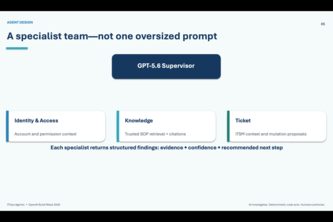
"ITOps Agentic is an AI-powered IT operations team using GPT-5.6 and Codex to diagnose issues, automate support, manage ManageEngine tickets, & resolve incidents with autonomous multi-agent workflows."
Inference: Based on this, the product appears to be a system that leverages large language models (LLMs) to perform tasks typically handled by IT operations teams — such as diagnosing technical problems, managing ticketing systems like ManageEngine, and resolving incidents autonomously through multi-agent workflows.
Not evidenced:
- No actual product functionality or interface shown.
- No demonstration of how the system works in practice.
- No mention of whether it integrates with real-world tools or is a proof-of-concept.
Positioning & Claim Evolution
The description states:
"ITOps Agentic is an AI-powered IT operations team using GPT-5.6 and Codex to diagnose issues, automate support, manage ManageEngine tickets, & resolve incidents with autonomous multi-agent workflows."
Claim: The product positions itself as an AI-driven IT operations automation tool that can function autonomously — replacing or augmenting human IT teams.
Not evidenced:
- No prior positioning or evolution of the idea.
- No evidence of how this differs from existing tools or platforms in the market (e.g., ITSM platforms, AIOps tools).
- No indication of whether the product is intended for internal use only, or as a SaaS offering.
Target Customer & ICP
The description states:
"ITOps Agentic is an AI-powered IT operations team using GPT-5.6 and Codex to diagnose issues, automate support, manage ManageEngine tickets, & resolve incidents with autonomous multi-agent workflows."
Inference: The target customer appears to be organizations that rely on IT operations teams and ticketing systems like ManageEngine, likely in enterprise or mid-sized business environments.
Not evidenced:
- No explicit identification of ICP (Ideal Customer Profile).
- No indication of whether the tool is aimed at internal IT teams, managed service providers, or end-users.
- No evidence of customer segmentation or use case prioritization.
Business Model & Pricing Evidence
The description states:
"ITOps Agentic is an AI-powered IT operations team using GPT-5.6 and Codex to diagnose issues, automate support, manage ManageEngine tickets, & resolve incidents with autonomous multi-agent workflows."
Not evidenced:
- No mention of pricing model (e.g., SaaS, per-seat, usage-based).
- No indication of monetization strategy or revenue streams.
- No evidence of business model assumptions or customer acquisition plans.
Technical & Delivery Signals
The description states:
"Built with (author-declared): gpt-5.5, python"
Inference: The system is built using Python and reportedly leverages GPT-5.5 (or a similar LLM).
Not evidenced:
- No technical architecture or design documentation.
- No evidence of how the multi-agent workflows are implemented.
- No indication of whether it’s a web app, API, CLI, or embedded system.
- No mention of data privacy, security, or infrastructure.
Traction & Maturity Signals
The description states:
"This project was submitted to the OpenAI 2026 hackathon on Devpost."
Inference: The product is a hackathon submission — likely a prototype or proof-of-concept.
Not evidenced:
- No evidence of customer adoption, usage metrics, or feedback.
- No indication of whether the project has been developed beyond the hackathon phase.
- No evidence of traction, revenue, or user engagement.
Competitive Context
The description states:
"ITOps Agentic is an AI-powered IT operations team using GPT-5.6 and Codex to diagnose issues, automate support, manage ManageEngine tickets, & resolve incidents with autonomous multi-agent workflows."
Inference: The product appears to be in the AIOps or ITSM (IT Service Management) space, competing with tools that automate incident management, diagnostics, and support.
Not evidenced:
- No mention of competitors.
- No indication of how this product differentiates from existing solutions.
- No evidence of competitive positioning or market analysis.
Open Questions & Risks
Risk 1: The project is a hackathon submission with no demonstrated functionality or traction.
Risk 2: The use of "GPT-5.6" and "Codex" is unverifiable — these are not publicly confirmed models, and the author may be using speculative or fictional tech names.
Risk 3: No evidence of product-market fit, customer validation, or business model clarity.
Risk 4: The single-member team (Thi Hong Hoa Ngo) raises questions about execution capability and scalability.
Questions the description leaves open
- What is the actual technical architecture of this system?
- Has it been tested in a real-world IT environment, or is it purely conceptual?
- How does it integrate with existing tools like ManageEngine?
- What are the assumptions behind the pricing model (if any)?
- Is there any customer feedback or early adoption yet?
- What is the roadmap beyond this hackathon submission?
- Are you planning to commercialize this, and if so, how?
Overall Assessment
Assessment: Not evidenced.
The description provides no evidence of a functioning product, traction, revenue, or even a clear business model. It reads like a hackathon idea submitted for competition, not a viable commercial opportunity.
Confidence level: Low — based on extremely thin self-reported evidence.
Recommendation: Do not proceed with due diligence unless the founder provides substantial additional information about product functionality, customer engagement, or technical implementation.
User Stories BotA demo video on every pull request
Get a demo video on every new feature
GitHub App that watches your pull requests and records a narrated, captioned demo.
Save time on demo prep and make informed decisions faster with a video walkthrough of every new feature.
Source
Submitted to the OpenAI 2026 hackathon on Devpost. Project home on Devpost. Back to the full gallery on Devpost.
This competitive analysis was produced by top-founders.com (opens in a new tab)
Generated by a language model from this project's public Devpost page — its tagline and any built-with tags listed there, since the author published no write-up — as captured in August 2026. Short quotations are the author's words. It is an opinion on the idea as a business, not on the people behind it, and it reflects the description as published then. If the project has moved on, request a correction below. The analysis is not independent research and contains no verified traction, revenue or customer data.
An independent guide by KFG International LLC — not affiliated with, endorsed by, or connected to Devpost or OpenAI.