

Archive position — measured, not model output
1 like on Devpost
505 of the 7,850 archived projects have more likes, and 1,758 share exactly 1 — so this project's #767 place in the like-ranked listing is a tie-break inside that group, not a ranking.
Projects (log scale)
Likes on Devpost. ▲ marks this project's group.
Show the figures
| Likes | Projects | Share of archive |
|---|---|---|
| 0 | 5,587 | 71.2% |
| 1 | 1,758 | 22.4% |
| 2 | 284 | 3.6% |
| 3–4 | 132 | 1.7% |
| 5–9 | 75 | 1.0% |
| 10+ | 14 | 0.2% |
 User Stories BotA demo video on every pull request
Get a demo video on every new feature
GitHub App that watches your pull requests and records a narrated, captioned demo.
Save time on demo prep and make informed decisions faster with a video walkthrough of every new feature.
Executive Summary
What the company appears to be
CareOrbit is a self-reported patient-facing mobile companion for people managing chronic conditions such as diabetes and hypertension. It is described as an AI-powered tool that provides daily care reminders, health record views, educational chat, and clinician-approved guidance.
What changed
The project was submitted as part of the OpenAI 2026 hackathon. It represents a single-person effort to build a prototype healthcare assistant with human-in-the-loop design principles, emphasizing clinician oversight and safety boundaries.
Single most important open question
Does CareOrbit have any evidence of real-world usage or clinical validation beyond its author's self-reported development?
What The Product Actually Is
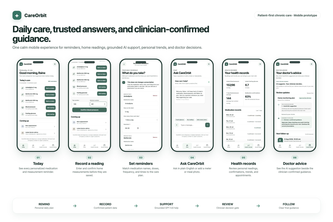
The description states that CareOrbit is a patient-facing mobile companion for people managing chronic conditions such as diabetes and hypertension. It provides four destinations:
- Today: Personalized medication, blood-pressure, and glucose reminders.
- Chat: Plain-English health questions and photo uploads for meter readings or meals.
- Health records: Simple views of the patient’s readings, medication confirmations, trends, and appointments.
- Doctor advice: A clear comparison between what the AI suggested and what the clinician ultimately approved.
The system uses GPT-5.6 through an OpenAI API gateway to handle conversational health questions, structured summaries, multimodal analysis (of synthetic blood-pressure and glucose meters), meal-image understanding, retrieval query rewriting, and validated structured outputs.
It implements a safety-gated retrieval workflow for general education questions using a source-verified knowledge base via OpenAI File Search. For safety-sensitive queries, it uses deterministic rules before calling GPT-5.6.
The product is built with FastAPI, SQLite, HTML, CSS, JavaScript, and Codex.
Evidence Self-reported by the author; no independent verification or data on actual use.
Positioning & Claim Evolution
The author positions CareOrbit as an AI-powered daily care tool that reduces routine clinician workload while ensuring patient safety through human-in-the-loop design. The goal is not to replace medical judgment but to support patients with reminders, information access, and appropriate escalation paths.
Key claims include:
- Providing timely daily support for chronic care patients.
- Reducing the burden on clinicians by handling routine tasks.
- Ensuring AI suggestions are reviewed and approved by clinicians.
- Not allowing AI to independently change medication or override clinician decisions.
The positioning evolves from a general idea of "AI-powered health support" into a specific focus on patient-facing interfaces with structured clinician handoffs.
Evidence Self-reported; no external validation or market positioning data provided.
Target Customer & ICP
The target customer is described as people managing chronic conditions such as diabetes and hypertension. The product is intended for patients who need daily reminders, health record access, educational support, and communication with clinicians between appointments.
It is explicitly stated that the interface is designed for patients only, not clinicians, though clinician decisions are visible within the "Doctor advice" section.
Evidence Self-reported; no evidence of customer segmentation or user feedback beyond the author’s own experience.
Business Model & Pricing Evidence
There is no evidence in the description of a business model or pricing structure. The project is presented as a hackathon submission with no indication of monetization, subscription plans, or revenue streams.
Evidence Not evidenced.
Technical & Delivery Signals
The system is built using:
- FastAPI
- SQLite
- HTML, CSS, JavaScript for mobile interface
- GPT-5.6 via OpenAI API gateway
- Codex for development assistance
It includes:
- Structured SBAR handoff summaries
- Multimodal analysis of synthetic blood-pressure and glucose meters
- Meal-image understanding
- Retrieval query rewriting
- Validated structured outputs
- Safety-gated retrieval workflow with source verification
- Deterministic rules for risk classification
- Automated tests (23)
- Synthetic patient data (20 fixed-seed patients, 90 days of observations)
The author notes that the mobile interface required several refinements to balance clarity and usability.
Evidence Self-reported; no evidence of production deployment or scalability beyond prototype.
Traction & Maturity Signals
There is no evidence of traction, customers, or adoption. The project is described as a single-person hackathon submission with synthetic data and automated tests. No real-world usage, user feedback, or performance metrics are mentioned.
Evidence Not evidenced.
Competitive Context
The description does not mention any competitors or competitive landscape. It focuses solely on the author’s own solution without reference to existing tools in the chronic care or AI health assistant space.
Evidence Not evidenced.
Open Questions & Risks
- Single-person development: The entire project was built by one person (Gloria J), raising questions about scalability, long-term maintenance, and team structure.
- No real-world testing: No evidence of usability testing with actual patients or clinicians.
- Unverified clinical safety: While the author claims safety boundaries, there is no evidence of regulatory compliance, privacy safeguards, or formal safety evaluation.
- Prototype-only status: The project is described as a hackathon submission and lacks production-grade features or deployment history.
- No commercial viability: No mention of monetization, partnerships, or business strategy beyond personal development.
Evidence Self-reported; no third-party validation or risk assessment data.
Questions the description leaves open
- What specific clinical workflows or integrations are planned for future versions?
- Has the author conducted any usability testing with actual patients or caregivers?
- How does the team plan to ensure compliance with healthcare regulations (e.g., HIPAA, FDA)?
- Are there plans to validate the educational content against authoritative sources?
- What is the roadmap for moving from prototype to production-ready system?
- How will patient authentication and data security be implemented at scale?
Inference These questions are based on the self-reported nature of the project and its lack of real-world validation or commercial strategy.
Overall Assessment
At this stage, CareOrbit is a prototype built by one individual as part of a hackathon. There is no evidence of revenue, customers, traction, or business model. The product shows technical sophistication in AI integration and safety design but lacks real-world deployment or clinical validation.
Confidence Level Low — the description provides limited evidence of commercial viability or market readiness.
Assessment Not ready for investment or partnership at this time. Further development, clinical validation, and user testing are required before any strategic consideration.
User Stories BotA demo video on every pull request
Get a demo video on every new feature
GitHub App that watches your pull requests and records a narrated, captioned demo.
Save time on demo prep and make informed decisions faster with a video walkthrough of every new feature.
Source
Submitted to the OpenAI 2026 hackathon on Devpost. Project home on Devpost. Back to the full gallery on Devpost.
This competitive analysis was produced by top-founders.com (opens in a new tab)
Generated by a language model from this project's public Devpost page — its tagline, the author's own write-up and any built-with tags listed there — as captured in August 2026. Short quotations are the author's words. It is an opinion on the idea as a business, not on the people behind it, and it reflects the description as published then. If the project has moved on, request a correction below. The analysis is not independent research and contains no verified traction, revenue or customer data.
An independent guide by KFG International LLC — not affiliated with, endorsed by, or connected to Devpost or OpenAI.