

Archive position — measured, not model output
0 likes on Devpost
2,263 of the 7,850 archived projects have more likes, and 5,587 share exactly 0 — so this project's #2,730 place in the like-ranked listing is a tie-break inside that group, not a ranking.
Projects (log scale)
Likes on Devpost. ▲ marks this project's group.
Show the figures
| Likes | Projects | Share of archive |
|---|---|---|
| 0 | 5,587 | 71.2% |
| 1 | 1,758 | 22.4% |
| 2 | 284 | 3.6% |
| 3–4 | 132 | 1.7% |
| 5–9 | 75 | 1.0% |
| 10+ | 14 | 0.2% |
 User Stories BotA demo video on every pull request
Get a demo video on every new feature
GitHub App that watches your pull requests and records a narrated, captioned demo.
Save time on demo prep and make informed decisions faster with a video walkthrough of every new feature.
Executive Summary
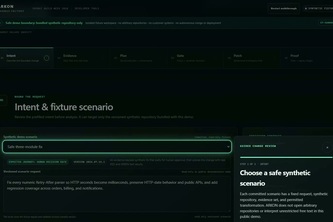
ARKON Change Factory is a self-reported proof-of-concept tool for governed code change workflows, built as a standalone Next.js application using TypeScript and Firebase. The system models a deterministic policy engine that enforces human decision-making at key points in the change lifecycle, with an emphasis on replayable receipts and evidence-based outcomes. It uses GPT-5.6 in a strictly bounded and separated evaluator role, without live model calls in its public version.
The project is described as a "governed change-workflow proof of concept" that separates model intent from execution, and enforces human review before code execution. The author states that the system models five terminal outcomes explicitly: awaiting_approval, verified, rejected, blocked, and verification_failed.
Key open question
What is the actual commercial viability or traction potential of this system, given that it's described as a proof-of-concept with no evidence of revenue, customers, or adoption?
What The Product Actually Is
The description states that ARKON Change Factory is a "governed change-workflow proof of concept" that allows a model to propose a narrow, typed code change while keeping all consequential decisions outside the model. It makes each terminal outcome replayable.
The system runs one visible governed chain:
- immutable intent -> cited evidence -> typed plan -> deterministic policy -> human decision -> isolated RED/GREEN execution -> sealed receipt -> 12-check replay
It explicitly models five terminal outcomes:
- awaiting_approval
- verified
- rejected
- blocked
- verification_failed
The description states that the model is not a shell, merge bot, policy authority, or proof engine. It can only return strict typed intermediate representation over supplied evidence and allowlisted transformations.
Positioning & Claim Evolution
The author claims that ARKON Change Factory is different because:
- The model is not a shell, merge bot, policy authority, or proof engine
- It can only return strict typed intermediate representation over supplied evidence and allowlisted transformations
- Deterministic code validates evidence coverage, paths, preimages, operation budgets, policy, decision bindings, diff conformance, tests, terminal state, and receipt replay
The author states that the system models five terminal outcomes explicitly, which suggests a structured approach to handling change workflows.
Target Customer & ICP
Not evidenced. The description does not identify specific target customers or ideal customer profiles (ICP). It describes the system's functionality but does not indicate who would use it or what their needs are.
Business Model & Pricing Evidence
Not evidenced. There is no information in the description about pricing, monetization strategies, or business model. The project is described as a proof-of-concept with no revenue or customer data.
Technical & Delivery Signals
The system was built using:
- Next.js + TypeScript
- Zod contracts for validation
- Firestore persistence
- Deterministic policy engine
- Causal fixture executor
- Content-addressed evidence
- Execution leases
- Atomic operation budgets
- 12-domain replay verifier
It uses:
- GPT-5.6 via OpenAI Responses API (in a protected, evaluator-separated workflow)
- Codex for architecture, typed model contracts, adversarial evals, trust-boundary reviews, browser journeys, and CI/CD
- Docker, Firebase Hosting, Google Cloud Run, Playwright, React, Vitest, Workload Identity Federation
The description states that the public product is fixture-only and secret-free, showing only an allowlisted historical evidence projection without live model calls.
Traction & Maturity Signals
Not evidenced. The project is described as a proof-of-concept submitted to a hackathon (OpenAI 2026). There is no evidence of revenue, customers, adoption, or traction beyond the author's own description.
Competitive Context
Not evidenced. The description does not mention any competitors or competitive landscape. It does not describe how this solution compares to existing tools in the market for code change governance or workflow management.
Open Questions & Risks
- The system is described as a proof-of-concept with no evidence of traction, revenue, or customers
- The public version makes no live model calls and shows only fixture data
- The project is built by a single team member (Efthimios Fousekis)
- No information about scalability, production readiness, or integration capabilities
- The system's value proposition appears to be around governance and auditability rather than automation or speed
Questions the description leaves open
- What specific use cases are you targeting with this system?
- How does this solution differ from existing change management tools in the market?
- What is your plan for moving beyond the proof-of-concept stage?
- Are there any potential customers or partners interested in adopting this technology?
- What are the technical challenges you anticipate in scaling this solution?
- How do you plan to monetize this product if it moves beyond the proof-of-concept phase?
Overall Assessment
Not evidenced. The description does not provide sufficient information to assess commercial viability, traction potential, or investment appeal. It is described as a proof-of-concept submitted to a hackathon with no evidence of revenue, customers, or adoption. The author states that the public product is fixture-only and secret-free, indicating limited demonstration of actual functionality.
User Stories BotA demo video on every pull request
Get a demo video on every new feature
GitHub App that watches your pull requests and records a narrated, captioned demo.
Save time on demo prep and make informed decisions faster with a video walkthrough of every new feature.
Source
Submitted to the OpenAI 2026 hackathon on Devpost. Project home on Devpost. Back to the full gallery on Devpost.
This competitive analysis was produced by top-founders.com (opens in a new tab)
Generated by a language model from this project's public Devpost page — its tagline, the author's own write-up and any built-with tags listed there — as captured in August 2026. Short quotations are the author's words. It is an opinion on the idea as a business, not on the people behind it, and it reflects the description as published then. If the project has moved on, request a correction below. The analysis is not independent research and contains no verified traction, revenue or customer data.
An independent guide by KFG International LLC — not affiliated with, endorsed by, or connected to Devpost or OpenAI.