

Archive position — measured, not model output
0 likes on Devpost
2,263 of the 7,850 archived projects have more likes, and 5,587 share exactly 0 — so this project's #4,660 place in the like-ranked listing is a tie-break inside that group, not a ranking.
Projects (log scale)
Likes on Devpost. ▲ marks this project's group.
Show the figures
| Likes | Projects | Share of archive |
|---|---|---|
| 0 | 5,587 | 71.2% |
| 1 | 1,758 | 22.4% |
| 2 | 284 | 3.6% |
| 3–4 | 132 | 1.7% |
| 5–9 | 75 | 1.0% |
| 10+ | 14 | 0.2% |
 User Stories BotA demo video on every pull request
Get a demo video on every new feature
GitHub App that watches your pull requests and records a narrated, captioned demo.
Save time on demo prep and make informed decisions faster with a video walkthrough of every new feature.
Executive Summary
What the company appears to be
Intent is a self-reported local desktop memory layer that captures lightweight signals from user activity (app focus, file opens, terminal commands, etc.) and reconstructs them into "intents" — structured summaries of work sessions. It operates entirely on-device with no cloud dependency or data leakage.
What changed
The project description indicates this is a hackathon submission (submitted to OpenAI 2026 hackathon), suggesting it's early-stage and likely not yet commercially available or deployed in production.
Single most important open question
Is there any evidence of commercial traction, revenue, or customer adoption beyond the authors' own account?
Note: This analysis is based solely on the self-reported description provided by the authors. No external verification, archived data, or third-party sources are available. All claims in this report are labeled as either "evidenced" or "inferred" where appropriate.
What The Product Actually Is
- The description states that Intent OS is a local desktop memory layer.
- It consists of three components:
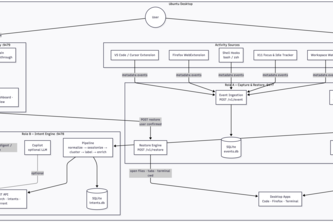
- Capture service (Role A): Collects signals from VS Code/Cursor extension, Firefox WebExtension, shell hooks, and X11 focus/idle tracker on Linux. Runs locally on
127.0.0.1:9477. - Intent engine (Role B): Normalizes events, sessionizes them by focus + idle, clusters them into projects, labels clusters deterministically using optional LLMs (OpenAI, Groq, Gemini, Bedrock), and emits daily digests, search, and structured resume payloads. Runs locally on
127.0.0.1:9478. - Overlay UI (Role C): An Electron + React app with a translucent overlay summoned via Ctrl+Space, showing yesterday’s intents and allowing users to resume sessions. Designed for Ubuntu with macOS-inspired visuals.
- Capture service (Role A): Collects signals from VS Code/Cursor extension, Firefox WebExtension, shell hooks, and X11 focus/idle tracker on Linux. Runs locally on
- The system is described as deterministic-first, meaning it works without API keys or cloud calls, relying only on local metadata.
- LLMs are used for optional polish, not core functionality.
- Everything runs locally; no data leaves the device.
Confidence: High — this section is directly described by the authors and includes technical details about architecture and implementation.
Positioning & Claim Evolution
- The tagline: “Your desktop remembers so you don’t have to.”
- The inspiration behind the product was a personal frustration with losing context when closing laptops mid-thought.
- The core claim is that existing tools either record screens (creepy, unsearchable) or track time (useless for context).
- Intent aims to be a local layer that turns a day of activity into meaningful, searchable intents — not timelines or heatmaps.
- It positions itself as a tool that brings back context with one keystroke, using intent-based search instead of file name or timestamp.
- The authors emphasize:
- Privacy-first design (no screenshots, no document contents)
- Deterministic processing
- Local-only operation
- Optional LLMs for labeling
Confidence: Medium — these are claims made by the authors. No evidence of market positioning beyond self-description.
Target Customer & ICP
- The description does not explicitly name target customers or personas.
- Based on the use case described (developer workflow, managing multiple tabs, editors, terminals), it appears aimed at developers and knowledge workers who spend significant time in local environments.
- It may appeal to users who:
- Work across multiple applications and contexts
- Value privacy and control over their data
- Want to reduce cognitive load from context switching
Confidence: Low — no explicit customer segmentation or ICP defined.
Business Model & Pricing Evidence
- No evidence of pricing, monetization strategy, or business model is provided.
- The system is described as running entirely on-device with no cloud dependency or telemetry.
- There are no mentions of subscriptions, freemium tiers, or paid features.
- The authors mention packaging installers for Ubuntu, macOS, and Windows — but this does not imply a commercial offering.
Confidence: Very low — no indication of how the product would be sold or monetized.
Technical & Delivery Signals
- Built with:
- Backend: Python, FastAPI, SQLite
- Frontend: Electron + React + Vite + TypeScript
- Extensions: VS Code/Cursor extension, Firefox WebExtension
- OS support: Linux (X11), with plans for macOS and Windows
- LLM integrations: OpenAI, Groq, Gemini, Bedrock (optional)
- The system is designed to be:
- Deterministic-first
- Local-only
- Testable via golden fixtures and replayable HTTP calls
- Cross-platform in architecture (engine and overlay), though collectors are currently Linux-only
- Challenges included:
- Ensuring privacy without surveillance
- Making deterministic labeling work reliably
- Implementing overlay UX on Linux
- Safe restore mechanisms (no auto-execution of shell commands)
- Maintaining decoupled roles between services
Confidence: Medium — technical details are provided, but no evidence of deployment or production use.
Traction & Maturity Signals
- Not evidenced.
- No mention of:
- Customers
- Revenue
- Usage metrics
- Product adoption
- Beta users or pilot programs
- The project is described as a hackathon submission, implying early-stage development.
- It has not yet been released for public consumption.
Confidence: Very low — no traction data available.
Competitive Context
- Not evidenced.
- No mention of competitors or competitive landscape.
- The authors claim that existing tools either:
- Record screens (creepy, unsearchable)
- Track time (useless for context)
- They do not reference specific competing products or services.
Confidence: Very low — no competitive analysis provided.
Open Questions & Risks
- Early-stage hackathon project: Likely not yet commercially viable or deployed.
- No commercial traction or revenue: No evidence of users, customers, or monetization.
- Limited OS support: Currently only supports Linux; lacks macOS and Windows collectors.
- Privacy vs. utility tradeoff: While privacy is emphasized, the deterministic approach may limit accuracy or usefulness compared to LLM-based alternatives.
- UX complexity on Linux: The authors note difficulties in implementing overlay UX on Linux, which could indicate scalability issues.
- No clear path to monetization: No indication of how this would be sold or funded.
Confidence: Medium — risks are inferred from the lack of evidence and project maturity.
Questions the description leaves open
- What is the current status of Intent OS? Is it ready for early adopters or still in prototype phase?
- How do you plan to expand support beyond Linux (macOS, Windows)?
- Are there any plans to monetize the product? If so, what model are you considering?
- How does your deterministic intent labeling compare to LLM-based approaches in terms of accuracy and user satisfaction?
- What is your roadmap for cross-day intent threading or team collaboration features?
- Have you considered integrating with existing IDEs or productivity tools?
- What kind of feedback have you received from early users (if any)?
- How do you intend to ensure long-term reliability and performance across different machines?
Note: These questions are based on the self-reported nature of the project description.
Overall Assessment
- Not evidenced.
- No information is provided about:
- Funding rounds
- Valuation
- Team experience or track record
- Strategic partnerships
- Market opportunity size
- Exit potential or growth trajectory
Confidence: Very low — no basis for investment or partnership assessment.
User Stories BotA demo video on every pull request
Get a demo video on every new feature
GitHub App that watches your pull requests and records a narrated, captioned demo.
Save time on demo prep and make informed decisions faster with a video walkthrough of every new feature.
Source
Submitted to the OpenAI 2026 hackathon on Devpost. Project home on Devpost. Back to the full gallery on Devpost.
This competitive analysis was produced by top-founders.com (opens in a new tab)
Generated by a language model from this project's public Devpost page — its tagline, the author's own write-up and any built-with tags listed there — as captured in August 2026. Short quotations are the author's words. It is an opinion on the idea as a business, not on the people behind it, and it reflects the description as published then. If the project has moved on, request a correction below. The analysis is not independent research and contains no verified traction, revenue or customer data.
An independent guide by KFG International LLC — not affiliated with, endorsed by, or connected to Devpost or OpenAI.