

Archive position — measured, not model output
1 like on Devpost
505 of the 7,850 archived projects have more likes, and 1,758 share exactly 1 — so this project's #1,230 place in the like-ranked listing is a tie-break inside that group, not a ranking.
Projects (log scale)
Likes on Devpost. ▲ marks this project's group.
Show the figures
| Likes | Projects | Share of archive |
|---|---|---|
| 0 | 5,587 | 71.2% |
| 1 | 1,758 | 22.4% |
| 2 | 284 | 3.6% |
| 3–4 | 132 | 1.7% |
| 5–9 | 75 | 1.0% |
| 10+ | 14 | 0.2% |
 User Stories BotA demo video on every pull request
Get a demo video on every new feature
GitHub App that watches your pull requests and records a narrated, captioned demo.
Save time on demo prep and make informed decisions faster with a video walkthrough of every new feature.
Executive Summary
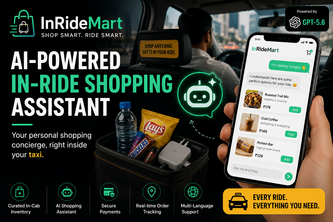
The company appears to be a single-person project (Sohail M) that self-reports building an AI-powered in-ride shopping concierge for taxi passengers. The author states the product enables passengers to browse, chat with an AI, and purchase products from within a taxi using an MVP built with microservices, GPT-5.6, and a mobile-first UI.
What changed
The project is described as a hackathon submission (Devpost entry for OpenAI 2026) that includes a working MVP, but no evidence of commercial traction or customer adoption exists.
Single most important open question
Is there any evidence of real-world usage, revenue, or partnerships with taxi services?
Analysis basis
Self-reported only. No archived data, third-party verification, or independent sources. All claims are from the author’s own description and must be treated as unverified.
What The Product Actually Is
The description states that InRideMart is an AI-powered in-ride shopping assistant that transforms a taxi into a smart convenience store.
It allows passengers to:
- Register and log in securely
- Browse products inside the cab
- Chat with an AI concierge
- Receive intelligent recommendations based on journey context (destination, duration, weather, etc.)
- Add items directly from AI chat
- Complete mock checkout and order tracking
The system integrates with:
- Backend: Java, Spring Boot, PostgreSQL, Docker, REST APIs
- Frontend: Next.js, React, TypeScript, Tailwind CSS
- AI Layer: GPT-5.6, OpenAI API, conversational AI, translation support
Inference The product is described as a microservices-based MVP with an AI layer and mobile UI, but no evidence of live deployment or real-world usage.
Positioning & Claim Evolution
The author positions InRideMart as:
- A solution to the problem of passengers needing essentials during travel (e.g., phone chargers, snacks).
- An alternative to traditional quick-commerce platforms like Blinkit, Zepto, and Instamart, which are designed for home delivery.
- A way to turn travel time into shopping time.
The project claims to offer:
- AI-powered recommendations
- Context-aware shopping bundles
- Multilingual communication
- Smart travel integration (destination, weather, budget)
Claim vs. Fact
These are self-reported claims about intent and positioning, not proof of traction or adoption.
Target Customer & ICP
The author states that the primary customer is:
- Taxi passengers who spend 15–60 minutes in a cab
- Individuals needing essentials like phone chargers, drinks, snacks, wellness products, or personal care items during travel
Inference The target is defined by passenger behavior and journey context. No evidence of actual customers or personas beyond the author’s description.
Business Model & Pricing Evidence
The project description does not include any information about:
- Revenue model
- Pricing structure
- Monetization strategy
- Payment gateway integration (only mock payments are mentioned)
Not evidenced No indication of how the product would generate revenue or what pricing might look like in a real-world scenario.
Technical & Delivery Signals
The project is built with:
- Backend: Java, Spring Boot, PostgreSQL, Docker, REST APIs
- Frontend: Next.js, React, TypeScript, Tailwind CSS
- AI Layer: GPT-5.6, OpenAI API, conversational AI
- Architecture: Microservices-based with an API gateway
The author notes:
- End-to-end working MVP
- JWT authentication across microservices
- Docker networking and service communication challenges
- Mock payment integration
- Responsive UI design
Inference The technical stack suggests a modern, scalable architecture. However, no evidence of production deployment or performance data.
Traction & Maturity Signals
The project is described as:
- A hackathon submission (Devpost entry)
- An MVP with full functionality
- Built in a short timeframe (implied by hackathon context)
No evidence of:
- Real users or customers
- Revenue or monetization
- Product-market fit
- Live deployment or usage metrics
Not evidenced No traction data, user base, or commercial adoption is provided.
Competitive Context
The author mentions that traditional quick-commerce platforms like Blinkit, Zepto, and Instamart are not designed for in-cab shopping. InRideMart positions itself as an alternative to these by:
- Focusing on travel-time commerce
- Integrating with taxi services (future roadmap includes Uber and Ola)
Inference The author sees a gap in the market for in-ride shopping, but no evidence of competitive analysis or existing players in this space.
Open Questions & Risks
Key risks and open questions based on the self-reported description:
- Single-person team: No evidence of scaling or operational capacity beyond one developer.
- Unverified AI model: GPT-5.6 is mentioned, but no details on training, fine-tuning, or performance metrics.
- No real-world integration: Only mock payments and MVP functionality are described; no live taxi or driver integrations.
- No monetization strategy: No pricing, revenue model, or payment gateway details.
- Hackathon origin: The project is a hackathon submission, not a commercial product.
Inference The lack of real-world usage, funding, or partnerships raises questions about viability and scalability.
Questions the description leaves open
- What is the current status of taxi service integrations (Uber, Ola)?
- How does the AI concierge handle context-aware recommendations in practice?
- Are there any real users or pilot programs running?
- What is the plan for monetization and revenue generation?
- How is the product being tested or validated with actual passengers?
- What are the technical challenges that remain unresolved in production?
Overall Assessment
Not evidenced No data on commercial traction, revenue, customer base, or market validation exists.
Assessment The project is a hackathon MVP with a promising concept and solid technical foundation. However, there is no evidence of real-world usage, monetization, or scalability. It is not ready for investment or partnership without further development, validation, and traction.
User Stories BotA demo video on every pull request
Get a demo video on every new feature
GitHub App that watches your pull requests and records a narrated, captioned demo.
Save time on demo prep and make informed decisions faster with a video walkthrough of every new feature.
Source
Submitted to the OpenAI 2026 hackathon on Devpost. Project home on Devpost. Back to the full gallery on Devpost.
This competitive analysis was produced by top-founders.com (opens in a new tab)
Generated by a language model from this project's public Devpost page — its tagline, the author's own write-up and any built-with tags listed there — as captured in August 2026. Short quotations are the author's words. It is an opinion on the idea as a business, not on the people behind it, and it reflects the description as published then. If the project has moved on, request a correction below. The analysis is not independent research and contains no verified traction, revenue or customer data.
An independent guide by KFG International LLC — not affiliated with, endorsed by, or connected to Devpost or OpenAI.