

Archive position — measured, not model output
0 likes on Devpost
2,263 of the 7,850 archived projects have more likes, and 5,587 share exactly 0 — so this project's #5,156 place in the like-ranked listing is a tie-break inside that group, not a ranking.
Projects (log scale)
Likes on Devpost. ▲ marks this project's group.
Show the figures
| Likes | Projects | Share of archive |
|---|---|---|
| 0 | 5,587 | 71.2% |
| 1 | 1,758 | 22.4% |
| 2 | 284 | 3.6% |
| 3–4 | 132 | 1.7% |
| 5–9 | 75 | 1.0% |
| 10+ | 14 | 0.2% |
 User Stories BotA demo video on every pull request
Get a demo video on every new feature
GitHub App that watches your pull requests and records a narrated, captioned demo.
Save time on demo prep and make informed decisions faster with a video walkthrough of every new feature.
Executive Summary
What the company appears to be
MarketLens is a self-reported tool that uses AI to analyze competitor websites and generate structured reports covering business model, target customers, product analysis, SWOT, feature matrix, market position, strategic recommendations, and decision cards. The author states it was built with Codex and GPT-5.6 Luna model for development and runtime use.
What changed
The project is presented as a hackathon submission that has been developed into a working prototype with modular architecture, UI components, and PDF export capabilities. It includes prompt engineering to produce decision-oriented outputs and handles web scraping and Azure OpenAI integration.
Single most important open question
Is there any evidence of actual customer adoption, revenue generation, or commercial traction beyond the self-reported project description?
What The Product Actually Is
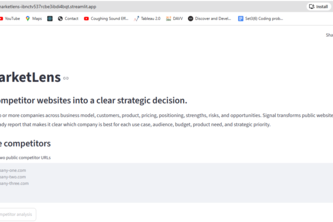
The description states that MarketLens accepts two or more public company URLs and generates a structured competitor analysis covering:
- Executive summary
- Business model
- Target customers
- Product and pricing analysis
- SWOT analysis
- Competitor comparison
- Feature matrix
- Market position
- Opportunities and risks
- Strategic recommendations
- Direct winner picks for use case, customer segment, budget, and product need
The report is presented as a readable web experience with highlighted section headings, decision cards, loading feedback, report clearing, and PDF export.
Evidence The author's own write-up describes the functionality in detail.
Inference The tool appears to be an AI-powered competitor intelligence platform that transforms public website data into structured business insights. It is not evidenced whether this is a commercial product or just a prototype.
Positioning & Claim Evolution
The tagline states: "MarketLens turns competitor websites into AI-powered insights, helping teams compare companies and make faster strategic decisions."
The author claims the tool compresses a slow, fragmented competitive research workflow into one focused experience. It allows users to provide sources, receive structured analysis, and share polished reports with stakeholders.
Evidence Self-reported by the author.
Inference The positioning is that of an AI-powered competitor intelligence platform aimed at business teams needing fast strategic decision-making. No evidence suggests this has evolved from a prototype or been tested in real commercial environments.
Target Customer & ICP
The description states that MarketLens helps "teams compare companies and make faster strategic decisions." It is designed for stakeholders who need to evaluate competitors quickly and share insights with others.
Evidence The author's own write-up mentions teams needing to make fast strategic decisions.
Inference The target customer appears to be business decision-makers, strategy teams, or analysts working in B2B environments. No evidence of specific industry focus or detailed buyer personas is provided.
Business Model & Pricing Evidence
There is no evidence of pricing structure, monetization model, or revenue streams in the description.
Evidence Not evidenced.
Inference The tool appears to be a prototype or proof-of-concept built for a hackathon. No indication exists that it has a commercial business model or pricing strategy.
Technical & Delivery Signals
The product was built using:
- Python + Streamlit for web application and UI
- Azure OpenAI / OpenAI-compatible v1 client with GPT-5.6 Luna model
- BeautifulSoup and Requests for extracting visible text and metadata from public webpages
- Prompt engineering to produce a consistent 12-part consulting report
- ReportLab for downloadable PDF reports
- HTML/CSS inside Streamlit for branded cards, visual hierarchy, responsive layouts
The application keeps model calls separate from scraping, prompts, rendering, and exporting so each part can be improved independently.
Evidence The author's own write-up describes the technical stack and architecture.
Inference The tool is built with a modular approach and uses AI for content generation. It is not evidenced whether this has been scaled or deployed in production environments.
Traction & Maturity Signals
There is no evidence of customer adoption, revenue, ARR, headcount, or any traction metrics beyond the self-reported project description.
Evidence Not evidenced.
Inference The tool appears to be a hackathon prototype with no commercial traction. It has not been independently verified for real-world use or performance.
Competitive Context
The author does not provide information about existing competitive products or market positioning in relation to them.
Evidence Not evidenced.
Inference No evidence exists of how MarketLens compares to other competitor intelligence tools, whether they are SaaS platforms, consulting firms, or AI-powered research tools. The competitive landscape is unknown.
Open Questions & Risks
- Unverified claims: All features and functionality are self-reported without independent verification.
- No commercial traction: No evidence of revenue, customers, or adoption beyond the project description.
- AI dependency risks: Heavy reliance on a proprietary model (GPT-5.6 Luna) that may not be available long-term.
- Limited scope: The tool only analyzes public websites and does not appear to support private data sources or enterprise features.
- Prototype nature: Built for a hackathon, with no evidence of commercialization or scalability.
Evidence Not evidenced.
Questions the description leaves open
- What is the actual business model behind MarketLens? Is it intended to be sold as SaaS?
- Have you tested this tool with real users or teams in a business context?
- How do you plan to scale beyond the current prototype and handle data privacy concerns?
- Are there any plans for monetization, pricing tiers, or enterprise features?
- What are the limitations of the GPT-5.6 Luna model in terms of accuracy and reliability for business decisions?
- How does MarketLens ensure compliance with website terms of service and data scraping regulations?
Overall Assessment
Confidence level Low — based entirely on self-reported project description.
Assessment MarketLens appears to be a hackathon prototype that demonstrates technical capability in AI-powered competitor analysis but lacks evidence of commercial traction, customer adoption, or business model. It is not evidenced whether it has moved beyond the proof-of-concept stage or has any revenue-generating potential. The tool's positioning as an AI-powered competitor intelligence platform is claimed by the author, but no independent validation exists.
Recommendation
Further due diligence required to assess commercial viability, market fit, and scalability before considering investment or partnership opportunities.
User Stories BotA demo video on every pull request
Get a demo video on every new feature
GitHub App that watches your pull requests and records a narrated, captioned demo.
Save time on demo prep and make informed decisions faster with a video walkthrough of every new feature.
Source
Submitted to the OpenAI 2026 hackathon on Devpost. Project home on Devpost. Back to the full gallery on Devpost.
This competitive analysis was produced by top-founders.com (opens in a new tab)
Generated by a language model from this project's public Devpost page — its tagline, the author's own write-up and any built-with tags listed there — as captured in August 2026. Short quotations are the author's words. It is an opinion on the idea as a business, not on the people behind it, and it reflects the description as published then. If the project has moved on, request a correction below. The analysis is not independent research and contains no verified traction, revenue or customer data.
An independent guide by KFG International LLC — not affiliated with, endorsed by, or connected to Devpost or OpenAI.