

Archive position — measured, not model output
0 likes on Devpost
2,263 of the 7,850 archived projects have more likes, and 5,587 share exactly 0 — so this project's #4,619 place in the like-ranked listing is a tie-break inside that group, not a ranking.
Projects (log scale)
Likes on Devpost. ▲ marks this project's group.
Show the figures
| Likes | Projects | Share of archive |
|---|---|---|
| 0 | 5,587 | 71.2% |
| 1 | 1,758 | 22.4% |
| 2 | 284 | 3.6% |
| 3–4 | 132 | 1.7% |
| 5–9 | 75 | 1.0% |
| 10+ | 14 | 0.2% |
 User Stories BotA demo video on every pull request
Get a demo video on every new feature
GitHub App that watches your pull requests and records a narrated, captioned demo.
Save time on demo prep and make informed decisions faster with a video walkthrough of every new feature.
Executive Summary
What the company appears to be
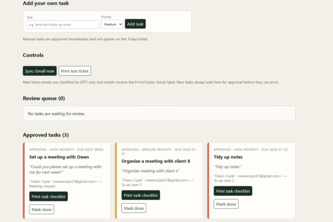
Inbox on the Menu is a self-reported personal productivity tool that integrates an email inbox with a Bluetooth thermal receipt printer. The system uses GPT-5.6 and Codex to extract tasks from incoming emails, prioritize them, and print them as physical tickets via a receipt printer.
What changed
The author reports building this tool over a short timeframe (likely a hackathon project) using AI-assisted development tools like Codex and GPT-5.6. It is described as a personal prototype that works but has not yet been scaled or commercialized.
Single most important open question
Is there any evidence of traction, revenue, or customer adoption beyond the author’s own use? The description provides no data on usage beyond the individual user.
Note: This analysis is based entirely on the self-reported, unverified project description provided by the caller. No third-party verification or historical data exists for this project.
What The Product Actually Is
The description states that Inbox on the Menu:
- Turns an email inbox into printed to-do tickets using a Bluetooth thermal receipt printer.
- Uses GPT-5.6 (via OpenAI API) to extract tasks and due dates from incoming emails.
- Automatically prints a “today ticket” each morning, aggregating and deduplicating tasks from the last 24 hours.
- Operates via IMAP to monitor the inbox independently.
- Includes a small HTML interface for manual task entry or monitoring.
- Runs on a local machine (Windows), scheduled to auto-start via Task Scheduler.
- Was built using Codex, JavaScript, Python, HTML, IMAP, Powershell, and POS technologies.
Inference: The product is described as a personal automation tool that bridges digital email with physical task management. It is not a commercial SaaS offering or marketplace.
Positioning & Claim Evolution
The author claims:
- They were dissatisfied with existing to-do systems (paper and digital).
- They wanted the satisfaction of a restaurant kitchen ticketing system applied to their work inbox.
- The tool was built using AI tools like Codex and GPT-5.6, which they describe as enabling rapid development.
Claim: The product positions itself as a tactile, satisfying, and AI-enhanced solution for managing email-based tasks.
Inference: The positioning is personal and niche — not aimed at a broader market or commercial audience.
Target Customer & ICP
The description states:
- The tool was built by one individual (the author) for their own use.
- It is described as a personal productivity hack, not a product for others.
Not evidenced: No information on target customers beyond the author. No evidence of market segmentation or customer personas.
Business Model & Pricing Evidence
The description states:
- The tool is built by one person and used personally.
- There is no mention of pricing, subscriptions, or monetization.
- It was submitted as a hackathon project.
Not evidenced: No business model or pricing information provided. The tool appears to be non-commercial in nature.
Technical & Delivery Signals
The description states:
- Built using Codex and GPT-5.6 for development assistance.
- Uses IMAP to monitor the email inbox.
- Integrates with a Bluetooth thermal receipt printer.
- Includes an HTML interface for manual task entry.
- Runs on Windows via Task Scheduler.
- The author used mobile (iOS) to continue building.
- The system is designed to run autonomously.
Inference: The tool is technically functional but limited in scope and deployment. It is not a scalable or enterprise-grade solution.
Traction & Maturity Signals
The description states:
- The author reports that the tool “actually works” and they are going to use it.
- It was built within a short timeframe (likely a hackathon).
- It is described as a prototype, not a production-ready product.
- No evidence of customer adoption or usage beyond the author.
Not evidenced: No data on user base, retention, or usage metrics. The tool appears to be in early-stage development.
Competitive Context
The description states:
- The author was dissatisfied with existing to-do systems (paper and digital).
- No mention of competitors or market positioning.
- The project is not described as part of a larger product ecosystem or marketplace.
Not evidenced: No information on competitive landscape, similar tools, or market positioning beyond the author’s personal dissatisfaction.
Open Questions & Risks
The description states:
- The tool is built by one person and used personally.
- It is not scalable or commercialized.
- It relies on a single user’s machine to run (Windows laptop).
- No mention of security, privacy, or data handling practices.
- No evidence of long-term viability or product-market fit.
Inference: The tool lacks scalability, commercialization, and market traction. It is not a viable business model as described.
Questions the description leaves open
- What is the actual user base for this tool beyond the author?
- Has there been any attempt to monetize or scale this product?
- Are there any privacy or security concerns with how email data is processed and stored?
- How does the system handle errors or failures in email parsing or printing?
- Is there a plan to move beyond a personal prototype to a scalable solution?
Overall Assessment
The description states:
- The tool was built as a hackathon project.
- It is used personally by the author.
- There is no evidence of commercial traction, revenue, or customer adoption.
Not evidenced: No basis for investment or partnership consideration. The product appears to be a personal prototype with no commercial viability or market appeal described.
Assessment: Not suitable for investment or partnership at this stage. The tool lacks evidence of traction, scalability, or commercialization.
User Stories BotA demo video on every pull request
Get a demo video on every new feature
GitHub App that watches your pull requests and records a narrated, captioned demo.
Save time on demo prep and make informed decisions faster with a video walkthrough of every new feature.
Source
Submitted to the OpenAI 2026 hackathon on Devpost. Project home on Devpost. Back to the full gallery on Devpost.
This competitive analysis was produced by top-founders.com (opens in a new tab)
Generated by a language model from this project's public Devpost page — its tagline, the author's own write-up and any built-with tags listed there — as captured in August 2026. Short quotations are the author's words. It is an opinion on the idea as a business, not on the people behind it, and it reflects the description as published then. If the project has moved on, request a correction below. The analysis is not independent research and contains no verified traction, revenue or customer data.
An independent guide by KFG International LLC — not affiliated with, endorsed by, or connected to Devpost or OpenAI.