

Archive position — measured, not model output
0 likes on Devpost
2,263 of the 7,850 archived projects have more likes, and 5,587 share exactly 0 — so this project's #4,581 place in the like-ranked listing is a tie-break inside that group, not a ranking.
Projects (log scale)
Likes on Devpost. ▲ marks this project's group.
Show the figures
| Likes | Projects | Share of archive |
|---|---|---|
| 0 | 5,587 | 71.2% |
| 1 | 1,758 | 22.4% |
| 2 | 284 | 3.6% |
| 3–4 | 132 | 1.7% |
| 5–9 | 75 | 1.0% |
| 10+ | 14 | 0.2% |
 User Stories BotA demo video on every pull request
Get a demo video on every new feature
GitHub App that watches your pull requests and records a narrated, captioned demo.
Save time on demo prep and make informed decisions faster with a video walkthrough of every new feature.
Executive Summary
What the company appears to be
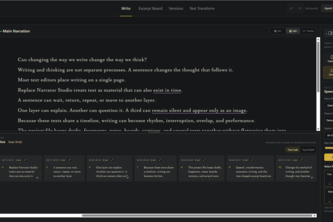
Replace Narrator Studio is a self-reported local-first visual text editor that allows writers to arrange, rearrange, layer, and perform text in time and space. It is built as a client-side single-page application using React, TypeScript, and Vite, with no backend or external database. The tool supports timeline-based editing, multiple text layers, playback systems (browser TTS or embedded audio), and non-destructive arrangements of text fragments.
What changed
The project evolved from an earlier prototype into a redesigned version during OpenAI Build Week. It expanded its timeline, navigation, layering, and playback systems, while maintaining a focus on preserving text identity through stable IDs and supporting local-first workflows.
Single most important open question
Is there any evidence of user adoption or commercial traction beyond the author’s own development and submission to a hackathon?
Note: This analysis is based entirely on the self-reported description provided by the author. No external verification, revenue data, customer names, or usage metrics are available.
What The Product Actually Is
The description states that Replace Narrator Studio is:
- A local-first visual text editor
- Designed for writing, rearranging, listening to, and performing text
- Built as a client-side single-page application using React, TypeScript, Vite
- Uses no backend or external database
- Stores data in browser LocalStorage, with export capability via JSON
- Supports stable text-fragment IDs, non-destructive editing, and timeline-based composition
It allows users to:
- Manage multiple texts in a shared Pool
- View paragraphs as movable timeline cards
- Create multiple non-destructive arrangements from the same source text
- Combine complete texts or fragments in an editing timeline
- Add independent text layers
- Move cards horizontally across cue columns
- Assign colors, sizes, opacity, positions, and speech presets to layers
- Play timelines using browser TTS or embedded audio files
- Export as TXT or Word
- Save excerpts to a spatial Excerpt Board
- Compare and restore earlier Versions
Inference: The tool appears to be designed for experimental or artistic writing environments rather than general-purpose text editing. It emphasizes structure, rhythm, and performance over linear composition.
Positioning & Claim Evolution
The author claims:
- Writing is the same as thinking.
- Changing how we write can change how we think.
- The tool should not decide what the writer should say; instead, it changes conditions in which writing happens.
- It helps writers discover structures, relationships, and meanings that may not appear in conventional editors.
The project evolved from a prototype to a more fully featured version during OpenAI Build Week. The author notes:
- The original timeline was derived from current text.
- Reordering cards could recreate the text string, lose blank-line information, invalidate selections, or break links used by search, bookmarks, and speech.
- The solution involved introducing stable-ID text fragments to preserve unchanged IDs across edits.
Claim vs Fact: These are claims made by the author about intent and philosophy. There is no evidence of external validation or user feedback on these assertions.
Target Customer & ICP
Not evidenced.
The description does not identify:
- Specific target users
- Industry verticals
- Use cases beyond personal or experimental writing
- Demographics or professional roles
Absence of Evidence: No indication who uses this tool, if anyone, or how it might be adopted commercially.
Business Model & Pricing Evidence
Not evidenced.
The description does not mention:
- Any pricing model
- Revenue streams
- Monetization strategy
- Subscription plans or licensing options
Absence of Evidence: There is no evidence of any business model or commercial structure.
Technical & Delivery Signals
The application is built with:
- Frontend stack: React, TypeScript, Vite
- Storage: Browser LocalStorage, JSON export/import
- Audio support: Web Speech API (browser TTS), HTML Audio elements for embedded files
- Text handling: Stable text-fragment IDs, copy-on-write behavior
- Cross-platform delivery: Windows standalone package with PowerShell local server
- Japanese language features: Kuroshiro and Kuromoji for phonetic transformation
Inference: The tool is designed to be self-contained and portable, supporting offline use and local-first workflows. It integrates AI tools (GPT-5.6 Thinking, Codex) during development but does not call them at runtime.
Traction & Maturity Signals
Not evidenced.
The description states:
- This was submitted to the OpenAI 2026 hackathon
- No revenue, customer, or traction data is available beyond the author’s account
- The tool remains local-first and can be distributed as a Windows standalone package
Absence of Evidence: There is no evidence of users, customers, or adoption metrics.
Competitive Context
Not evidenced.
The description does not reference:
- Competitors in the writing or text editing space
- Similar tools or platforms
- Market positioning relative to existing solutions
Absence of Evidence: No competitive landscape or market differentiation described.
Open Questions & Risks
- No commercial traction or user base: The tool is presented as a hackathon submission with no evidence of adoption.
- Limited scalability: Built for local-first use, with no backend or cloud storage — may not support collaboration or large-scale usage.
- Niche focus: Emphasizes experimental writing and performance over general-purpose text editing.
- AI dependency during development only: AI tools were used for design and implementation but are not part of the runtime experience.
- No monetization strategy: No indication of how this would generate revenue or be sold.
Inference: The tool may appeal to niche users (e.g., artists, experimental writers), but lacks commercial viability without further evidence of traction or market demand.
Questions the description leaves open
- What is the intended user base for this tool?
- Are there any existing users or pilot programs?
- How does the team plan to monetize or scale this product?
- Has the tool been tested with real-world writers or in creative contexts?
- What are the long-term technical and maintenance plans?
- Is there a roadmap beyond the current features, especially around collaboration or cloud integration?
Overall Assessment
Not evidenced.
There is no evidence of:
- Funding rounds
- Valuation
- Partnerships
- Commercial interest from investors or strategic partners
Assessment: Based on the self-reported description alone, there is insufficient evidence to support an investment or partnership decision. The tool appears experimental and non-commercial in nature, with no demonstrated traction or monetization strategy.
User Stories BotA demo video on every pull request
Get a demo video on every new feature
GitHub App that watches your pull requests and records a narrated, captioned demo.
Save time on demo prep and make informed decisions faster with a video walkthrough of every new feature.
Source
Submitted to the OpenAI 2026 hackathon on Devpost. Project home on Devpost. Back to the full gallery on Devpost.
This competitive analysis was produced by top-founders.com (opens in a new tab)
Generated by a language model from this project's public Devpost page — its tagline, the author's own write-up and any built-with tags listed there — as captured in August 2026. Short quotations are the author's words. It is an opinion on the idea as a business, not on the people behind it, and it reflects the description as published then. If the project has moved on, request a correction below. The analysis is not independent research and contains no verified traction, revenue or customer data.
An independent guide by KFG International LLC — not affiliated with, endorsed by, or connected to Devpost or OpenAI.