

Archive position — measured, not model output
0 likes on Devpost
2,263 of the 7,850 archived projects have more likes, and 5,587 share exactly 0 — so this project's #6,544 place in the like-ranked listing is a tie-break inside that group, not a ranking.
Projects (log scale)
Likes on Devpost. ▲ marks this project's group.
Show the figures
| Likes | Projects | Share of archive |
|---|---|---|
| 0 | 5,587 | 71.2% |
| 1 | 1,758 | 22.4% |
| 2 | 284 | 3.6% |
| 3–4 | 132 | 1.7% |
| 5–9 | 75 | 1.0% |
| 10+ | 14 | 0.2% |
 User Stories BotA demo video on every pull request
Get a demo video on every new feature
GitHub App that watches your pull requests and records a narrated, captioned demo.
Save time on demo prep and make informed decisions faster with a video walkthrough of every new feature.
Executive Summary
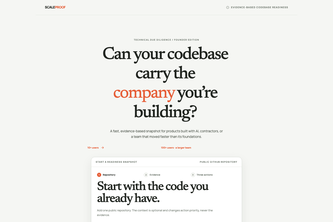
Scaleproof is a self-reported tool that evaluates public GitHub repositories for readiness to scale, claiming to assess codebase quality across seven technical dimensions (architecture, quality, security, etc.) and provide a “Fundable”, “Fixable”, or “Rewrite” recommendation. It uses static analysis and GPT-based evaluation to generate reports, with the author stating it was built using Next.js, TypeScript, and AI tools like Codex and OpenAI API. The tool is described as not performing full audits but offering rapid insights for founders assessing technical readiness.
The single most important open question is: What is the actual utility of this tool in real-world founder or engineering team decision-making? The description does not provide evidence of traction, adoption, or commercial use beyond a hackathon submission. There is no indication that the tool has been used by any external users or teams.
The analysis is based entirely on self-reported information from the author’s Devpost write-up and project metadata. No third-party verification, revenue data, customer feedback, or usage metrics are available.
What The Product Actually Is
The description states that Scaleproof evaluates public GitHub repositories for technical readiness to scale. It claims to analyze codebases across seven areas: architecture, quality, security, observability, reliability, data resilience, and AI readiness. The tool provides a recommendation of “Fundable”, “Fixable”, or “Rewrite” based on its scan.
It generates a downloadable report and checks contributor activity to provide signals for scaling. It is described as not performing full audits but offering rapid analysis.
Evidence
- The author states: “Scaleproof evaluates a GitHub repository in seven areas…”
- The author states: “It checks contributor activity and provides signals for scaling”
- The author states: “This tool offers a rapid analysis rather than a full audit”
Inference The tool is described as a static code analyzer with GPT-assisted evaluation, but no details are given about how it determines its recommendations or what constitutes the “seven areas”.
Positioning & Claim Evolution
Scaleproof positions itself as a tool for founders to quickly assess whether a codebase can support 10x growth. It is described as helping founders make decisions about technical readiness without needing deep engineering expertise.
The author claims that Scaleproof gives clear guidance on whether a codebase is “Fundable”, “Fixable”, or needs a “Rewrite”. It also recommends three actionable steps, suggesting it aims to be prescriptive in its output.
Evidence
- The tagline: “Founders, can your codebase carry 10x more users and a real engineering team?”
- The author states: “Scaleproof provides an instant evaluation of a public GitHub repository, giving a clear guidance, if the codebase is 'Fundable', 'Fixable', or needs a 'Rewrite'.”
- The author states: “It recommends three actionable steps.”
Inference The positioning implies that Scaleproof targets early-stage startups or investors who want to assess technical risk quickly. However, there is no evidence of how this tool would be used in practice beyond the hackathon submission.
Target Customer & ICP
The description states that Scaleproof is intended for founders evaluating codebases for scaling. It also implies a use case for engineering teams or investors who need rapid insights into technical readiness.
Evidence
- The author states: “Founders need quick technical insights on codebases to determine its readiness for growth.”
- The tagline implies an audience of founders and engineering teams.
Inference The target customer is likely early-stage startup founders, angel investors, or internal engineering leads who are assessing whether a codebase can support rapid scaling. No evidence of actual customers or user personas is provided.
Business Model & Pricing Evidence
There is no evidence in the description of how Scaleproof would generate revenue or what its pricing model might be. The tool appears to be a hackathon submission, and no commercialization strategy or monetization plan is described.
Evidence
- No mention of pricing, subscriptions, or monetization
- No indication of paid features or tiered access
Inference The business model remains unknown. It may be intended as a free tool for public repositories, or it could evolve into a paid SaaS offering — but there is no evidence to support either.
Technical & Delivery Signals
Scaleproof is built using Next.js and TypeScript, with AI tools like Codex and OpenAI API used in its development process. The author describes an implementation-and-review loop involving GPT, suggesting some level of quality control during development.
Evidence
- Built with: codex, eslint, github-actions, github-api, gpt-5.6, next.js, node.js, npm, openai-api, playwright, react, recharts, tailwind-css, typescript, vitest, zod
- The author states: “I used Codex in at least two distinct sessions...”
- The author states: “The primary implementation session runs the research, architecture, implementation, tests, browser QA, and documentation.”
- The author states: “A separate Codex 'reviewer' session independently reviewed the results.”
Inference The tool is built with modern web stack and AI-assisted development. However, there is no evidence of how it performs static analysis or how GPT contributes to its evaluation logic.
Traction & Maturity Signals
There is no evidence of traction, adoption, or usage beyond the hackathon submission. No customers, revenue, or user feedback are mentioned. The tool appears to be a prototype or proof-of-concept.
Evidence
- Submitted to OpenAI 2026 hackathon
- No mention of users, customers, or real-world deployment
- No data on usage frequency or impact
Inference The product is at an early stage and lacks any maturity signals. It has not been tested in production or with real users.
Competitive Context
No evidence is provided about existing tools or competitors in the space of codebase evaluation or technical readiness assessment. The author does not reference similar products or platforms.
Evidence
- No mention of competitive landscape or comparable tools
Inference It is unclear whether there are existing tools that perform similar functions, or if Scaleproof fills a gap in the market.
Open Questions & Risks
- Lack of real-world validation: The tool has only been tested in a hackathon environment with no external users.
- Unverified claims: The author makes strong claims about evaluation accuracy and actionable insights, but provides no data or evidence to support them.
- Unclear methodology: There is no explanation of how the “Fundable”, “Fixable”, or “Rewrite” decisions are made.
- AI dependency: Heavy reliance on GPT for evaluation raises concerns about consistency, bias, and reproducibility.
Evidence
- No evidence of real-world use or feedback
- No explanation of scoring logic or decision-making process
- Heavy AI involvement without clarity on how it’s applied
Questions the description leaves open
- What specific technical signals does Scaleproof look for in each of the seven areas (architecture, quality, etc.)?
- How does the tool distinguish between missing evidence and actual issues?
- Has the tool been tested with real codebases beyond the hackathon submission?
- What is the intended business model or monetization strategy?
- Are there any existing users or early adopters who have provided feedback?
- How does Scaleproof handle edge cases or complex codebases?
Overall Assessment
Not evidenced.
The description provides no information on whether Scaleproof has traction, revenue, or a viable path to monetization. It is presented as a hackathon submission with no indication of commercial viability or market demand.
Confidence Low This is a self-reported, unverified account of a prototype tool. No evidence supports its utility in real-world applications or its potential for investment or partnership.
User Stories BotA demo video on every pull request
Get a demo video on every new feature
GitHub App that watches your pull requests and records a narrated, captioned demo.
Save time on demo prep and make informed decisions faster with a video walkthrough of every new feature.
Source
Submitted to the OpenAI 2026 hackathon on Devpost. Project home on Devpost. Back to the full gallery on Devpost.
This competitive analysis was produced by top-founders.com (opens in a new tab)
Generated by a language model from this project's public Devpost page — its tagline, the author's own write-up and any built-with tags listed there — as captured in August 2026. Short quotations are the author's words. It is an opinion on the idea as a business, not on the people behind it, and it reflects the description as published then. If the project has moved on, request a correction below. The analysis is not independent research and contains no verified traction, revenue or customer data.
An independent guide by KFG International LLC — not affiliated with, endorsed by, or connected to Devpost or OpenAI.