

Archive position — measured, not model output
0 likes on Devpost
2,263 of the 7,850 archived projects have more likes, and 5,587 share exactly 0 — so this project's #4,583 place in the like-ranked listing is a tie-break inside that group, not a ranking.
Projects (log scale)
Likes on Devpost. ▲ marks this project's group.
Show the figures
| Likes | Projects | Share of archive |
|---|---|---|
| 0 | 5,587 | 71.2% |
| 1 | 1,758 | 22.4% |
| 2 | 284 | 3.6% |
| 3–4 | 132 | 1.7% |
| 5–9 | 75 | 1.0% |
| 10+ | 14 | 0.2% |
 User Stories BotA demo video on every pull request
Get a demo video on every new feature
GitHub App that watches your pull requests and records a narrated, captioned demo.
Save time on demo prep and make informed decisions faster with a video walkthrough of every new feature.
Executive Summary
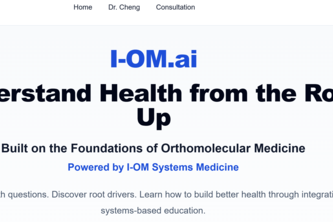
The description states that I-OM.ai is a physician-guided AI platform for Integrative Orthomolecular Systems Medicine, built with OpenAI GPT-5.6 and RAG. The author claims it aims to augment physician expertise and make decades of systems medicine knowledge globally accessible. It is described as a model-agnostic architecture designed to support future regional deployments using different LLMs while maintaining consistent medical knowledge. The platform is said to be built on a structured medical knowledge architecture including core doctrine, consultation frameworks, educational resources, and benchmark-driven evaluation.
The single most important open question is: What evidence exists that this platform has been validated in clinical or research settings, or that there are users beyond the single founder?
This analysis is based entirely on self-reported information from the project description. No independent verification of claims, traction, revenue, customers, or adoption is available.
What The Product Actually Is
The description states that I-OM.ai is:
- A physician-guided AI platform
- Powered by OpenAI GPT-5.6 via Dify and Retrieval-Augmented Generation (RAG)
- Built upon a structured medical knowledge architecture
- Designed to support medical education, clinical reasoning, consultation workflows, and continuous quality improvement
- Model-agnostic, allowing deployment with different LLMs while maintaining consistent knowledge foundation
The platform is described as combining:
- OpenAI GPT-5.6 via Dify
- Retrieval-Augmented Generation (RAG)
- GitHub-based knowledge management
- Physician-guided knowledge architecture
- Benchmark-driven continuous evaluation
Not evidenced: whether this constitutes a working product, prototype, or concept; what specific functionality it delivers beyond general AI chatbot capabilities.
Positioning & Claim Evolution
The description states that I-OM.ai is positioned as:
- An AI platform for Integrative Orthomolecular Systems Medicine
- Designed to augment physician expertise rather than replace physicians
- Aims to make decades of systems medicine knowledge globally accessible
- Not simply another AI chatbot, but a knowledge platform that continuously evolves with advances in AI
- Grounded in expert medical knowledge while remaining adaptable to future AI models
The author claims the platform combines:
- Reasoning power of modern LLMs
- Physician-guided knowledge architecture
- Continuous evolution and improvement
- Reliability, explainability, and transparency in medical responses
Inference: The positioning appears to be evolving from a general-purpose AI tool toward a specialized, expert-driven medical knowledge platform. However, the claim that it "augments physician expertise" lacks evidence of actual use or validation.
Target Customer & ICP
The description states:
- Primary users are physicians (specifically physician-scientists)
- Also targets researchers, educators, and patients
- Intended for global accessibility of systems medicine knowledge
- Designed for clinical reasoning, consultation workflows, and continuous quality improvement
Not evidenced: specific customer segments beyond the author's own role as a physician-scientist; whether there are actual users or pilot programs; what percentage of target customers have engaged with the platform.
Business Model & Pricing Evidence
The description does not state:
- Any pricing model
- Revenue streams
- Customer acquisition strategy
- Monetization approach
Not evidenced: business model, pricing structure, or commercial viability. The author only describes the technical architecture and intended use cases.
Technical & Delivery Signals
The description states that I-OM.ai is built using:
- OpenAI GPT-5.6 via Dify
- Retrieval-Augmented Generation (RAG)
- GitHub-based knowledge management
- Model-agnostic architecture
- Benchmark-driven continuous evaluation
The platform is said to be designed with:
- Reusable modules supporting medical education, clinical reasoning, consultation workflows, and quality improvement
- Ability to support future regional deployments using different LLMs
- Continuous knowledge improvement through physician review
Inference: The technical approach suggests a hybrid architecture combining LLMs with structured knowledge bases. However, no evidence is provided about actual implementation details, scalability, or delivery mechanisms beyond the stated components.
Traction & Maturity Signals
The description states:
- Built for the OpenAI 2026 hackathon
- Developed by one team member (TeamCheng Cheng)
- No mention of users, customers, or adoption
- No evidence of revenue, ARR, or funding rounds
- No mention of pilot programs or clinical validation
Not evidenced: any traction signals including user engagement, customer feedback, or market validation. The project appears to be in early development stage.
Competitive Context
The description does not state:
- Direct competitors
- Market size or growth trends
- Competitive advantages
- Differentiation from other medical AI platforms
Not evidenced: competitive landscape, positioning relative to existing solutions, or market dynamics.
Open Questions & Risks
Key risks and open questions identified:
- Single founder: Only one team member is mentioned, raising questions about execution capability and scalability
- Unverified claims: All claims are self-reported without independent verification
- No traction evidence: No users, customers, or adoption data provided
- Unclear commercial viability: No pricing model or revenue streams described
- Medical regulatory uncertainty: No mention of compliance with medical regulations or clinical validation
- Technical feasibility: No evidence that the claimed architecture has been implemented or tested in practice
Questions the description leaves open
- What specific clinical use cases have been validated or tested?
- How is the physician-guided knowledge architecture currently being maintained and updated?
- What are the actual technical implementation details beyond the stated components (Dify, RAG, GitHub)?
- Have there been any pilot programs with actual physicians or healthcare institutions?
- What is the plan for regulatory compliance in medical AI applications?
- How will the platform be monetized and scaled beyond the current hackathon prototype?
- What specific benchmarks are used for continuous evaluation of knowledge quality?
Overall Assessment
Not evidenced: investment potential, partnership opportunities, or commercial viability.
The description indicates this is a concept or early-stage prototype built for a hackathon. There is no evidence of:
- Revenue generation
- Customer adoption
- Market traction
- Commercial scalability
- Regulatory compliance
- Technical implementation beyond stated components
The author's claims about physician-guided knowledge architecture and continuous improvement lack verification. The single-founder structure raises concerns about execution capability.
This appears to be a conceptual framework for a medical AI platform rather than an operational product with demonstrated value or market demand. Any investment or partnership potential would require substantial validation of the technical implementation, clinical utility, and commercial viability beyond what is self-reported in this description.
User Stories BotA demo video on every pull request
Get a demo video on every new feature
GitHub App that watches your pull requests and records a narrated, captioned demo.
Save time on demo prep and make informed decisions faster with a video walkthrough of every new feature.
Source
Submitted to the OpenAI 2026 hackathon on Devpost. Project home on Devpost. Back to the full gallery on Devpost.
This competitive analysis was produced by top-founders.com (opens in a new tab)
Generated by a language model from this project's public Devpost page — its tagline, the author's own write-up and any built-with tags listed there — as captured in August 2026. Short quotations are the author's words. It is an opinion on the idea as a business, not on the people behind it, and it reflects the description as published then. If the project has moved on, request a correction below. The analysis is not independent research and contains no verified traction, revenue or customer data.
An independent guide by KFG International LLC — not affiliated with, endorsed by, or connected to Devpost or OpenAI.