

Archive position — measured, not model output
0 likes on Devpost
2,263 of the 7,850 archived projects have more likes, and 5,587 share exactly 0 — so this project's #4,576 place in the like-ranked listing is a tie-break inside that group, not a ranking.
Projects (log scale)
Likes on Devpost. ▲ marks this project's group.
Show the figures
| Likes | Projects | Share of archive |
|---|---|---|
| 0 | 5,587 | 71.2% |
| 1 | 1,758 | 22.4% |
| 2 | 284 | 3.6% |
| 3–4 | 132 | 1.7% |
| 5–9 | 75 | 1.0% |
| 10+ | 14 | 0.2% |
 User Stories BotA demo video on every pull request
Get a demo video on every new feature
GitHub App that watches your pull requests and records a narrated, captioned demo.
Save time on demo prep and make informed decisions faster with a video walkthrough of every new feature.
Executive Summary
What the company appears to be
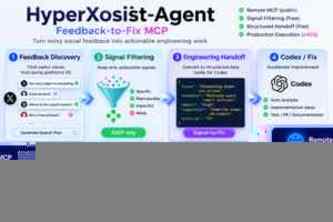
HyperXosist-Agent is a self-reported Remote MCP workflow that filters noisy product feedback and converts actionable signals into structured engineering handoffs for Codex. It positions itself as a tool for AI agents and developers to process public feedback, reduce noise, and generate structured output for implementation.
What changed
The project description indicates this is a hackathon submission (Devpost entry for OpenAI 2026) with a focus on building a prototype of an AI-powered feedback-to-fix pipeline using MCP, Codex, and GPT-5.6. It includes a public demo and documentation but no evidence of revenue, customers or adoption.
Single most important open question
Is there any evidence that the system has been used in production or by real users beyond the synthetic demo?
What The Product Actually Is
The description states that HyperXosist-Agent is a Remote MCP workflow designed to:
- Plan targeted product-feedback research
- Generate noise-reduced official X search URLs
- Filter weak or irrelevant signals
- Preserve high-value feedback as KEEP-only evidence
- Produce structured handoffs for downstream coding workflows
- Separate free planning from paid production execution through x402
It uses GPT-5.6, Codex, and MCP (Model Context Protocol) to enable these functions.
The system is described as a publicly available Remote MCP service that supports:
- Multilingual search planning
- Noise-reduced X query generation
- Signal filtering
- Structured Signal-to-Fix handoff
It also integrates with x402, USDC on Base, and the official MCP Registry.
Inference The product appears to be a proof-of-concept or prototype built for a hackathon, not yet a commercial offering. It is described as a tool that bridges feedback discovery and engineering implementation via AI agents.
Positioning & Claim Evolution
The author claims that HyperXosist-Agent addresses the gap between feedback collection and actionable engineering work. It positions itself as a solution to the problem of fragmented, noisy public feedback on platforms like X (formerly Twitter).
Key claims:
- “Product feedback on social platforms is valuable, but it is fragmented, repetitive, and noisy.”
- “AI agents can search for it, yet the results rarely arrive in a form that developers can immediately use to improve a product.”
- “HyperXosist-Agent was built to close that gap.”
It also states:
- “The goal is not merely to search X. The goal is to convert public signals into a repeatable path from feedback discovery to code change.”
- “Teams often collect feedback but fail to convert it into engineering action.”
Inference The positioning suggests an intent to build a platform that helps developers and product teams operationalize feedback, though there is no evidence of traction or adoption beyond the demo.
Target Customer & ICP
The description states that HyperXosist-Agent is designed for:
- Independent developers
- AI-agent builders
- Product teams
- Support teams
- Researchers
- Developers using Codex for implementation
It also mentions:
- “The system is designed for independent developers, AI-agent builders, product teams, support teams, researchers, and developers using Codex for implementation.”
Inference The target audience includes both technical users (developers, AI agents) and product-oriented users (teams, researchers). However, no evidence of actual customer segmentation or user data is provided.
Business Model & Pricing Evidence
The description states:
- Free planning tools remain separate from automated production execution.
- Production execution is protected by an x402 payment boundary.
- Uses USDC on Base for settlement.
- Paid API execution is separated from free tools.
It also mentions:
- “Separate free planning from paid production execution through x402.”
- “x402-paid production execution using USDC on Base.”
Inference The business model appears to be a freemium or usage-based pricing model, where basic tools are free and paid execution is gated behind x402. However, no pricing details, revenue streams, or monetization data are provided.
Technical & Delivery Signals
The system is built with:
- base
- cloudflare-workers
- github
- gpt-5.6
- model-context-protocol (mcp)
- node.js
- openai-codex
- typescript
- usdc
- x402
It uses:
- Remote MCP for planning and filtering
- Codex for implementation
- GPT-5.6 for architecture and tool development
- x402 for payment boundaries
The architecture includes:
- GitHub Pages (human-facing demo)
- Remote MCP (free tools)
- Paid API (automated execution)
- x402 (payment boundary)
- Base / USDC (settlement)
It is described as a Streamable HTTP MCP, with support for CLI, npm, and stdio interfaces.
Inference The technical stack suggests a modern, developer-focused architecture using open-source tools and AI models. However, no evidence of scalability, reliability, or production deployment beyond the demo.
Traction & Maturity Signals
The description states:
- “This submission uses synthetic feedback for demonstration.”
- “The public GitHub Pages site and Remote MCP endpoint are real and reproducible.”
- “The demo does not directly scrape X.”
It also mentions:
- “Judges can test the project without rebuilding it.”
- “Planning, filtering, and handoff are free. Production execution and external data collection are separated behind the x402 paid API.”
Inference There is no evidence of real-world usage or adoption beyond the demo. The system is described as a prototype for a hackathon.
Competitive Context
The description does not mention any competitors or direct market positioning against existing tools.
Inference No competitive analysis or differentiation from other feedback processing or AI agent platforms is provided.
Open Questions & Risks
- No evidence of real-world usage or adoption
- Prototype vs. production-ready system
- No revenue, customer, or traction data
- Unverified claims about functionality and performance
- Limited team size (1 person)
- No mention of scalability, reliability, or security
Inference The project is likely in early-stage development and lacks commercial viability indicators.
Questions the description leaves open
- What is the actual usage rate of the free vs. paid components?
- Are there any real users or teams currently using this system?
- How does the x402 integration work in practice? Is it secure and scalable?
- Has the system been tested with real feedback data, not just synthetic?
- What are the long-term plans for monetization beyond the current demo?
- How is the system maintained or updated given the single-team size?
Overall Assessment
Not evidenced.
The description provides no evidence of revenue, customers, traction, or commercial viability. It is a self-reported hackathon submission with a prototype architecture and synthetic demo.
Confidence: Low.
This project appears to be a proof-of-concept, not a product in development or deployment. There is no indication that it has moved beyond the experimental stage or has any commercial traction.
User Stories BotA demo video on every pull request
Get a demo video on every new feature
GitHub App that watches your pull requests and records a narrated, captioned demo.
Save time on demo prep and make informed decisions faster with a video walkthrough of every new feature.
Source
Submitted to the OpenAI 2026 hackathon on Devpost. Project home on Devpost. Back to the full gallery on Devpost.
This competitive analysis was produced by top-founders.com (opens in a new tab)
Generated by a language model from this project's public Devpost page — its tagline, the author's own write-up and any built-with tags listed there — as captured in August 2026. Short quotations are the author's words. It is an opinion on the idea as a business, not on the people behind it, and it reflects the description as published then. If the project has moved on, request a correction below. The analysis is not independent research and contains no verified traction, revenue or customer data.
An independent guide by KFG International LLC — not affiliated with, endorsed by, or connected to Devpost or OpenAI.