

Archive position — measured, not model output
0 likes on Devpost
2,263 of the 7,850 archived projects have more likes, and 5,587 share exactly 0 — so this project's #4,577 place in the like-ranked listing is a tie-break inside that group, not a ranking.
Projects (log scale)
Likes on Devpost. ▲ marks this project's group.
Show the figures
| Likes | Projects | Share of archive |
|---|---|---|
| 0 | 5,587 | 71.2% |
| 1 | 1,758 | 22.4% |
| 2 | 284 | 3.6% |
| 3–4 | 132 | 1.7% |
| 5–9 | 75 | 1.0% |
| 10+ | 14 | 0.2% |
 User Stories BotA demo video on every pull request
Get a demo video on every new feature
GitHub App that watches your pull requests and records a narrated, captioned demo.
Save time on demo prep and make informed decisions faster with a video walkthrough of every new feature.
Executive Summary
What the company appears to be
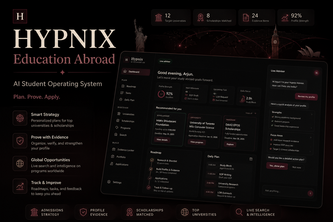
Hypnix Education Abroad is a self-described AI-powered student operating system for global education and admissions planning. The description states it aims to connect fragmented parts of a student's educational journey — from profile creation to roadmap generation — using live research, evidence management, and persistent context.
What changed
The project was submitted as part of the OpenAI 2026 hackathon. It is described as an active product in development with a functioning live-search path and production deployment, but not yet complete.
Single most important open question
Is there sufficient evidence that this system can meaningfully integrate real-world educational data into actionable pathways for students, or does it remain a conceptual framework?
This analysis is based entirely on the self-reported project description provided by the author. No independent verification, traction, revenue, or customer data exists beyond what was stated.
What The Product Actually Is
The description states that Hypnix Education Abroad is:
- A full-stack web application built with Next.js, React, TypeScript, Tailwind CSS, Supabase, PostgreSQL, and various AI tools including Anthropic, SerpAPI, OpenAI Codex, and GPT-5.6-assisted engineering.
- An AI student operating system designed to manage the entire educational journey from onboarding to progress tracking.
- A platform that performs live searches using SerpAPI, displays confidence scores, relevance explanations, and unresolved facts.
- Capable of providing profile-aware planning and transforming advice into action through roadmaps and daily tasks.
It is described as a persistent system that remembers students over time but ensures current requests take precedence over saved context.
This is a self-reported product description; no independent validation or demonstration of functionality outside the author’s account exists.
Positioning & Claim Evolution
The description states:
- Hypnix positions itself as an AI student operating system, distinct from generic chatbots.
- It claims to offer "a path that remembers them" rather than just answers.
- The product differentiates itself by managing the journey after an answer is given, not merely answering questions.
- It emphasizes trust through architecture — specifically, how context and verification are handled.
- The author frames it as a tool for students who have ambition but lack direction due to fragmented information sources.
The claim evolution appears to move from a general idea ("students need a path that remembers them") to a specific technical implementation ("live search with source grounding").
These are claims made by the author; no external corroboration or market positioning data is available.
Target Customer & ICP
The description states:
- Hypnix targets students planning for international education and admissions.
- It is built for students who have ambition, grades, achievements, but lack a clear path forward.
- The system supports profile-aware planning based on academic direction, curriculum, geography, budget, etc.
- The target includes students aged 16+ (as noted by the founder's age), particularly those navigating complex global education systems.
There is no explicit segmentation beyond student type or age group; no mention of specific demographics, geographic regions, or educational levels.
This is a self-described customer base; no evidence of actual users or market validation.
Business Model & Pricing Evidence
The description states:
- Hypnix is described as an AI-powered platform for education planning.
- It includes systems for subscriptions, advisor-style conversation, and community features.
- No pricing model, monetization strategy, or revenue streams are mentioned.
No evidence of business model or pricing structure exists in the provided description.
Technical & Delivery Signals
The description states:
- Built with Next.js, React, TypeScript, Tailwind CSS, Supabase, PostgreSQL, Anthropic, SerpAPI, OpenAI Codex, GPT-5.6-assisted engineering.
- Contains interconnected systems for authentication, student profiles, evidence, opportunity intelligence, applications, essays, roadmaps, daily execution, community, subscriptions, and advisor-style conversation.
- The live-search path is functional in production.
- Engineering work focused on server-side architecture, intent classification, source normalization, safe handling of URLs/snippets, current-request precedence, stale-context isolation, and automated regression testing.
- GPT-5.6 was used to shape product logic itself.
These are technical claims made by the author; no independent verification or performance metrics exist.
Traction & Maturity Signals
The description states:
- Hypnix is described as an active product in development.
- The submitted production build completes its core live-search path.
- It has a publicly deployed production build, accessible repository, and operational Supabase instance.
- The system includes 419 automated tests that passed, TypeScript type-checking, linting, and successful builds.
- Some modules are incomplete, such as deeper official-page extraction, roadmap milestone conversion, and daily execution bundles.
No evidence of user adoption, revenue, or customer traction beyond the author’s own account.
Competitive Context
The description states:
- The product is positioned against fragmented tools like chatbots, directories, spreadsheets.
- It claims to be a persistent system that connects disparate parts of the student journey.
- No direct competitors are named.
No competitive landscape or market positioning data is provided.
Open Questions & Risks
The description states:
- The greatest danger in an AI product is not always an obvious error, but a fluent answer built on wrong context.
- Risk of contamination from old information overriding new requests.
- Risk of blind trust in live search results without verification.
- Risk of disconnected dashboards rather than integrated operating system.
- Engineering under time pressure led to issues like stale context, authentication failures, and deployment recovery.
These are identified risks by the author; no external validation or historical performance data available.
Questions the description leaves open
- What specific educational outcomes does Hypnix aim to achieve for students?
- How is the system validated to ensure accuracy of live-search results?
- Are there any partnerships with universities, scholarship organizations, or educational institutions?
- How will the platform scale beyond a single founder and initial development team?
- What mechanisms exist to prevent misuse or misinterpretation of AI-generated content?
- What are the key metrics used to evaluate success in student outcomes?
- Is there a plan for integrating feedback loops from users into system improvements?
These questions are intended to probe deeper into the unverified claims and assumptions made by the author.
Overall Assessment
The description states:
- Hypnix is described as an active product in development with a functioning live-search path.
- It has a publicly deployed build, automated tests, and a working codebase.
- The system is still incomplete, with remaining work on roadmap milestones, execution bundles, and progress recalibration.
No evidence of traction, revenue, or customer validation exists. The project appears to be in early development stage, likely post-hackathon, with no clear path to monetization or market adoption.
Assessment Hypnix Education Abroad is a self-described AI-powered student operating system that shows early signs of technical capability and conceptual clarity. However, it lacks evidence of traction, revenue, customers, or validated market demand. The product is described as incomplete and in active development, with no indication of commercial viability or scalability beyond its initial scope.
This assessment is based solely on the self-reported description provided by the author.
User Stories BotA demo video on every pull request
Get a demo video on every new feature
GitHub App that watches your pull requests and records a narrated, captioned demo.
Save time on demo prep and make informed decisions faster with a video walkthrough of every new feature.
Source
Submitted to the OpenAI 2026 hackathon on Devpost. Project home on Devpost. Back to the full gallery on Devpost.
This competitive analysis was produced by top-founders.com (opens in a new tab)
Generated by a language model from this project's public Devpost page — its tagline, the author's own write-up and any built-with tags listed there — as captured in August 2026. Short quotations are the author's words. It is an opinion on the idea as a business, not on the people behind it, and it reflects the description as published then. If the project has moved on, request a correction below. The analysis is not independent research and contains no verified traction, revenue or customer data.
An independent guide by KFG International LLC — not affiliated with, endorsed by, or connected to Devpost or OpenAI.