

Archive position — measured, not model output
1 like on Devpost
505 of the 7,850 archived projects have more likes, and 1,758 share exactly 1 — so this project's #1,209 place in the like-ranked listing is a tie-break inside that group, not a ranking.
Projects (log scale)
Likes on Devpost. ▲ marks this project's group.
Show the figures
| Likes | Projects | Share of archive |
|---|---|---|
| 0 | 5,587 | 71.2% |
| 1 | 1,758 | 22.4% |
| 2 | 284 | 3.6% |
| 3–4 | 132 | 1.7% |
| 5–9 | 75 | 1.0% |
| 10+ | 14 | 0.2% |
 User Stories BotA demo video on every pull request
Get a demo video on every new feature
GitHub App that watches your pull requests and records a narrated, captioned demo.
Save time on demo prep and make informed decisions faster with a video walkthrough of every new feature.
Executive Summary
What the company appears to be
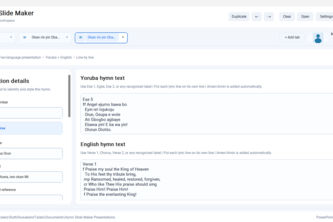
Hymn Slide Maker is a self-reported Windows desktop application built by one developer (Lincoln-T Talabi) to automate the creation of PowerPoint presentations for church hymns and songs, particularly in monolingual or bilingual formats.
What changed
The project was submitted as part of the OpenAI 2026 hackathon. It is described as an actively developed tool that supports custom language profiles, dynamic layout adjustments, and multilingual slide generation.
Single most important open question
Is there any evidence of actual usage or adoption by churches or users beyond the developer’s own testing?
What The Product Actually Is
The description states that Hymn Slide Maker is a Windows desktop application built using Python and customtkinter. It generates PowerPoint presentations from user-entered hymn or song data, including support for:
- Monolingual and bilingual layouts
- Line-by-line and side-by-side presentation formats
- Built-in language profiles (English, Yoruba, Hausa, French, Spanish)
- Custom language profiles
- Dynamic font sizing
- Continuation slides
- Undo/redo functionality
It uses python-pptx for PowerPoint generation and OpenAI Codex for development assistance.
The app is packaged as a Windows executable using PyInstaller, and includes an automated regression suite with over 160 tests, supplemented by manual testing.
Inference The product appears to be a niche tool targeting churches or religious organizations needing multilingual hymn presentations. It is not described as a SaaS offering or cloud-hosted solution.
Positioning & Claim Evolution
The author claims that Hymn Slide Maker was created to speed up and organize the process of preparing PowerPoint slides for church hymns and worship songs, especially when using two languages.
It positions itself as a tool that helps churches spend less time manually formatting slides. It also emphasizes:
- Support for multiple presentation languages
- Customizable language profiles
- Smart lyric layouts
- Church-ready controls
The author does not describe any marketing or branding efforts beyond the hackathon submission.
Inference The positioning is very narrow — focused on a specific use case (church presentations) and a specific audience (individuals or small teams within churches). There is no indication of broader commercial intent or market expansion plans.
Target Customer & ICP
The description states that Hymn Slide Maker is intended for churches preparing hymn or song PowerPoints, particularly those using bilingual content. It supports both monolingual and bilingual presentations.
It also mentions a "user-created presentation-language profile" feature, suggesting customization for specific needs — possibly implying a need for tailored workflows in different religious contexts.
There is no mention of other potential users (e.g., schools, choirs, or worship leaders outside churches).
Inference The ICP appears to be churches or religious organizations, with a focus on small teams or individuals preparing multilingual hymn presentations. No evidence suggests targeting larger institutions or commercial entities.
Business Model & Pricing Evidence
The description does not mention any pricing, licensing, or monetization strategy.
It states that the app is not a SaaS product, and that it is built as a desktop application with no indication of subscription or pay-per-use models.
There is no evidence of revenue streams, customer acquisition costs, or monetization plans beyond the developer’s own use case.
Inference The business model is not evident. It may be a personal project or prototype without commercial intent at this stage.
Technical & Delivery Signals
The app is built using:
- Python
- CustomTkinter for UI
- python-pptx for PowerPoint generation
- PyInstaller for packaging
- OpenAI Codex for development assistance
It includes an automated test suite with over 160 tests, and relies on manual testing for visual and packaged-app behavior.
The app is designed to be a Windows executable, though it is noted that the executable is unsigned, which may cause Windows security warnings.
Inference The technical stack suggests a lightweight, desktop-focused tool built by one developer. It is not described as scalable or cloud-based, nor does it indicate integration with other platforms or APIs.
Traction & Maturity Signals
The description states that the project is actively developed, and includes:
- Over 160 automated tests
- Manual testing for visual and packaged behavior
- A first-run setup process
- Support for compatibility with earlier versions (though some workflows may require additional testing)
There is no evidence of user adoption, customer feedback, or real-world usage beyond the developer’s own testing.
Inference The project shows signs of active development and testing but lacks any traction or adoption data. It remains a prototype or personal tool.
Competitive Context
The description does not mention any competitors or similar tools in the market.
It is not clear whether there are existing tools for generating church hymn presentations, nor whether Hymn Slide Maker fills a gap in the market.
Inference No competitive landscape is described. It is unclear if this is an original idea or one that already exists in some form.
Open Questions & Risks
- No evidence of traction or adoption: The tool is described as self-developed and not yet used by others.
- Single-person development team: Only one developer (Lincoln-T Talabi) is involved, which may limit scalability or long-term maintenance.
- Limited commercial intent: No pricing, monetization, or customer acquisition strategy is evident.
- Windows-only executable: The app is only available for Windows and is unsigned, which could limit distribution.
- No third-party integrations or APIs: It does not appear to connect with external systems or services.
Inference The project is in a very early stage of development and lacks commercial viability or traction. It may be a prototype or personal tool rather than a scalable product.
Questions the description leaves open
- What is the actual user base for this tool? Has it been used by churches or religious organizations?
- Are there any plans to monetize or scale the product beyond its current form?
- How does the developer intend to support compatibility with future versions of PowerPoint or other platforms?
- Is there a plan to expand beyond the current set of supported languages or features?
- What are the long-term maintenance and support plans for this tool?
Overall Assessment
Not evidenced.
There is no evidence of revenue, customers, or traction to assess investment potential or partnership viability.
The project is described as a self-developed prototype, built by one person, with no indication of commercial intent or market validation.
It appears to be an early-stage tool with limited evidence of adoption or scalability.
Confidence Low. The description provides no data on usage, revenue, or customer feedback — only the author’s own account of development and features.
User Stories BotA demo video on every pull request
Get a demo video on every new feature
GitHub App that watches your pull requests and records a narrated, captioned demo.
Save time on demo prep and make informed decisions faster with a video walkthrough of every new feature.
Source
Submitted to the OpenAI 2026 hackathon on Devpost. Project home on Devpost. Back to the full gallery on Devpost.
This competitive analysis was produced by top-founders.com (opens in a new tab)
Generated by a language model from this project's public Devpost page — its tagline, the author's own write-up and any built-with tags listed there — as captured in August 2026. Short quotations are the author's words. It is an opinion on the idea as a business, not on the people behind it, and it reflects the description as published then. If the project has moved on, request a correction below. The analysis is not independent research and contains no verified traction, revenue or customer data.
An independent guide by KFG International LLC — not affiliated with, endorsed by, or connected to Devpost or OpenAI.