

Archive position — measured, not model output
0 likes on Devpost
2,263 of the 7,850 archived projects have more likes, and 5,587 share exactly 0 — so this project's #4,529 place in the like-ranked listing is a tie-break inside that group, not a ranking.
Projects (log scale)
Likes on Devpost. ▲ marks this project's group.
Show the figures
| Likes | Projects | Share of archive |
|---|---|---|
| 0 | 5,587 | 71.2% |
| 1 | 1,758 | 22.4% |
| 2 | 284 | 3.6% |
| 3–4 | 132 | 1.7% |
| 5–9 | 75 | 1.0% |
| 10+ | 14 | 0.2% |
 User Stories BotA demo video on every pull request
Get a demo video on every new feature
GitHub App that watches your pull requests and records a narrated, captioned demo.
Save time on demo prep and make informed decisions faster with a video walkthrough of every new feature.
Executive Summary
The company appears to be a solo developer project — a personal hackathon submission — that self-reports an AI-powered devotional generator for spiritual use. The author states the tool creates personalized devotionals using OpenAI and other technologies, but there is no evidence of revenue, customers, or product-market fit beyond the author's own claims.
What changed
The project was submitted to a hackathon, suggesting it was built as a prototype or proof-of-concept rather than a commercial offering.
Single most important open question
Is this a one-off personal project or an early-stage product with potential for growth and user adoption?
What The Product Actually Is
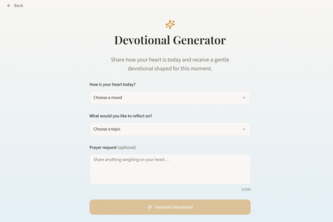
The description states that HolyWordSpace is an AI devotional generator. It produces personalized devotionals based on user mood, topic, and prayer request. Each devotional includes:
- A Bible verse
- A short reflection
- A prayer
- An action step
It is built with React, TypeScript, TailwindCSS, Supabase, OpenAI, Vite, Node.js, and Lovable’s AI-assisted development tools.
Inference The product is a web-based application that uses AI to generate spiritual content. It is not evidenced to be a commercial product or service in use by users beyond the author.
Positioning & Claim Evolution
The project self-reports its positioning as:
- A peaceful AI companion
- A tool for connecting with scripture, reflection, and prayer
- A calm, simple, and meaningful spiritual experience
It is described as a “digital sanctuary” that blends faith and technology.
Inference The author positions the product as a spiritually uplifting, low-stress alternative to traditional devotional tools. It is not evidenced to have evolved from an earlier version or to be part of a broader platform.
Target Customer & ICP
The description states that the tool is for people seeking a peaceful place to meet with God and connect with scripture, reflection, and prayer.
It does not identify specific customer segments, personas, or user types beyond “people” who want spiritual connection.
Inference The target audience appears to be individuals interested in personal faith practices, but there is no evidence of segmentation or defined ICP.
Business Model & Pricing Evidence
There is no evidence of a business model or pricing strategy. The description does not mention monetization, subscriptions, or any revenue-generating mechanism.
Inference No commercial model is evident from the self-reported description.
Technical & Delivery Signals
The project is built with:
- React
- TypeScript
- TailwindCSS
- Supabase
- OpenAI
- Vite
- Node.js
- Lovable’s AI-assisted development tools
It uses OpenAI for scripture selection and devotional generation, Supabase for authentication and storage, and Vite for performance.
Inference The tech stack suggests a modern, lightweight web application. It is not evidenced to be production-ready or scalable beyond the author's own use.
Traction & Maturity Signals
The project was submitted as a hackathon entry (OpenAI 2026). No evidence of users, customers, or adoption is provided.
The author states that the tool is “fully functional” and includes features like:
- Daily devotional reminders
- User accounts
- Saved devotionals
- AI Reflection Coach
- AI Prayer Assistant
- AI Study Coach
However, these are described as future plans, not current features.
Inference No traction or maturity signals beyond a prototype or MVP. The project is not evidenced to have launched or gained users.
Competitive Context
There is no evidence of competitors or market analysis in the description.
Inference No competitive landscape is evident from the self-reported information.
Open Questions & Risks
- Solo developer project: No team, no external validation, and no evidence of traction.
- No revenue or monetization: The product is not evidenced to generate income.
- Unproven market demand: No evidence of customer interest or adoption beyond the author’s own use.
- Hackathon prototype: Likely a proof-of-concept, not a commercial product.
- AI content generation risks: The tool uses AI to generate spiritual content, which may raise ethical or theological concerns if not carefully managed.
Questions the description leaves open
- What is the intended user acquisition strategy?
- Are there any early users or feedback from people who have tried the tool?
- How do you plan to monetize this product?
- What are your plans for scaling beyond a single developer?
- Have you considered potential ethical concerns around AI-generated spiritual content?
Overall Assessment
Not evidenced.
The project is described as a solo developer hackathon submission with no evidence of traction, revenue, or customer adoption. It is not evident whether it has evolved into a product with commercial viability or user demand.
Confidence Low. The description is self-reported and unverified, and lacks any data on users, customers, or business metrics.
User Stories BotA demo video on every pull request
Get a demo video on every new feature
GitHub App that watches your pull requests and records a narrated, captioned demo.
Save time on demo prep and make informed decisions faster with a video walkthrough of every new feature.
Source
Submitted to the OpenAI 2026 hackathon on Devpost. Project home on Devpost. Back to the full gallery on Devpost.
This competitive analysis was produced by top-founders.com (opens in a new tab)
Generated by a language model from this project's public Devpost page — its tagline, the author's own write-up and any built-with tags listed there — as captured in August 2026. Short quotations are the author's words. It is an opinion on the idea as a business, not on the people behind it, and it reflects the description as published then. If the project has moved on, request a correction below. The analysis is not independent research and contains no verified traction, revenue or customer data.
An independent guide by KFG International LLC — not affiliated with, endorsed by, or connected to Devpost or OpenAI.