

Archive position — measured, not model output
0 likes on Devpost
2,263 of the 7,850 archived projects have more likes, and 5,587 share exactly 0 — so this project's #4,530 place in the like-ranked listing is a tie-break inside that group, not a ranking.
Projects (log scale)
Likes on Devpost. ▲ marks this project's group.
Show the figures
| Likes | Projects | Share of archive |
|---|---|---|
| 0 | 5,587 | 71.2% |
| 1 | 1,758 | 22.4% |
| 2 | 284 | 3.6% |
| 3–4 | 132 | 1.7% |
| 5–9 | 75 | 1.0% |
| 10+ | 14 | 0.2% |
 User Stories BotA demo video on every pull request
Get a demo video on every new feature
GitHub App that watches your pull requests and records a narrated, captioned demo.
Save time on demo prep and make informed decisions faster with a video walkthrough of every new feature.
Executive Summary
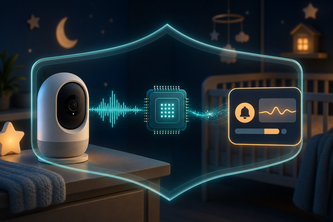
The project described by the caller is Home AI Assist: Private Baby Cry Monitor, a self-contained smart-home system that uses local AI inference to detect baby crying and send notifications via Home Assistant. The author states this is a privacy-first solution that avoids cloud processing of nursery audio or video, relying instead on local models (YAMNet, Gemma 4) and RTSP camera streams.
The system is built for a single developer using open-source tools and frameworks like ffmpeg, go2rtc, LiteRT, Ollama, and Home Assistant. It includes a sliding window decision engine to avoid false positives, daytime vision confirmation, and a minimal API boundary between local inference and Home Assistant automation.
What changed: The project was developed during the OpenAI Build Week hackathon, where it was refactored from an existing prototype into a safer, more testable form using OpenAI Codex and GPT-5.6. It includes unit tests, documentation, and a simulator to demonstrate functionality without requiring real hardware or nursery data.
Key open question: Is this system deployable as a practical smart-home feature, or is it limited to demonstration purposes? The description does not provide evidence of actual deployment, user feedback, or performance in real-world conditions beyond the demo.
What The Product Actually Is
The description states that Home AI Assist is a local baby cry detection system designed for use with existing smart home infrastructure. It listens to local camera streams, performs audio and visual analysis using local AI models (YAMNet for sound, Gemma 4 for vision), and sends minimal event data to Home Assistant when a potential cry is detected.
- The system uses RTSP to access camera feeds.
- Audio processing is handled by FFmpeg, converting streams into PCM windows.
- Local inference runs on YAMNet (for audio) and Gemma 4 (for vision).
- A sliding window decision rule requires at least 2 positive windows among the most recent 4, above a configurable threshold.
- During daytime, it uses a local Gemma 4 model to confirm baby presence before alerting.
- Nighttime behavior relies solely on audio evidence.
- The only data sent to Home Assistant is a numeric confidence score (e.g.,
{"score": 0.812}). - It does not upload or retain raw nursery media.
This is a local-first smart-home automation tool, not a medical device or substitute for adult supervision.
Positioning & Claim Evolution
The author positions Home AI Assist as a privacy-preserving baby monitor that avoids sending sensitive data to the cloud. The core claim is that it enables reliable alerts while keeping all processing local, including both audio and visual components.
- The system is described as “a convenience notification system”, not a medical device.
- It emphasizes local-first design and privacy by construction.
- The author notes that the project was refactored during OpenAI Build Week to improve safety, testability, and documentation using AI tools like Codex and GPT-5.6.
There is no evidence of prior commercial positioning or branding beyond this self-reported write-up. The evolution appears to be from a prototype to a more polished, documented, and demo-ready version.
Target Customer & ICP
The description states that the system is intended for parents using smart home ecosystems, particularly those who want to avoid cloud-based baby monitoring solutions.
- It integrates with Home Assistant, a popular open-source home automation platform.
- The target user likely has:
- A local camera setup (RTSP-compatible).
- An existing Home Assistant installation.
- A desire for privacy-preserving smart-home features.
No explicit customer segmentation or persona details are provided. The ICP is inferred from the technology stack and use case, but no evidence of market research or user interviews exists in the description.
Business Model & Pricing Evidence
The description does not contain any information about pricing, monetization, or business model. It is presented as a developer-built prototype submitted to a hackathon.
- No revenue streams are described.
- No paid features or tiers are mentioned.
- The system appears to be built for personal or hobbyist use, with no indication of commercial intent beyond the demo.
There is no evidence of any business model or pricing structure.
Technical & Delivery Signals
The project uses several open-source tools and frameworks:
- Camera transport: go2rtc (RTSP)
- Audio processing: FFmpeg
- Local inference: YAMNet, Gemma 4 via LiteRT and Ollama
- Home Assistant integration: REST API Events
- Development tools: OpenAI Codex, GPT-5.6
Key technical signals:
- The system is designed to be modular, separating stream handling, inference, decision policy, and Home Assistant transport.
- It includes a zero-network simulator for testing without hardware.
- A decision engine is deterministic and testable.
- It supports unit tests (14) covering various behaviors.
- The architecture allows for future extensibility, such as additional camera adapters or sensor health monitoring.
There is no evidence of production deployment, scalability, or performance metrics beyond the demo.
Traction & Maturity Signals
The description does not include any traction data, customer feedback, or adoption metrics. It is presented as a hackathon submission with limited real-world use.
- The system has:
- Produced real local alerts.
- Received HTTP 200 responses from Home Assistant.
- Passed 14 automated tests.
- Included a deterministic confirmed-cry demo with score
0.812andnetwork_calls=0.
However, there is no evidence of:
- Real-world deployment or usage.
- Customer base or feedback.
- Performance in actual nursery environments.
- Metrics on accuracy, false positive rates, or system reliability.
Competitive Context
The description does not provide any information about competitors or market positioning. It is unclear whether similar products exist in the market or how this solution compares to them.
- No mention of existing baby monitors (cloud-based or local).
- No reference to AI-powered home automation tools.
- The author only describes their own approach, without context of alternatives.
There is no evidence of competitive landscape analysis.
Open Questions & Risks
Several risks and open questions are evident from the description:
- No real-world testing or deployment: The system has not been tested in actual homes or under real conditions.
- Limited validation: While it passes unit tests, there is no evidence of field validation or performance data.
- Single developer team: Only one person built the project, which raises questions about scalability and long-term support.
- Demo-only architecture: The system includes a simulator but lacks evidence of production-ready deployment.
- Privacy assumptions: The system assumes local processing is sufficient, but no verification or audit of privacy claims exists.
- No commercial viability: No pricing, monetization, or business model is described.
Questions the description leaves open
- How was the accuracy of the YAMNet and Gemma 4 models validated in real-world conditions?
- What are the false positive and false negative rates for this system in practice?
- Has the system been tested with multiple camera types or network setups?
- Are there any known limitations or edge cases that could cause missed alerts or false alarms?
- What is the expected battery life or power consumption of the local inference components?
- How does the system handle situations where the camera stream is interrupted or degraded?
- Is there a plan to support additional camera protocols beyond RTSP?
- What are the long-term maintenance and update strategies for this project?
Overall Assessment
The description presents Home AI Assist as a proof-of-concept prototype built during a hackathon, not a commercial product or scalable solution.
- It is not evidenced to have traction, revenue, customers, or real-world deployment.
- The system is technically sound for demonstration purposes but lacks evidence of maturity or scalability.
- There is no indication of a business model, pricing strategy, or commercial intent beyond the demo.
- The project shows promise in terms of privacy and modularity but is not ready for investment or partnership consideration without further development and validation.
Assessment: Not ready for investment or partnership. This is a demo-grade prototype, not a product with demonstrated market fit or commercial viability.
User Stories BotA demo video on every pull request
Get a demo video on every new feature
GitHub App that watches your pull requests and records a narrated, captioned demo.
Save time on demo prep and make informed decisions faster with a video walkthrough of every new feature.
Source
Submitted to the OpenAI 2026 hackathon on Devpost. Project home on Devpost. Back to the full gallery on Devpost.
This competitive analysis was produced by top-founders.com (opens in a new tab)
Generated by a language model from this project's public Devpost page — its tagline, the author's own write-up and any built-with tags listed there — as captured in August 2026. Short quotations are the author's words. It is an opinion on the idea as a business, not on the people behind it, and it reflects the description as published then. If the project has moved on, request a correction below. The analysis is not independent research and contains no verified traction, revenue or customer data.
An independent guide by KFG International LLC — not affiliated with, endorsed by, or connected to Devpost or OpenAI.