

Archive position — measured, not model output
0 likes on Devpost
2,263 of the 7,850 archived projects have more likes, and 5,587 share exactly 0 — so this project's #4,528 place in the like-ranked listing is a tie-break inside that group, not a ranking.
Projects (log scale)
Likes on Devpost. ▲ marks this project's group.
Show the figures
| Likes | Projects | Share of archive |
|---|---|---|
| 0 | 5,587 | 71.2% |
| 1 | 1,758 | 22.4% |
| 2 | 284 | 3.6% |
| 3–4 | 132 | 1.7% |
| 5–9 | 75 | 1.0% |
| 10+ | 14 | 0.2% |
 User Stories BotA demo video on every pull request
Get a demo video on every new feature
GitHub App that watches your pull requests and records a narrated, captioned demo.
Save time on demo prep and make informed decisions faster with a video walkthrough of every new feature.
Executive Summary
What the company appears to be
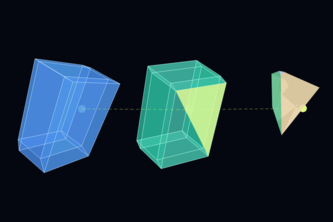
Holotope.js is a self-reported open-source TypeScript framework for constructing, observing, interacting with, and simulating N-dimensional systems in the browser. It is described as a toolkit for exploring higher-dimensional geometry, with an emphasis on maintaining mathematical accountability and traceability from higher-dimensional source models to lower-dimensional representations.
What changed
The project began as a personal curiosity about how higher-dimensional structures can be made intuitive through three-dimensional representations. The author reports building it over a short development period (during Build Week), using AI tools like Codex and GPT-5.6 Sol, and integrating core mathematical and physics components into a monorepo architecture.
Single most important open question
Is there any evidence of adoption or usage beyond the author’s own development and demonstrations? The description does not indicate any commercial traction, revenue, or customer base — only an open-source framework with technical depth.
Note: This analysis is based entirely on the self-reported project description provided by the caller. No external verification, archived data, or third-party sources are available. All claims are attributed to the author’s own account and should be treated as unverified.
What The Product Actually Is
The description states that Holotope.js is:
- An open-source TypeScript framework for working with N-dimensional systems.
- Designed for browser-based exploration, rendering, interaction, and simulation of higher-dimensional geometry.
- Built around:
- N-dimensional vectors, transformations, scene graphs, cameras, cell complexes, and exact polytope constructions.
- Coxeter/Wythoff geometry, lattices, spectral analysis, and cut-and-project model sets.
- Explicit projection and slicing from N-dimensions to 3D.
- Representation lineage that connects visible elements back to their source coordinates.
- Three.js bindings for projected surfaces, edges, slices, picking, and interactive rotation.
- Optional WebGPU paths with deterministic CPU checks.
- Four-dimensional rigid-body mechanics including Spin(4) orientation, six-plane angular motion, collision detection, friction, joints, kinematic motion, continuous collision detection.
- Dimension-independent XPBD foundations for particle systems and deformable materials.
It includes three primary packages:
@holotope/core: Zero-dependency Float64 kernel for N-dimensional math and geometry.@holotope/three: Bindings to Three.js for rendering and interaction.@holotope/physics: Higher-dimensional physics simulation components.
Inference: The product is described as a technical toolkit, not a commercial SaaS offering. It appears to be built for developers or researchers working in mathematical visualization or scientific computing.
Positioning & Claim Evolution
The author states that Holotope.js explores the bridge between higher-dimensional structure and three-dimensional intuition — specifically:
- A cohesive framework connecting projections, cross-sections, and physical simulations.
- It aims to keep representations traceable back to their source topology.
- It distinguishes between exact recovery from projection fibres, overlap, and ambiguity.
- The flagship demonstrations show synchronization across multiple views of a single 4D object.
Claim: The framework is positioned as a tool for mathematical communication, not just visualization.
Inference: This suggests a niche audience — likely researchers, educators, or developers in fields like geometry, physics, chemistry, or computer science who need interactive representations of higher-dimensional structures.
Target Customer & ICP
The description does not name specific customers or target segments. However, it implies usage by:
- Researchers working with higher-dimensional geometry.
- Educators or students exploring mathematical visualization.
- Developers in scientific computing, physics simulation, or computational geometry.
Inference: The ICP (Ideal Customer Profile) likely includes users who are technically sophisticated, interested in mathematical rigor, and working with N-dimensional systems where traditional 3D rendering falls short.
Not evidenced: No explicit customer personas, use cases, or market segmentation.
Business Model & Pricing Evidence
The description states that Holotope.js is an open-source framework. There is no mention of:
- Licensing terms beyond open source.
- Paid features or tiers.
- Revenue streams.
- Monetization strategy.
Not evidenced: No business model or pricing information provided.
Technical & Delivery Signals
Key technical elements reported include:
- Built with TypeScript, using pnpm for package management.
- Uses Three.js and WebGPU for rendering.
- Implements Float64 precision for accuracy.
- Includes auditable CPU implementations as correctness baseline.
- Supports differential checking between GPU and CPU paths.
- Integrates AI tools (Codex, GPT-5.6 Sol) in development workflow.
Inference: The project shows strong engineering rigor, especially around correctness and precision. It is built for performance-sensitive applications with a focus on reproducibility and validation.
Traction & Maturity Signals
The description does not provide evidence of:
- Any user base or adoption.
- Commercial traction or revenue.
- Customer feedback or testimonials.
- Product usage metrics.
- Release history or versioning beyond the current state.
Not evidenced: No signs of product maturity, traction, or real-world deployment.
Competitive Context
The description does not mention competitors. However, it implies a space involving:
- Higher-dimensional geometry visualization.
- Scientific computing tools.
- Browser-based 3D rendering and simulation (e.g., Three.js ecosystem).
- Mathematical modeling frameworks for N-dimensional systems.
Inference: The project may compete with or complement existing tools in computational geometry, scientific visualization, or educational software.
Not evidenced: No competitive landscape or market positioning data.
Open Questions & Risks
- Niche audience: The framework targets a very specific and potentially small group of users.
- Open-source only: Without monetization or commercial traction, there is no clear path to scaling or sustainability.
- Highly technical domain: Requires deep understanding of N-dimensional math and physics — limits accessibility.
- AI dependency in development: Reliance on AI tools may raise concerns about reproducibility or long-term maintainability if those tools change or become unavailable.
- No evidence of real-world use: No customers, no feedback, no adoption beyond the author’s own work.
Inference: The project is technically impressive but lacks commercial viability or traction indicators. It may be a research prototype or personal endeavor rather than a scalable product.
Questions the description leaves open
- What are the intended use cases for Holotope.js beyond the current demonstrations?
- Are there any existing users or collaborators who have adopted or contributed to the project?
- How does the framework plan to evolve beyond its current scope (e.g., more physics, better documentation)?
- Is there a roadmap for monetization or commercial applications?
- What are the long-term maintenance plans for the open-source project?
- How is the AI collaboration integrated into the development process, and what happens if those tools change?
Overall Assessment
Not evidenced: No financials, revenue, or customer data to assess investment potential.
Inference: As a technical framework with strong engineering depth, Holotope.js may be of interest to:
- Academic institutions or research labs.
- Open-source communities focused on scientific visualization.
- Founders or investors looking for niche tools in mathematical computing or education.
However, there is no indication of commercial traction, scalability, or monetization strategy. It appears to be a research-grade prototype, not a product ready for market entry or investment.
Assessment: Not suitable for investment or partnership unless further evidence emerges of adoption, traction, or commercial intent.
User Stories BotA demo video on every pull request
Get a demo video on every new feature
GitHub App that watches your pull requests and records a narrated, captioned demo.
Save time on demo prep and make informed decisions faster with a video walkthrough of every new feature.
Source
Submitted to the OpenAI 2026 hackathon on Devpost. Project home on Devpost. Back to the full gallery on Devpost.
This competitive analysis was produced by top-founders.com (opens in a new tab)
Generated by a language model from this project's public Devpost page — its tagline, the author's own write-up and any built-with tags listed there — as captured in August 2026. Short quotations are the author's words. It is an opinion on the idea as a business, not on the people behind it, and it reflects the description as published then. If the project has moved on, request a correction below. The analysis is not independent research and contains no verified traction, revenue or customer data.
An independent guide by KFG International LLC — not affiliated with, endorsed by, or connected to Devpost or OpenAI.