

Archive position — measured, not model output
4 likes on Devpost
89 of the 7,850 archived projects have more likes, and 39 share exactly 4 — so this project's #106 place in the like-ranked listing is a tie-break inside that group, not a ranking.
Projects (log scale)
Likes on Devpost. ▲ marks this project's group.
Show the figures
| Likes | Projects | Share of archive |
|---|---|---|
| 0 | 5,587 | 71.2% |
| 1 | 1,758 | 22.4% |
| 2 | 284 | 3.6% |
| 3–4 | 132 | 1.7% |
| 5–9 | 75 | 1.0% |
| 10+ | 14 | 0.2% |
 User Stories BotA demo video on every pull request
Get a demo video on every new feature
GitHub App that watches your pull requests and records a narrated, captioned demo.
Save time on demo prep and make informed decisions faster with a video walkthrough of every new feature.
Executive Summary
What the company appears to be
HATI (Homestead Autonomous Threat Intervention) is a self-reported hackathon project by one developer, Robyn Gangl, that uses AI and hardware to detect predators near a poultry coop and deploy an olfactory deterrent in response. It integrates local image processing with large language models for threat classification, and includes human veto and feedback mechanisms.
What changed
The author states this was built during a single hackathon week using AI tools like Codex and GPT-5.6 Luna, with no prior coding experience or formal team. It is described as a prototype, not yet deployed in the wild.
Single most important open question
Is there any evidence of real-world deployment, traction, revenue, or customer feedback beyond the author’s own testing and demonstration?
What The Product Actually Is
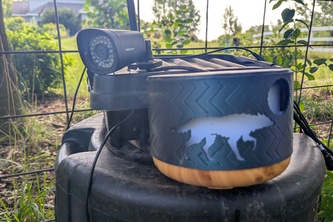
The description states that HATI is a surveillance system for homesteads that uses AI to detect threats near a poultry coop and deploy an olfactory deterrent. It includes:
- A camera (Foscam G4) capturing motion events.
- Local image processing using a Gemma 4 E4B model to filter benign events.
- A large language model (GPT-5.6 Luna) for visual interpretation of unclear events.
- Deterministic Python code to authorize physical action, including human veto and allowlists.
- A diffuser that sprays predator scent for up to five minutes.
- Telegram integration for alerts and feedback.
Inference The system is described as autonomous but with strong human oversight. It is not a full AI-driven automation without human control.
Positioning & Claim Evolution
The author states that HATI was built in response to the challenge of predation on poultry, where traditional deterrents like fencing and lights are insufficient or habituated to by predators. The system is positioned as an intelligent, humane, and autonomous solution for homesteaders.
Inference The positioning is rooted in a personal problem (losing chickens), not market research or customer feedback. The claim of autonomy is qualified by the presence of human veto and deterministic checks.
Target Customer & ICP
The description states that HATI targets homesteaders who keep poultry and are concerned about predation. It is described as a solution for hobby farmers or rural dwellers with small-scale livestock.
Inference The target customer is not clearly defined beyond the author’s own use case. No evidence of market segmentation, customer personas, or competitive positioning is provided.
Business Model & Pricing Evidence
The description does not state any pricing model, revenue streams, or monetization strategy. It is described as a prototype built for a hackathon and not intended for sale or commercial deployment.
Inference There is no evidence of a business model beyond the author’s own use case or demonstration.
Technical & Delivery Signals
The system uses:
- Local motion detection with OpenCV.
- A local Gemma 4 E4B model to suppress benign events.
- GPT-5.6 Luna for visual interpretation.
- Deterministic Python code for authorization and safety checks.
- Telegram for alerts and feedback.
- Tuya-based hardware control (diffuser).
- GitHub Actions CI and a public judge site.
Inference The system is described as robust in testing, with local processing to reduce API costs and safety checks. It includes feedback loops for improvement and crash recovery mechanisms.
Traction & Maturity Signals
The description states that the project was built during one hackathon week by a single developer. It includes:
- A real outdoor test event.
- A controlled improvement fixture that moved from 3/4 to 4/4 accuracy with zero regressions.
- A demo that runs without hardware or API keys.
- A public judge site and GitHub Actions CI.
Inference There is no evidence of customer adoption, revenue, or field deployment beyond the author’s own testing. The system is described as a prototype, not a product in use.
Competitive Context
The description does not mention any competitors or direct market context. It is positioned as solving a niche problem for homesteaders, but there is no evidence of existing solutions or competitive analysis.
Inference No competitive landscape is described. The author does not reference similar products or services.
Open Questions & Risks
- No traction or revenue: The system is described as a prototype with no real-world deployment.
- Single-person team: Only one developer, which raises concerns about scalability and long-term maintenance.
- Self-reported only: All information is from the author’s own account, with no third-party verification.
- Limited scope: The project is described as a hackathon effort, not a commercial product.
- No customer feedback or validation: No evidence of user testing or real-world feedback beyond the author.
Questions the description leaves open
- What is the actual cost of deploying this system at scale?
- Has there been any field testing beyond the controlled demo?
- Are there plans to commercialize or monetize this solution?
- How does the system handle false positives in real-world conditions?
- Is there any evidence of customer interest or demand beyond your own use case?
Overall Assessment
Not evidenced.
The project is described as a hackathon prototype with no revenue, customers, or traction. It is not a commercial product and does not appear to be in development for market release. The author states that it was built by one person over a week, and there is no evidence of any business model, funding, or team beyond the individual developer.
Confidence: Low.
This is a self-reported, unverified account of a prototype project with no evidence of commercial viability or traction. It cannot be evaluated as an investment or partnership opportunity without further information.
User Stories BotA demo video on every pull request
Get a demo video on every new feature
GitHub App that watches your pull requests and records a narrated, captioned demo.
Save time on demo prep and make informed decisions faster with a video walkthrough of every new feature.
Source
Submitted to the OpenAI 2026 hackathon on Devpost. Project home on Devpost. Back to the full gallery on Devpost.
This competitive analysis was produced by top-founders.com (opens in a new tab)
Generated by a language model from this project's public Devpost page — its tagline, the author's own write-up and any built-with tags listed there — as captured in August 2026. Short quotations are the author's words. It is an opinion on the idea as a business, not on the people behind it, and it reflects the description as published then. If the project has moved on, request a correction below. The analysis is not independent research and contains no verified traction, revenue or customer data.
An independent guide by KFG International LLC — not affiliated with, endorsed by, or connected to Devpost or OpenAI.