

Archive position — measured, not model output
0 likes on Devpost
2,263 of the 7,850 archived projects have more likes, and 5,587 share exactly 0 — so this project's #4,459 place in the like-ranked listing is a tie-break inside that group, not a ranking.
Projects (log scale)
Likes on Devpost. ▲ marks this project's group.
Show the figures
| Likes | Projects | Share of archive |
|---|---|---|
| 0 | 5,587 | 71.2% |
| 1 | 1,758 | 22.4% |
| 2 | 284 | 3.6% |
| 3–4 | 132 | 1.7% |
| 5–9 | 75 | 1.0% |
| 10+ | 14 | 0.2% |
 User Stories BotA demo video on every pull request
Get a demo video on every new feature
GitHub App that watches your pull requests and records a narrated, captioned demo.
Save time on demo prep and make informed decisions faster with a video walkthrough of every new feature.
Executive Summary
What the company appears to be
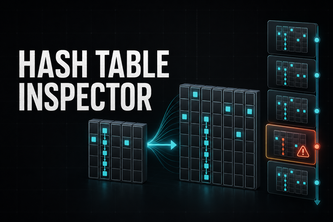
The author describes a single-person project named "Hash Table Inspector", an Android-native debugger for C11 hash tables. It visualizes real-time operations like collisions, rehashes, and invariant checks, with rewindable history and controlled corruption demonstrations.
What changed
This is a self-reported hackathon submission (Devpost entry) describing a technical prototype built over a compressed timeframe using AI tools (Codex + GPT-5.6). It does not indicate any prior commercial activity or product development beyond this one-off project.
Single most important open question
Is there evidence of traction, revenue, or customer adoption beyond the author’s own demonstration and self-reported use of AI tools?
Note: This analysis is based entirely on the self-reported description provided by the author. No external verification, archived data, or third-party sources are available.
What The Product Actually Is
The description states that Hash Table Inspector is an Android-native debugger for a real C11 hash table. It operates through a JNI bridge between native C code and Kotlin-based UI, using Jetpack Compose for presentation.
- The core functionality includes:
- Insert, update, lookup, delete operations.
- Visualization of buckets, collision chains, load factor, capacity, resize thresholds, chain-probe counts, and stable entry IDs.
- Rewindable history with up to 64 immutable snapshots.
- Deterministic demonstration of collisions, lookups, updates, deletes, and rehashes.
- Controlled corruption and invariant validation.
- JSON encoding of inspection frames.
- The native C code is written in strict C11, using separate chaining, deterministic hashing, stable entry IDs, and a 3/4 growth threshold.
- The Android layer uses Kotlin, JNI, and Jetpack Compose. Native results are passed via copied data to immutable Kotlin state.
Inference: The product appears to be a technical tool for developers or researchers working with low-level data structures, not intended for general consumers or production use.
Positioning & Claim Evolution
The author positions the tool as a way to make invisible transitions in hash tables visible and inspectable. It is framed as a debugging aid that reveals internal behavior such as collisions, rehashes, and invariants — things typically hidden from standard debuggers.
- The project began with a broader idea for inspecting native data structures but was narrowed down to one vertical slice (a C11 hash table).
- It emphasizes transparency and correctness by capturing events at stable points inside real operations rather than simulating behavior.
- There is no claim of commercialization or market readiness; it is presented as a hackathon submission.
Claim: The tool aims to improve observability of native data structures in Android development environments.
Not evidenced: Any positioning toward end-users, enterprise adoption, or broader market appeal.
Target Customer & ICP
The description does not name specific customers or personas. However, it implies a technical audience:
- Developers working with C11 and Android NDK.
- Researchers or engineers debugging hash table behavior.
- Users interested in low-level system introspection or educational purposes.
Inference: The target is likely niche — developers who work directly with native code and require deep visibility into data structures.
Not evidenced: Specific customer segments, personas, or use cases beyond the author's own needs.
Business Model & Pricing Evidence
There is no evidence of a business model or pricing strategy in the description.
- The project is described as a hackathon submission.
- No mention of monetization, licensing, subscriptions, or sales channels.
- No indication of whether it will be open-sourced or sold.
Not evidenced: Any commercial intent, revenue streams, or pricing plans.
Technical & Delivery Signals
The author provides detailed technical information:
- Built with Android NDK, C11, JNI, Kotlin, Jetpack Compose.
- Uses Bash and Clang for host builds; AddressSanitizer and UndefinedBehaviorSanitizer.
- Native inspection spine owns event envelopes and bounded FIFO timeline.
- Hash-table-specific adapter captures snapshots and performs validation.
- APK built for Samsung Galaxy S25 Ultra (API 36), physically tested on device.
Inference: The tool is technically sound, rigorously implemented, and validated through both automated testing and physical device use.
Not evidenced: Production deployment, scalability, or integration with existing tools beyond this prototype.
Traction & Maturity Signals
There is no evidence of traction or adoption:
- No customers, users, or feedback from real-world usage.
- No revenue, ARR, or funding rounds mentioned.
- The project is described as a single-person hackathon effort.
- No prior versions, releases, or product iterations are referenced.
Not evidenced: Any form of user engagement, market validation, or product maturity beyond the prototype stage.
Competitive Context
The description does not reference competitors or similar tools. It focuses on its own unique approach to inspecting hash tables rather than situating itself within a competitive landscape.
Inference: This is likely a standalone tool with no known direct competitors in this specific domain (C11 hash table inspection on Android).
Not evidenced: Competitor analysis, market positioning, or differentiation from other debugging tools.
Open Questions & Risks
Several risks and open questions emerge from the self-reported nature of the project:
- The entire product is a single-person effort — no team, no external validation.
- It's presented as a hackathon submission with no indication of follow-up or commercialization plans.
- No evidence of user feedback, usability testing beyond personal use, or integration into workflows.
- Reliance on AI tools (Codex + GPT-5.6) raises questions about long-term maintainability and ownership.
- The tool is limited to one vertical slice (C11 hash table), suggesting a narrow scope.
Inference: High risk of lack of traction, scalability, or market relevance without further development or adoption.
Not evidenced: Any evidence of product-market fit, scalability, or long-term viability.
Questions the description leaves open
- What is the intended future direction for this tool? Is there a plan to expand beyond C11 hash tables?
- Have you considered how this might be integrated into existing development workflows or IDEs?
- Are there any plans to open-source the project or make it available to others?
- How would you envision monetizing or commercializing this if at all?
- What are your thoughts on making this tool accessible to non-technical users or broader audiences?
Overall Assessment
There is no evidence of a viable business, traction, or investment-ready product in the description.
- The project is described as a hackathon submission with no indication of commercial intent.
- No revenue, customers, or market validation are evident.
- It lacks any signs of scalability or broader applicability beyond its current narrow scope.
Assessment: Not suitable for investment or partnership at this time.
Confidence level: Low — based on minimal self-reported evidence and lack of external validation.
User Stories BotA demo video on every pull request
Get a demo video on every new feature
GitHub App that watches your pull requests and records a narrated, captioned demo.
Save time on demo prep and make informed decisions faster with a video walkthrough of every new feature.
Source
Submitted to the OpenAI 2026 hackathon on Devpost. Project home on Devpost. Back to the full gallery on Devpost.
This competitive analysis was produced by top-founders.com (opens in a new tab)
Generated by a language model from this project's public Devpost page — its tagline, the author's own write-up and any built-with tags listed there — as captured in August 2026. Short quotations are the author's words. It is an opinion on the idea as a business, not on the people behind it, and it reflects the description as published then. If the project has moved on, request a correction below. The analysis is not independent research and contains no verified traction, revenue or customer data.
An independent guide by KFG International LLC — not affiliated with, endorsed by, or connected to Devpost or OpenAI.