

Archive position — measured, not model output
0 likes on Devpost
2,263 of the 7,850 archived projects have more likes, and 5,587 share exactly 0 — so this project's #4,458 place in the like-ranked listing is a tie-break inside that group, not a ranking.
Projects (log scale)
Likes on Devpost. ▲ marks this project's group.
Show the figures
| Likes | Projects | Share of archive |
|---|---|---|
| 0 | 5,587 | 71.2% |
| 1 | 1,758 | 22.4% |
| 2 | 284 | 3.6% |
| 3–4 | 132 | 1.7% |
| 5–9 | 75 | 1.0% |
| 10+ | 14 | 0.2% |
 User Stories BotA demo video on every pull request
Get a demo video on every new feature
GitHub App that watches your pull requests and records a narrated, captioned demo.
Save time on demo prep and make informed decisions faster with a video walkthrough of every new feature.
Executive Summary
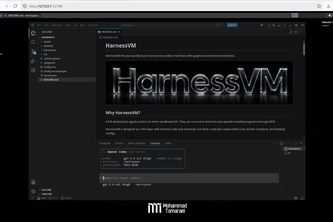
HarnessVM is a self-reported tool that creates secure, double-isolated AI coding sandboxes using Docker and Lima virtualization technologies. The author states it enables agentic development workflows by allowing users to run agents, tools, and local or cloud models in isolated environments with browser and terminal access. It supports YOLO (You Only Live Once) mode execution for AI agents.
The project appears to be a personal prototype built by one developer over a few days using Codex assistance. No commercial traction, customers, revenue or funding is evidenced. The author claims it works with VS Code, browser interfaces and various LLMs but provides no data on adoption, usage metrics or business model.
Most important open question
What is the actual commercial viability of this tool? The description shows a personal prototype with no evidence of market demand, customer feedback, pricing structure or monetization strategy.
What The Product Actually Is
The description states that HarnessVM:
- Creates secure AI sandboxes with browser and terminal access
- Uses Lima and Docker to build virtual machines with double isolation layers
- Provides graphical and terminal interfaces for interaction
- Comes preconfigured with VS Code, browser, and coding tools like Codex
- Isolates file systems and private networks from development environment
- Allows running agents, tools, and local/cloud models in "YOLO mode"
- Supports testing different agent harnesses and on-device LLMs
The author claims it was built using bash, codex, docker, gpt, lima technologies. It is described as a command-line tool that can be launched from project directories.
Not evidenced What the actual technical architecture looks like beyond these claims, what specific isolation mechanisms are implemented, or how it differs from existing sandboxing solutions.
Positioning & Claim Evolution
The author positions HarnessVM as:
- A solution for "agentic development" - running agents in parallel to translate requirements into implementations
- Tool that enables safe execution of AI agents without risk to user's computer or sensitive files
- Environment that allows "YOLO mode" execution with confidence
- Platform for testing different agent harnesses and LLMs without worrying about consequences
The claim evolution shows:
- Initial inspiration: agentic development as a "big game changer"
- Core functionality: secure sandboxing with isolation layers
- Value proposition: enabling safe, free execution of AI agents
- Future vision: testing various LLMs and agent configurations
Not evidenced How this compares to existing solutions, what specific competitive advantages it has, or whether the claims about "YOLO mode" execution are substantiated.
Target Customer & ICP
The description states that HarnessVM is for:
- Developers working with AI agents and agentic development workflows
- Users who want to run agents in isolated environments without risk to their systems
- People testing different agent harnesses and LLMs
- Software engineers using Codex or similar tools
Not evidenced Specific customer personas, market size estimates, user segmentation, or evidence of target customer demand. The description only mentions one developer as the creator.
Business Model & Pricing Evidence
The description states:
- No pricing information is provided
- The author built it for personal use and testing
- It uses industry-standard dependencies (Lima, Docker)
- The author mentions Codex's generous subscription plan was used during development
Not evidenced Any commercial business model, pricing structure, monetization strategy, or revenue streams. The project appears to be a prototype with no commercial elements described.
Technical & Delivery Signals
The description states:
- Built with bash, codex, docker, gpt, lima technologies
- Uses Lima and Docker for virtual machine creation
- Creates double isolation layers for security
- Provides browser and terminal interfaces
- Preconfigured with VS Code, browser, and coding tools
- Works locally or remotely via browser access
- Supports running agents, tools, and LLMs
Not evidenced Technical specifications, performance metrics, scalability claims, or delivery reliability. The description only describes what it does, not how well it performs.
Traction & Maturity Signals
The description states:
- Built in a couple of days using Codex
- Author is using it for personal projects
- Works smoothly with industry-standard dependencies
- Tested on own projects sometimes in parallel
- Used to test various cloud and on-device LLMs
Not evidenced Customer adoption, usage metrics, user feedback, market traction, or product maturity beyond a prototype stage. No evidence of revenue, customers, or growth indicators.
Competitive Context
The description states:
- The author is working with AI and agentic coding tools for 2-3 years
- Uses Codex for development assistance
- Works with GPT-5.6 Sol model
- References existing tools like Codex, Lima, Docker
Not evidenced Specific competitive landscape analysis, direct competitors, market positioning relative to existing sandboxing or AI development platforms, or differentiation from similar solutions.
Open Questions & Risks
Key risks and open questions include:
- Single-person development team with no evidence of commercial traction
- Prototype-only status with no customer feedback or adoption metrics
- No pricing model or monetization strategy described
- Self-reported claims without independent verification
- Limited technical details beyond basic functionality
- No evidence of market demand or competitive positioning
- Reliance on a single developer's personal experience rather than broader market validation
Not evidenced Specific market risks, financial viability concerns, or detailed competitive threats.
Questions the description leaves open
- What specific problems are you solving that existing solutions don't address?
- How do you plan to monetize this tool given it's currently a prototype?
- What customer feedback have you received from users beyond yourself?
- How does your isolation security compare to established sandboxing solutions?
- What is your go-to-market strategy for reaching developers?
- How do you plan to scale beyond single-person development?
- What are the technical limitations of your current implementation?
- How do you measure success for this product?
Overall Assessment
Not evidenced Commercial viability, market opportunity, or investment potential.
The description shows a personal prototype with no evidence of traction, customers, revenue, or business model. The author states it's a working prototype they use personally but provides no data on adoption, usage metrics, or commercial viability.
The project appears to be in early development stage with no commercial elements described. No funding, partnerships, or market validation are evidenced.
Confidence level Very low - based entirely on self-reported description with no external verification or traction data.
User Stories BotA demo video on every pull request
Get a demo video on every new feature
GitHub App that watches your pull requests and records a narrated, captioned demo.
Save time on demo prep and make informed decisions faster with a video walkthrough of every new feature.
Source
Submitted to the OpenAI 2026 hackathon on Devpost. Project home on Devpost. Back to the full gallery on Devpost.
This competitive analysis was produced by top-founders.com (opens in a new tab)
Generated by a language model from this project's public Devpost page — its tagline, the author's own write-up and any built-with tags listed there — as captured in August 2026. Short quotations are the author's words. It is an opinion on the idea as a business, not on the people behind it, and it reflects the description as published then. If the project has moved on, request a correction below. The analysis is not independent research and contains no verified traction, revenue or customer data.
An independent guide by KFG International LLC — not affiliated with, endorsed by, or connected to Devpost or OpenAI.