

Archive position — measured, not model output
1 like on Devpost
505 of the 7,850 archived projects have more likes, and 1,758 share exactly 1 — so this project's #1,177 place in the like-ranked listing is a tie-break inside that group, not a ranking.
Projects (log scale)
Likes on Devpost. ▲ marks this project's group.
Show the figures
| Likes | Projects | Share of archive |
|---|---|---|
| 0 | 5,587 | 71.2% |
| 1 | 1,758 | 22.4% |
| 2 | 284 | 3.6% |
| 3–4 | 132 | 1.7% |
| 5–9 | 75 | 1.0% |
| 10+ | 14 | 0.2% |
 User Stories BotA demo video on every pull request
Get a demo video on every new feature
GitHub App that watches your pull requests and records a narrated, captioned demo.
Save time on demo prep and make informed decisions faster with a video walkthrough of every new feature.
Executive Summary
What the company appears to be
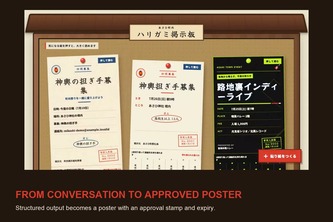
Harigami is a self-reported digital neighborhood bulletin board with an AI caretaker, designed for Japanese communities. The product enables residents to submit notices via voice or text, which are then processed by an AI that interviews users, enforces local rules, approves or rejects submissions, and generates posters pinned to a Showa-inspired corkboard. It is built as a local-first, non-networked prototype using Next.js, React, TypeScript, Tailwind CSS, and OpenAI's GPT-5.6.
What changed
The project began with the question: “What if the bulletin board itself could serve as that caretaker?” It evolved into a conversational interface for posting notices on physical community boards, integrating AI to manage the entire process from intake to expiration.
Single most important open question
Is there evidence of real-world traction or user feedback beyond the prototype? The description states no revenue, customers, or adoption data exist — only an author-built prototype. The self-reported nature of the description means that claims about functionality, impact, and scalability are unverified.
What The Product Actually Is
The description states Harigami is a digital neighborhood bulletin board with a built-in AI caretaker designed for Japanese communities. It allows residents to submit notices via voice or text, which are processed by an AI that:
- Identifies the type of notice (e.g., recruitment, event)
- Extracts structured information
- Asks only two questions at a time to gather missing details
- Requires contact information
- Checks submissions against local rules
- Approves or rejects based on those rules
- Generates a poster with a QR code and tear-off contact slips
- Automatically removes expired posters
- Records all decisions in an audit log
The AI caretaker uses GPT-5.6 through two server-side API routes:
- A "board caretaker" that classifies, extracts, resolves relative expressions, and checks rules.
- A "poster editor" that generates structured editorial content (headline, body, color, emoji) but not HTML or CSS.
The interface is rendered using Next.js, React, TypeScript, Tailwind CSS, and deployed on Vercel. Voice input uses browser APIs and OpenAI speech-to-text. The prototype uses localStorage instead of a database, reflecting a local-first architecture where each board is isolated.
Not evidenced: actual usage, customer feedback, or production deployment beyond the prototype.
Positioning & Claim Evolution
The description states Harigami was built to address a challenge in Japan: physical bulletin boards are locked behind glass and reserved for official information. The real issue, according to the author, is not creating posters but providing a human reception desk behind the board — someone who collects details, checks rules, clarifies responsibility, approves or rejects, and removes expired notices.
The product is positioned as:
- A digital version of a physical community board
- An AI caretaker that manages the full posting process
- A local-first tool, intentionally avoiding accounts, feeds, or online sharing
It is not described as a general-purpose AI poster generator but rather as an implementation of a civic process using AI.
Inferred: The positioning reflects a desire to preserve community trust and physical interaction while leveraging AI for automation. The claim evolution suggests a shift from idea to prototype with emphasis on locality, process, and interface fidelity, not scalability or monetization.
Target Customer & ICP
The description states Harigami is designed for Japanese communities — specifically, residents who use physical bulletin boards in places like:
- Community associations
- Public halls
- Schools
- Shrines
- Shopping streets
These users are likely to post notices about:
- Festival announcements
- Local activities
- Safety information
- Public notices
The ICP is not explicitly defined beyond “Japanese community boards.” The author notes that the tool is intentionally local, with no global network or user accounts.
Not evidenced: No data on actual users, demographics, or customer segments. The description does not name specific types of administrators or residents who would use it.
Business Model & Pricing Evidence
The description states Harigami is a prototype and does not include any information about:
- Revenue streams
- Pricing models
- Monetization strategy
- Customer acquisition plans
It is described as a local-first tool, with no accounts, feeds, or sharing features. This implies that the business model is not yet defined beyond its current prototype form.
Not evidenced: No evidence of any business model, pricing, or monetization strategy.
Technical & Delivery Signals
The project was built using:
- Next.js App Router
- React
- TypeScript
- Tailwind CSS
- Vercel for deployment
- OpenAI GPT-5.6 via structured API calls
- Codex for specification-driven development
- Browser APIs for voice input (MediaRecorder, speech-to-text)
- Playwright and Vitest for testing
Key technical decisions include:
- Use of structured outputs to control AI behavior
- Server-side prompts and JSON schemas to enforce consistency
- Deterministic poster templates to avoid layout fragility
- Local-first architecture, using localStorage instead of a database
- No HTML/CSS generation by AI, only structured editorial content
The prototype is described as:
- Phased with explicit completion criteria
- Buildable and testable after each phase
- Includes automated tests for validation logic, expiration, QR payloads, and rejection paths
Inferred: The technical approach reflects a strong emphasis on control over AI behavior and predictability, rather than open-ended generative capabilities.
Traction & Maturity Signals
The description states Harigami is a prototype built for the OpenAI 2026 hackathon. It includes:
- A working demonstration
- End-to-end conversational flow
- Automated tests
- Playwright script for full demo recording
However, there is no evidence of:
- Real-world deployment
- Customer adoption or feedback
- Revenue or monetization
- Product-market fit validation
Not evidenced: No traction data, user metrics, or market validation beyond the prototype.
Competitive Context
The description does not mention any direct competitors. It positions Harigami as a local-first, AI-powered community board tool that integrates with physical spaces and enforces local rules.
It is not described as competing with:
- General-purpose social platforms
- Digital bulletin boards (e.g., Facebook groups)
- AI poster generators
Inferred: The competitive context is likely limited to physical community boards and informal notice systems in Japan. It may overlap with tools for managing local events or civic engagement, but no specific competitors are named.
Open Questions & Risks
- Prototype-only status: Harigami exists only as a prototype, with no evidence of real-world use or feedback.
- No monetization strategy: No indication of how the product would be sold or funded beyond its hackathon origin.
- Local-first design may limit scalability: The intentional lack of accounts, feeds, and cloud sharing could hinder broader adoption.
- AI control risks: While structured outputs are used, there is no evidence that AI behavior has been rigorously tested in real-world scenarios.
- No validation of user needs: The description does not include any user research or feedback from actual community boards.
Questions the description leaves open
- What specific problems do you observe in Japanese community boards that Harigami addresses?
- Have you conducted any user testing with real residents or administrators?
- How would you scale this beyond a single prototype, and what are the key technical or business barriers?
- What is your plan for integrating with existing physical infrastructure (e.g., signage, local government systems)?
- Are there any legal or regulatory considerations in Japan around AI use in public spaces or community boards?
- How do you envision the transition from AI-only to human-administrated approval workflows?
Overall Assessment
The description states Harigami is a prototype built for a hackathon, with no evidence of traction, revenue, or customer adoption.
Assessment Not ready for investment or partnership. The project is in an early prototype phase and lacks any commercial evidence. It is not demonstrated to have product-market fit, scalability, or monetization potential.
Inferred: If the founders intend to build a commercial product, they must demonstrate:
- Real-world usage
- Customer feedback
- A clear business model
- Technical robustness beyond the prototype
Until then, Harigami remains an idea with strong design and technical execution — but no evidence of commercial viability.
User Stories BotA demo video on every pull request
Get a demo video on every new feature
GitHub App that watches your pull requests and records a narrated, captioned demo.
Save time on demo prep and make informed decisions faster with a video walkthrough of every new feature.
Source
Submitted to the OpenAI 2026 hackathon on Devpost. Project home on Devpost. Back to the full gallery on Devpost.
This competitive analysis was produced by top-founders.com (opens in a new tab)
Generated by a language model from this project's public Devpost page — its tagline, the author's own write-up and any built-with tags listed there — as captured in August 2026. Short quotations are the author's words. It is an opinion on the idea as a business, not on the people behind it, and it reflects the description as published then. If the project has moved on, request a correction below. The analysis is not independent research and contains no verified traction, revenue or customer data.
An independent guide by KFG International LLC — not affiliated with, endorsed by, or connected to Devpost or OpenAI.