

Archive position — measured, not model output
2 likes on Devpost
221 of the 7,850 archived projects have more likes, and 284 share exactly 2 — so this project's #339 place in the like-ranked listing is a tie-break inside that group, not a ranking.
Projects (log scale)
Likes on Devpost. ▲ marks this project's group.
Show the figures
| Likes | Projects | Share of archive |
|---|---|---|
| 0 | 5,587 | 71.2% |
| 1 | 1,758 | 22.4% |
| 2 | 284 | 3.6% |
| 3–4 | 132 | 1.7% |
| 5–9 | 75 | 1.0% |
| 10+ | 14 | 0.2% |
 User Stories BotA demo video on every pull request
Get a demo video on every new feature
GitHub App that watches your pull requests and records a narrated, captioned demo.
Save time on demo prep and make informed decisions faster with a video walkthrough of every new feature.
Executive Summary
What the company appears to be
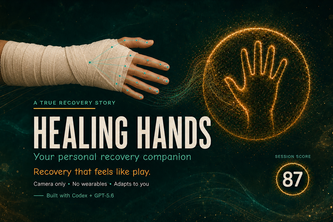
Healing Hands is a self-reported camera-based hand rehabilitation tool designed to provide personalized feedback during home recovery exercises. The project was built as part of an OpenAI 2026 hackathon submission and is described as a prototype with no verified revenue, customers or traction.
What changed
The description shows a shift from personal experience (a car accident) to a product concept that uses computer vision and AI to track hand movements. It positions itself as a way to improve engagement in home-based physical therapy through gamification and real-time feedback.
The single most important open question
Is there any evidence of actual user testing, clinical validation or pilot programs with patients or therapists? The description states the project is a prototype but does not indicate whether it has moved beyond that stage.
What The Product Actually Is
- The description states Healing Hands is a camera-based hand-training companion.
- It uses computer vision to track 21 points on each hand and turns exercises into interactive experiences.
- Users perform three calibration movements: making a fist, touching thumb to fingertip, and bringing palms together.
- The system provides feedback through particles, sound, progress indicators, and scoring.
- It is described as not replacing therapists but helping users follow exercises consistently and keep records.
Inference Based on the author's own write-up, Healing Hands appears to be a browser-based prototype that uses MediaPipe for tracking and integrates with AI tools like Codex and GPT-5.6 for development support.
Positioning & Claim Evolution
- The description states Healing Hands aims to address the gap in home recovery where people lack feedback and motivation.
- It positions itself as a tool that makes repetitive exercises more engaging by turning them into interactive experiences with visual and auditory rewards.
- The author claims it adapts to each person’s current ability, making limited movement feel like progress rather than failure.
- There is no mention of specific medical or clinical validation in the description.
Inference The positioning evolved from a personal recovery need (after a car accident) into a broader solution for home-based rehabilitation that could be scalable beyond hand injuries.
Target Customer & ICP
- The description states Healing Hands targets individuals recovering from hand and wrist injuries who are practicing at home.
- It is intended to help people stay engaged between therapy appointments, especially those with limited mobility or access to frequent in-person sessions.
- The system is described as not replacing therapists but supporting self-guided practice.
Inference Based on the author's own words, the ICP likely includes patients recovering from hand injuries who are looking for structured, motivating, and accessible recovery tools.
Business Model & Pricing Evidence
- No evidence of pricing or monetization strategy is provided.
- The description does not mention any business model, subscription plans, or revenue streams.
- It is described as a prototype built for a hackathon.
Inference There is no indication that Healing Hands has moved beyond the prototype stage or has a defined path to monetization.
Technical & Delivery Signals
- Built using CSS, MediaPipe, Python, and TypeScript.
- Uses camera tracking to observe 21 points on each hand.
- Tracks movement over time rather than frame-by-frame to handle imperfect tracking.
- Incorporates AI tools like Codex and GPT-5.6 for concept development and prototyping.
- Includes checks for sequence, stability, hold duration, and tracking confidence to avoid counting accidental movements.
Inference The technical approach suggests a browser-based prototype with some integration of AI for feedback generation and experience design.
Traction & Maturity Signals
- Not evidenced.
- No mention of users, customers, or adoption metrics.
- The project is described as a hackathon submission.
- No data on usage frequency, retention, or performance improvements.
Inference There is no evidence of traction or maturity beyond the initial prototype phase.
Competitive Context
- Not evidenced.
- No information about existing competitors or market players in the space of home-based rehabilitation tools.
- The description does not reference similar products or platforms.
Inference Without any competitive analysis, it's unclear whether Healing Hands addresses a unique gap or overlaps with other solutions.
Open Questions & Risks
- The project is described as a hackathon prototype with no verified clinical validation or user testing.
- No evidence of real-world usage or feedback from patients or professionals.
- The description does not indicate any regulatory compliance or safety considerations for medical devices.
- The claim that AI tools like GPT-5.6 were used implies reliance on unverified or experimental technology.
Inference The lack of clinical validation, user testing, and traction raises concerns about the product's readiness for real-world deployment.
Questions the description leaves open
- Has Healing Hands been tested with actual patients or therapists?
- What kind of feedback have users given during early trials?
- Are there any plans to integrate with existing healthcare systems or devices?
- How does the system ensure accuracy and reliability in varying lighting conditions or user movements?
- Is there a plan for clinical validation or regulatory approval?
- What is the roadmap beyond the current prototype?
Overall Assessment
- Not evidenced.
- No information on funding, team traction, or strategic partnerships.
- The project is described as a hackathon submission with no indication of commercial viability or scalability.
Inference Based solely on the self-reported description, Healing Hands appears to be an early-stage idea with limited evidence of traction or maturity. It would require significant further development and validation before any investment or partnership consideration.
User Stories BotA demo video on every pull request
Get a demo video on every new feature
GitHub App that watches your pull requests and records a narrated, captioned demo.
Save time on demo prep and make informed decisions faster with a video walkthrough of every new feature.
Source
Submitted to the OpenAI 2026 hackathon on Devpost. Project home on Devpost. Back to the full gallery on Devpost.
This competitive analysis was produced by top-founders.com (opens in a new tab)
Generated by a language model from this project's public Devpost page — its tagline, the author's own write-up and any built-with tags listed there — as captured in August 2026. Short quotations are the author's words. It is an opinion on the idea as a business, not on the people behind it, and it reflects the description as published then. If the project has moved on, request a correction below. The analysis is not independent research and contains no verified traction, revenue or customer data.
An independent guide by KFG International LLC — not affiliated with, endorsed by, or connected to Devpost or OpenAI.