

Archive position — measured, not model output
2 likes on Devpost
221 of the 7,850 archived projects have more likes, and 284 share exactly 2 — so this project's #341 place in the like-ranked listing is a tie-break inside that group, not a ranking.
Projects (log scale)
Likes on Devpost. ▲ marks this project's group.
Show the figures
| Likes | Projects | Share of archive |
|---|---|---|
| 0 | 5,587 | 71.2% |
| 1 | 1,758 | 22.4% |
| 2 | 284 | 3.6% |
| 3–4 | 132 | 1.7% |
| 5–9 | 75 | 1.0% |
| 10+ | 14 | 0.2% |
 User Stories BotA demo video on every pull request
Get a demo video on every new feature
GitHub App that watches your pull requests and records a narrated, captioned demo.
Save time on demo prep and make informed decisions faster with a video walkthrough of every new feature.
Executive Summary
What the company appears to be
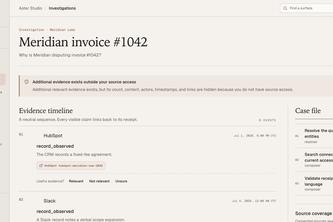
Hindsight is a self-reported tool for reconstructing disputed client invoices by aggregating and organizing financial, CRM, email, chat, and project records into an ordered, evidence-based investigation trail. It allows users to explore authorized records in sequence, identify conflicts, and detect missing evidence — all while maintaining access controls and avoiding causal or blame attribution.
What changed
The project was built as a hackathon submission (Devpost entry) with a focus on demonstrating a vertical slice of functionality using a deterministic 90-day corpus. It uses AI to structure findings into timelines, conflicts, gaps, and next actions, but does not make judgments about fault or causality.
Single most important open question
Is there any evidence that Hindsight has been used in production by real clients, or that it has moved beyond the demo stage?
What The Product Actually Is
The description states that Hindsight is a tool for reconstructing disputed client invoices across multiple systems (finance, CRM, email, chat, project tools). It builds an ordered evidence trail from authorized records and separates results into four categories: timeline, conflict, gap, and next action.
It uses AI models (e.g., GPT-5.6-sol) to parse questions, compose structured outputs, and answer follow-ups within the bounds of available evidence. Evidence IDs are returned instead of URLs directly, and access is validated server-side before resolving receipts.
The system is built as a TypeScript modular monolith using Next.js, React, PostgreSQL, Inngest, and integrates with services like Clerk for authentication, Nango for connectors, and OpenAI for language processing.
Not evidenced: whether this is a managed SaaS product or still in prototype form; no mention of actual customers, revenue, or deployment beyond the hackathon demo.
Positioning & Claim Evolution
The description claims Hindsight helps agency owners enter difficult client conversations with an ordered, verifiable account of what happened. It positions itself as a tool for operations teams to resolve disputes by showing which evidence supports each conclusion and what is missing.
It explicitly avoids declaring fault or assigning blame — the user makes those judgments. The product is framed as a neutral investigation assistant rather than a decision engine.
Inferred: This suggests a positioning shift from generic document search toward structured dispute resolution, but there is no evidence of prior versions or evolution in claims beyond the hackathon context.
Target Customer & ICP
The description states that Hindsight targets agency owners and operations leads who deal with client disputes involving invoices, contracts, scope changes, and project deliverables. These users are expected to have access to systems like HubSpot, Slack, Asana, QuickBooks, and Gmail.
Not evidenced: No explicit segmentation or persona definition beyond “operations teams” or “agency owners.” No evidence of customer interviews, usage data, or target market size.
Business Model & Pricing Evidence
The description does not mention pricing, subscriptions, or monetization strategies. It only describes the product’s functionality and architecture.
Not evidenced: No indication of a business model, pricing tiers, or revenue streams beyond the hackathon demo.
Technical & Delivery Signals
Hindsight is built as a TypeScript modular monolith using Next.js, React, PostgreSQL, Inngest, and integrates with tools like Clerk, Nango, OpenAI, and others. It uses structured outputs (Zod) to manage AI responses and enforces access control at the retrieval level.
The system includes:
- Normalized event data
- ACL-aware retrieval
- Evidence ID-based citations
- Server-side receipt resolution
- Multi-model architecture (GPT for composition, smaller model for entity linking)
Not evidenced: No information on scaling, performance metrics, or production stability. No mention of cloud infrastructure beyond Vercel and Cloudflare.
Traction & Maturity Signals
The project is described as a hackathon submission from the OpenAI 2026 hackathon. It includes a demo at hindsight.questili.com and a repository with local setup instructions.
Not evidenced: No evidence of user adoption, customer feedback, or product traction beyond the demo environment. No mention of funding, headcount, or growth metrics.
Competitive Context
The description does not reference direct competitors or similar tools in the market. It implies that existing systems (CRM, email, project management platforms) do not provide a unified view for dispute resolution.
Inferred: Hindsight may compete with or complement tools like HubSpot, Salesforce, Asana, and QuickBooks by offering a structured way to cross-reference data during disputes, but no competitive analysis is provided.
Open Questions & Risks
- Unverified claims: All information comes from the author’s own description — no independent validation.
- Demo-only status: No evidence of production use or real-world adoption.
- No business model clarity: No indication of how Hindsight will generate revenue.
- Limited access control testing: While access boundaries are enforced, there is no evidence of robustness in real-world usage.
- AI dependency without transparency: The system relies heavily on AI for structuring outputs; no mention of explainability or auditability features.
Questions the description leaves open
- Has Hindsight been used in production by any clients yet?
- What is the plan for monetization and pricing?
- How does Hindsight handle data privacy and compliance (e.g., GDPR, CCPA)?
- Are there plans to support more integrations beyond those mentioned in the tech stack?
- What are the key assumptions about user behavior or workflows that underpin this product?
- How is the AI output validated or corrected by users?
- What are the main technical challenges encountered during development and deployment?
Overall Assessment
Not evidenced: There is no evidence of traction, revenue, customers, or funding to support an investment or partnership decision.
The project appears to be a hackathon prototype with a clear concept and some technical execution. However, without any indication of real-world usage, business model clarity, or commercial viability, it cannot be evaluated for investment or partnership potential at this time.
This is a self-reported, unverified product in early-stage development. Any further diligence would require access to actual user data, financials, or operational metrics — none of which are provided.
User Stories BotA demo video on every pull request
Get a demo video on every new feature
GitHub App that watches your pull requests and records a narrated, captioned demo.
Save time on demo prep and make informed decisions faster with a video walkthrough of every new feature.
Source
Submitted to the OpenAI 2026 hackathon on Devpost. Project home on Devpost. Back to the full gallery on Devpost.
This competitive analysis was produced by top-founders.com (opens in a new tab)
Generated by a language model from this project's public Devpost page — its tagline, the author's own write-up and any built-with tags listed there — as captured in August 2026. Short quotations are the author's words. It is an opinion on the idea as a business, not on the people behind it, and it reflects the description as published then. If the project has moved on, request a correction below. The analysis is not independent research and contains no verified traction, revenue or customer data.
An independent guide by KFG International LLC — not affiliated with, endorsed by, or connected to Devpost or OpenAI.