

Archive position — measured, not model output
2 likes on Devpost
221 of the 7,850 archived projects have more likes, and 284 share exactly 2 — so this project's #340 place in the like-ranked listing is a tie-break inside that group, not a ranking.
Projects (log scale)
Likes on Devpost. ▲ marks this project's group.
Show the figures
| Likes | Projects | Share of archive |
|---|---|---|
| 0 | 5,587 | 71.2% |
| 1 | 1,758 | 22.4% |
| 2 | 284 | 3.6% |
| 3–4 | 132 | 1.7% |
| 5–9 | 75 | 1.0% |
| 10+ | 14 | 0.2% |
 User Stories BotA demo video on every pull request
Get a demo video on every new feature
GitHub App that watches your pull requests and records a narrated, captioned demo.
Save time on demo prep and make informed decisions faster with a video walkthrough of every new feature.
Executive Summary
What the company appears to be
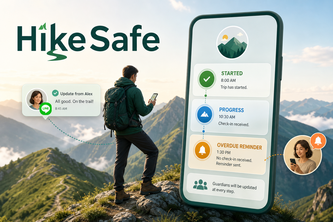
HikeSafe is a LINE-based hiking safety companion built as a hackathon project by one developer. The product enables hikers to plan trips, check in at key moments, and keep guardians informed with staged alerts when plans run late. It integrates LINE Login, LIFF, and Messaging API for communication.
What changed
This is a self-reported, unverified project submitted to the OpenAI 2026 hackathon. No prior version or commercial activity has been evidenced. The author describes building a functional prototype with offline queuing, idempotency handling, retry logic, and alert staging.
The single most important open question
Is there any evidence of traction, revenue, customer adoption, or market validation beyond the author’s own description?
What The Product Actually Is
The description states that HikeSafe is a LINE-based hiking safety companion. It allows hikers to:
- Create structured trip plans including route, team members, expected return time, equipment, vehicle, and emergency contact details.
- Start a hike with an explicit location check-in.
- Send progress updates using GPS or text-only status reports.
- Request help and share latest available information.
- Confirm that the entire team has safely returned.
- Extend the expected return time when plans change.
It also sends staged LINE alerts at 0, 60, and 120 minutes past the expected return time. Guardians can view last reported time/location, route, team members, and other relevant details. At the highest alert level, it provides a copyable report summary for contacting authorities.
Not evidenced: whether any of these features are live or used by users; no actual product deployment or customer data is described.
Positioning & Claim Evolution
The author positions HikeSafe as a tool to close communication gaps between hikers and their guardians. The goal is not to replace rescue services or professional equipment, but to help hikers communicate clearly and give guardians reliable information when something goes wrong.
Key claims:
- “I created HikeSafe to close this communication gap.”
- “HikeSafe does not perform background GPS tracking, interpret silence as an emergency, or automatically contact rescue services.”
- “The system cancels pending alerts immediately after a confirmed finish.”
These are self-reported intentions. No evidence of market positioning, branding, or messaging beyond the author’s own account is provided.
Target Customer & ICP
The description states that HikeSafe targets hikers in Taiwan who use LINE for communication. It was initially built with LINE as the primary platform because it is widely used there.
Not evidenced: actual customer segments, user personas, or any evidence of target market size or behavior beyond the author’s own experience.
Business Model & Pricing Evidence
No business model or pricing information is provided in the description. The project is presented as a hackathon submission with no indication of monetization strategy, subscription plans, or revenue streams.
Not evidenced: any commercial structure, pricing tiers, or monetization approach.
Technical & Delivery Signals
The author built HikeSafe using:
- Next.js App Router
- TypeScript
- PostgreSQL
- Drizzle ORM
- LINE Login, LIFF, and Messaging API
Key technical features include:
- LINE-based authentication and viewer authorization.
- Structured trip and route data.
- Explicit GPS and text-only check-ins.
- Offline check-in queuing for temporary network loss.
- Idempotency keys to prevent duplicate actions and notifications.
- Retryable LINE message delivery.
- Staged alert processing at multiple time thresholds.
- Alert cancellation after a confirmed safe return.
Not evidenced: production deployment, scalability metrics, or performance data.
Traction & Maturity Signals
The project is described as a hackathon submission. No evidence of user adoption, customer base, or usage statistics is provided.
Not evidenced: any form of traction, revenue, or product maturity beyond the author’s own account.
Competitive Context
No competitive analysis or market positioning is included in the description. The author does not reference existing solutions or competitors.
Not evidenced: competitive landscape, differentiation strategy, or market presence.
Open Questions & Risks
- Single-person team: Only one developer is mentioned; no evidence of team expansion or support structure.
- Unverified claims: All features and functionality are self-reported without external validation.
- No commercial traction: No evidence of users, customers, or revenue.
- Limited scope: The product is built for LINE first, with future integrations planned but not executed.
- Technical complexity assumptions: Handling race conditions, retries, and offline behavior suggests a high level of engineering maturity, but no production validation is evident.
Questions the description leaves open
- Has the LINE integration been deployed with real credentials?
- Have you tested the full experience with hikers and guardians in realistic conditions?
- What are your plans for scaling beyond Taiwan or expanding to other messaging platforms?
- How do you intend to validate demand for this product in the market?
- Are there any existing partnerships or pilot programs with hiking groups, outdoor clubs, or rescue services?
Overall Assessment
This is a self-reported hackathon project with no evidence of traction, revenue, or customer adoption. The author describes a functional prototype with strong technical design, but there is no indication that the product has moved beyond concept or testing phases.
Confidence Level: Low
Assessment: Not ready for investment or partnership consideration without further validation and evidence of market demand, user engagement, or commercial viability.
User Stories BotA demo video on every pull request
Get a demo video on every new feature
GitHub App that watches your pull requests and records a narrated, captioned demo.
Save time on demo prep and make informed decisions faster with a video walkthrough of every new feature.
Source
Submitted to the OpenAI 2026 hackathon on Devpost. Project home on Devpost. Back to the full gallery on Devpost.
This competitive analysis was produced by top-founders.com (opens in a new tab)
Generated by a language model from this project's public Devpost page — its tagline, the author's own write-up and any built-with tags listed there — as captured in August 2026. Short quotations are the author's words. It is an opinion on the idea as a business, not on the people behind it, and it reflects the description as published then. If the project has moved on, request a correction below. The analysis is not independent research and contains no verified traction, revenue or customer data.
An independent guide by KFG International LLC — not affiliated with, endorsed by, or connected to Devpost or OpenAI.