

Archive position — measured, not model output
1 like on Devpost
505 of the 7,850 archived projects have more likes, and 1,758 share exactly 1 — so this project's #1,163 place in the like-ranked listing is a tie-break inside that group, not a ranking.
Projects (log scale)
Likes on Devpost. ▲ marks this project's group.
Show the figures
| Likes | Projects | Share of archive |
|---|---|---|
| 0 | 5,587 | 71.2% |
| 1 | 1,758 | 22.4% |
| 2 | 284 | 3.6% |
| 3–4 | 132 | 1.7% |
| 5–9 | 75 | 1.0% |
| 10+ | 14 | 0.2% |
 User Stories BotA demo video on every pull request
Get a demo video on every new feature
GitHub App that watches your pull requests and records a narrated, captioned demo.
Save time on demo prep and make informed decisions faster with a video walkthrough of every new feature.
Executive Summary
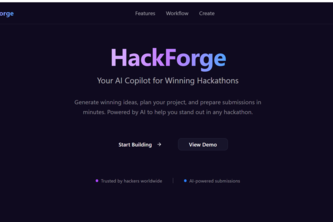
HackForge is a self-reported AI-powered hackathon copilot built by a single developer (Saranya Sai Cheedella) for the OpenAI 2026 hackathon. The product claims to streamline the hackathon workflow from idea generation to submission preparation using AI tools like GPT-5.6 and Codex, with a frontend built on Next.js, React, and Tailwind CSS.
The author states that HackForge aims to reduce time spent on repetitive planning tasks so developers can focus on innovation. It includes features such as idea generation, project planning, documentation export, and UI refinement powered by AI.
Key commercial due-diligence read
The description does not contain any evidence of revenue, customers, or product-market fit beyond the author's own claims. There is no indication of traction or adoption outside of this single hackathon submission. The most important open question is whether this project has evolved into a viable product with real users or remains an experimental MVP.
What The Product Actually Is
The description states that HackForge is:
- An AI-powered hackathon copilot
- A platform designed to help developers generate ideas, plan projects, organize documentation, and prepare winning hackathon submissions in one place
- Built using Next.js, React, TypeScript, Tailwind CSS, Vercel, OpenAI GPT-5.6, and Codex
The author describes it as a tool that guides users from idea generation to final submission during hackathons.
Inference Based on the technology stack and feature claims, HackForge appears to be a web-based application with AI-assisted functionality for developers participating in hackathons.
Positioning & Claim Evolution
The description states:
- HackForge is positioned as an "AI-powered hackathon copilot"
- It aims to simplify the entire hackathon workflow so developers can focus on innovation
- The goal is to reduce time spent on repetitive planning tasks and increase productivity during hackathons
Inference The positioning suggests a niche tool targeting hackathon participants, with a focus on automation and efficiency gains. However, there is no evidence of how this compares to existing tools or whether it addresses a significant pain point beyond the author's personal experience.
Target Customer & ICP
The description states:
- The target audience is "developers" participating in hackathons
- It helps users generate ideas, plan projects, organize documentation, and prepare submissions
Inference The ICP appears to be individual developers or small teams involved in hackathons. No further segmentation or targeting beyond this is evident.
Business Model & Pricing Evidence
The description does not contain any information about:
- Revenue model
- Pricing structure
- Monetization strategy
Not evidenced
Technical & Delivery Signals
The description states:
- Built with Next.js, React, TypeScript, Tailwind CSS, Vercel
- Uses OpenAI GPT-5.6 for brainstorming, UI refinement, documentation, and improving user experience
- Uses OpenAI Codex for code generation, debugging, refactoring, and accelerating development
- Manual completion of final architecture, testing, feature selection, debugging, deployment, and project customization
Inference The technical stack indicates a modern frontend application with AI integration. However, there is no evidence of scalability, performance metrics, or production-grade delivery beyond the MVP.
Traction & Maturity Signals
The description states:
- Submitted to the OpenAI 2026 hackathon on Devpost
- Successfully deployed on Vercel
- Well-structured GitHub repository
- Professional documentation and project organization
- Fully responsive modern UI
- Multiple AI-assisted planning features
Not evidenced There is no evidence of actual usage, user base, or adoption beyond the hackathon submission. No data on engagement, retention, or customer feedback.
Competitive Context
The description does not contain any information about:
- Competitors
- Market landscape
- Differentiation from existing tools
Not evidenced
Open Questions & Risks
Key risks and open questions based on the description:
- Single-person team (no evidence of scaling or support)
- No revenue, customers, or traction data beyond a hackathon submission
- Self-reported claims without independent verification
- Limited evidence of product-market fit or real-world usage
- Unclear path to monetization or long-term viability
Inference The lack of verified traction and business model raises concerns about whether this is a viable commercial product or merely an experimental prototype.
Questions the description leaves open
- What specific problems do you observe in the current hackathon workflow that your tool solves?
- Have you validated your solution with actual users beyond the hackathon context?
- How do you plan to monetize this tool if it's not just for hackathons?
- Are there any existing tools that already offer similar functionality, and how does yours differ?
- What is your roadmap for moving from MVP to a scalable product?
- Do you have any plans for user authentication or team collaboration features beyond the MVP?
Overall Assessment
The description states:
- HackForge was built as part of a hackathon submission
- It includes AI-assisted features and a responsive UI
- The author has experience with rapid prototyping and deployment workflows
Not evidenced No evidence of revenue, customers, or market traction. The project is described as a single-person effort with no indication of commercial viability or scalability.
Assessment Based on the self-reported description alone, there is insufficient evidence to support an investment or partnership decision. This appears to be an experimental MVP submitted for a hackathon rather than a proven product with real users or revenue streams. Any potential value would depend on further development and validation beyond this initial submission.
User Stories BotA demo video on every pull request
Get a demo video on every new feature
GitHub App that watches your pull requests and records a narrated, captioned demo.
Save time on demo prep and make informed decisions faster with a video walkthrough of every new feature.
Source
Submitted to the OpenAI 2026 hackathon on Devpost. Project home on Devpost. Back to the full gallery on Devpost.
This competitive analysis was produced by top-founders.com (opens in a new tab)
Generated by a language model from this project's public Devpost page — its tagline, the author's own write-up and any built-with tags listed there — as captured in August 2026. Short quotations are the author's words. It is an opinion on the idea as a business, not on the people behind it, and it reflects the description as published then. If the project has moved on, request a correction below. The analysis is not independent research and contains no verified traction, revenue or customer data.
An independent guide by KFG International LLC — not affiliated with, endorsed by, or connected to Devpost or OpenAI.