

Archive position — measured, not model output
0 likes on Devpost
2,263 of the 7,850 archived projects have more likes, and 5,587 share exactly 0 — so this project's #3,126 place in the like-ranked listing is a tie-break inside that group, not a ranking.
Projects (log scale)
Likes on Devpost. ▲ marks this project's group.
Show the figures
| Likes | Projects | Share of archive |
|---|---|---|
| 0 | 5,587 | 71.2% |
| 1 | 1,758 | 22.4% |
| 2 | 284 | 3.6% |
| 3–4 | 132 | 1.7% |
| 5–9 | 75 | 1.0% |
| 10+ | 14 | 0.2% |
 User Stories BotA demo video on every pull request
Get a demo video on every new feature
GitHub App that watches your pull requests and records a narrated, captioned demo.
Save time on demo prep and make informed decisions faster with a video walkthrough of every new feature.
Executive Summary
What the company appears to be
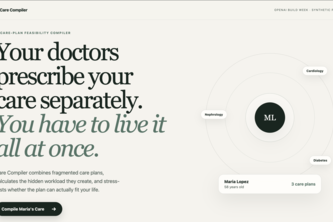
Care Compiler is a self-reported tool that uses AI and deterministic logic to analyze fragmented medical care plans and assess whether a patient can realistically follow them given their life constraints. It is presented as a feasibility compiler for complex care regimens, not a decision-making or treatment tool.
What changed
The project was submitted as part of the OpenAI 2026 hackathon. It demonstrates an early-stage prototype with synthetic data and a limited set of features, including GPT-5.6 integration for structured extraction and a deterministic engine for workload modeling.
Single most important open question
Is there evidence that Care Compiler has traction or adoption beyond its demo, or that it can scale to real-world patient populations and care teams?
Note
This analysis is based entirely on the self-reported project description provided by the author. No external verification, revenue data, customer feedback or usage metrics are available.
What The Product Actually Is
The description states that Care Compiler:
- Combines fragmented care plans (e.g., for cardiology, nephrology, diabetes) with a patient’s real-life constraints.
- Uses GPT-5.6 to extract obligations from care-plan text via structured outputs and Zod validation.
- Applies a deterministic TypeScript engine to calculate visible and invisible workload, dependencies, deadlines, and logistical conflicts.
- Performs a weekly feasibility stress test and generates a “Care Conversation Brief” for patients and care teams.
- Does not decide which care to skip or alter; instead, it creates an evidence-backed conversation brief.
It is described as a tool that asks: “Can this person actually live this plan?”
Inference The product is a feasibility analysis engine, not a clinical decision support system or treatment recommender.
Positioning & Claim Evolution
The author states:
- Care Compiler addresses the problem of “treatment burden” where patients must manage multiple chronic conditions.
- It challenges the assumption that care plans are medically reasonable but practically impossible to execute.
- The tool is positioned as a way to enable evidence-backed conversations between patients and care teams, not to replace or override clinical decisions.
Claim
The product aims to shift focus from “adherence” to “feasibility.”
Inference This is a repositioning of the patient-care interaction from compliance-based to capacity-based.
Target Customer & ICP
The description states:
- The primary user is a patient with multiple chronic conditions.
- Care teams (doctors, nurses, care coordinators) are also intended users.
- A synthetic patient named Maria is used in the demo to illustrate functionality.
Inference The ICP appears to be patients with complex care regimens and their healthcare providers.
Not evidenced No stated customer segments beyond the demo scenario or any indication of how many such patients exist, or whether there are actual users beyond the demo.
Business Model & Pricing Evidence
The description does not state:
- Any pricing model
- Revenue streams
- Monetization strategy
- Customer acquisition approach
- B2B vs. B2C positioning
Not evidenced No evidence of a business model or pricing structure.
Technical & Delivery Signals
The description states:
- Built with: codex, GPT-5.6, next.js, openai, openai-responses-api, react, typescript, vercel, vitest, zod.
- Uses structured extraction from GPT-5.6 with Zod validation.
- Includes a deterministic fallback for API failures.
- Has 49 automated tests and a production-ready demo.
- The interface is designed to be honest about when fallbacks are active.
Inference The product uses a hybrid AI-deterministic architecture, which suggests an attempt at reliability and safety in clinical contexts.
Traction & Maturity Signals
The description states:
- A working prototype with synthetic data.
- A deployed demo.
- 49 passing automated tests.
- No mention of real-world validation or user feedback.
- No evidence of customer adoption, revenue, or usage metrics.
Not evidenced No traction signals beyond the demo and internal testing.
Competitive Context
The description does not state:
- Any competitors
- Market size or landscape
- How Care Compiler differentiates from existing tools in care coordination or patient engagement
Not evidenced No competitive positioning or market analysis.
Open Questions & Risks
- The product is described as a prototype with synthetic data.
- It does not make clinical decisions, but it may influence care conversations — raising questions about liability and safety.
- GPT-5.6 is used for structured extraction, but the system is constrained to avoid altering treatments; however, this may still raise concerns around AI reliability in clinical settings.
- No evidence of real-world validation or patient feedback.
- The team size is listed as 1, which raises questions about scalability and ongoing development.
Inference Risk of over-reliance on synthetic data and lack of real-world testing could hinder adoption.
Questions the description leaves open
- What are the actual clinical or regulatory requirements for a tool like this to be used in patient care?
- How does Care Compiler handle edge cases where care-plan data is incomplete or ambiguous?
- Have you validated the accuracy of GPT-5.6’s structured extraction with real-world care plans?
- What safeguards are in place to prevent misuse or over-reliance on the tool by patients or providers?
- Are there any pilot programs or partnerships with healthcare organizations currently underway?
Overall Assessment
The description states that Care Compiler is a prototype built for a hackathon, and no evidence of traction, revenue, or customer adoption is provided.
Assessment Not evidenced as a viable investment or partnership opportunity at this stage. The project shows early technical capability but lacks commercial proof-of-concept, market validation, or scalability signals.
Confidence level Low — based on self-reported prototype and synthetic data only.
User Stories BotA demo video on every pull request
Get a demo video on every new feature
GitHub App that watches your pull requests and records a narrated, captioned demo.
Save time on demo prep and make informed decisions faster with a video walkthrough of every new feature.
Source
Submitted to the OpenAI 2026 hackathon on Devpost. Project home on Devpost. Back to the full gallery on Devpost.
This competitive analysis was produced by top-founders.com (opens in a new tab)
Generated by a language model from this project's public Devpost page — its tagline, the author's own write-up and any built-with tags listed there — as captured in August 2026. Short quotations are the author's words. It is an opinion on the idea as a business, not on the people behind it, and it reflects the description as published then. If the project has moved on, request a correction below. The analysis is not independent research and contains no verified traction, revenue or customer data.
An independent guide by KFG International LLC — not affiliated with, endorsed by, or connected to Devpost or OpenAI.