

Archive position — measured, not model output
0 likes on Devpost
2,263 of the 7,850 archived projects have more likes, and 5,587 share exactly 0 — so this project's #3,128 place in the like-ranked listing is a tie-break inside that group, not a ranking.
Projects (log scale)
Likes on Devpost. ▲ marks this project's group.
Show the figures
| Likes | Projects | Share of archive |
|---|---|---|
| 0 | 5,587 | 71.2% |
| 1 | 1,758 | 22.4% |
| 2 | 284 | 3.6% |
| 3–4 | 132 | 1.7% |
| 5–9 | 75 | 1.0% |
| 10+ | 14 | 0.2% |
 User Stories BotA demo video on every pull request
Get a demo video on every new feature
GitHub App that watches your pull requests and records a narrated, captioned demo.
Save time on demo prep and make informed decisions faster with a video walkthrough of every new feature.
Executive Summary
Company: CareBridge AI
Self-reported basis: The analysis is based entirely on the author-supplied project description, tagline, and write-up — all self-reported and unverified. No external corroboration or historical data are available.
Commercial due-diligence read: CareBridge AI appears to be a prototype tool for family caregivers to convert voice or text health updates into structured reports using AI. The author states it is a working prototype, but there is no evidence of revenue, customers, or adoption. The product's positioning as an aid to healthcare communication is claimed, but not demonstrated. The single most important open question is whether the tool will gain traction among caregivers or healthcare providers — a key commercial uncertainty given its early-stage nature and lack of verified user engagement.
What The Product Actually Is
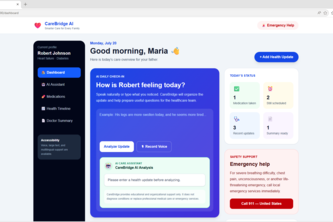
The description states that CareBridge AI allows caregivers to record health updates by voice or text, and uses AI to transform those inputs into organized, doctor-ready reports. It includes features such as:
- AI-powered health analysis
- Voice-to-text input
- Structured caregiver summaries
- Patient health timeline
- Doctor-ready printable report
- Medication dashboard
The product is built with Next.js, React, TypeScript, Tailwind CSS, OpenAI API, and browser Speech Recognition API. It is described as a prototype that integrates voice input, AI analysis, patient history, and report generation.
Evidence: The author’s own account.
Confidence: Low — this is a self-reported description of a prototype with no external validation or demonstration.
Positioning & Claim Evolution
The author states that CareBridge AI was inspired by the difficulty family caregivers have in remembering symptoms and health updates during medical appointments. It is positioned as a tool to help caregivers communicate more effectively with healthcare professionals, not to replace them.
The product claims to address a real-world problem faced by many families, but there is no evidence of market validation or customer feedback beyond the author’s own experience.
Evidence: The author's own account.
Confidence: Low — this is a self-described positioning and intent, not a validated market claim.
Target Customer & ICP
The description states that CareBridge AI targets family caregivers who need to communicate health updates to doctors. It is implied that these are individuals managing the care of patients, possibly elderly or chronically ill, who may struggle with documentation during medical visits.
There is no evidence of segmentation beyond this broad category, nor any indication of how many such caregivers exist or how they might be reached.
Evidence: The author's own account.
Confidence: Low — no data on customer profiles, personas, or market size.
Business Model & Pricing Evidence
The description does not mention a business model or pricing strategy. It is unclear whether the tool will be offered as a freemium service, a paid subscription, or through another mechanism.
There is no evidence of monetization plans, revenue streams, or pricing tiers.
Evidence: Not evidenced.
Confidence: Very low — no indication of how the product would generate value or income.
Technical & Delivery Signals
The tool is built with modern web technologies including Next.js, React, TypeScript, Tailwind CSS, and integrates OpenAI API and browser Speech Recognition API. It supports voice-to-text input and AI-powered analysis.
It is described as a working prototype that combines these technologies to produce structured reports from caregiver inputs.
Evidence: The author's own account.
Confidence: Low — this is a self-reported technical stack, not an independent assessment of delivery or scalability.
Traction & Maturity Signals
The description states that CareBridge AI is a working prototype and was submitted to the OpenAI 2026 hackathon. There is no evidence of user adoption, revenue, customer base, or product traction beyond the author’s own claims.
No metrics, usage data, or feedback from users are provided.
Evidence: The author's own account.
Confidence: Very low — no evidence of traction or maturity.
Competitive Context
The description does not mention any competitors or competitive landscape. It is unclear whether similar tools exist in the market for caregivers to organize health information or communicate with doctors.
No comparison to existing solutions is made.
Evidence: Not evidenced.
Confidence: Very low — no indication of competitive positioning or market analysis.
Open Questions & Risks
- Lack of traction or adoption: The product is described as a prototype with no evidence of real-world usage.
- Unclear monetization strategy: No business model or pricing information is provided.
- Privacy and compliance risks: Handling health data raises regulatory concerns, but there is no mention of data security or HIPAA compliance.
- User experience uncertainty: The tool is designed for caregivers with little technical experience, but the prototype’s usability is not evaluated.
- AI accuracy and reliability: No evidence of how AI outputs are validated or how errors might be handled.
Evidence: Inferred from self-reported description.
Confidence: Medium to high — based on the lack of evidence for key commercial signals.
Questions the description leaves open
- What specific problem are caregivers facing that this tool solves, and how did you validate that?
- How do you plan to ensure data privacy and compliance with healthcare regulations?
- Have you tested the AI output accuracy with real caregivers or medical professionals?
- What is your go-to-market strategy for reaching family caregivers or healthcare providers?
- Are there any existing tools in this space, and how does CareBridge AI differentiate from them?
- How do you plan to monetize this product, and what is your pricing model?
- What are the key technical challenges you anticipate scaling this tool?
- Do you have any feedback or early user testing results?
Evidence: Inferred from self-reported description.
Confidence: Medium — these questions are necessary due to lack of evidence in the description.
Overall Assessment
The description indicates that CareBridge AI is a prototype built for a hackathon, with no verified traction or revenue. It addresses a potential market need but lacks commercial validation.
There is insufficient evidence to support a conclusion about investment or partnership viability at this stage.
Evidence: The author's own account.
Confidence: Very low — no data on product-market fit, scalability, or financials.
User Stories BotA demo video on every pull request
Get a demo video on every new feature
GitHub App that watches your pull requests and records a narrated, captioned demo.
Save time on demo prep and make informed decisions faster with a video walkthrough of every new feature.
Source
Submitted to the OpenAI 2026 hackathon on Devpost. Project home on Devpost. Back to the full gallery on Devpost.
This competitive analysis was produced by top-founders.com (opens in a new tab)
Generated by a language model from this project's public Devpost page — its tagline, the author's own write-up and any built-with tags listed there — as captured in August 2026. Short quotations are the author's words. It is an opinion on the idea as a business, not on the people behind it, and it reflects the description as published then. If the project has moved on, request a correction below. The analysis is not independent research and contains no verified traction, revenue or customer data.
An independent guide by KFG International LLC — not affiliated with, endorsed by, or connected to Devpost or OpenAI.