

Archive position — measured, not model output
0 likes on Devpost
2,263 of the 7,850 archived projects have more likes, and 5,587 share exactly 0 — so this project's #4,396 place in the like-ranked listing is a tie-break inside that group, not a ranking.
Projects (log scale)
Likes on Devpost. ▲ marks this project's group.
Show the figures
| Likes | Projects | Share of archive |
|---|---|---|
| 0 | 5,587 | 71.2% |
| 1 | 1,758 | 22.4% |
| 2 | 284 | 3.6% |
| 3–4 | 132 | 1.7% |
| 5–9 | 75 | 1.0% |
| 10+ | 14 | 0.2% |
 User Stories BotA demo video on every pull request
Get a demo video on every new feature
GitHub App that watches your pull requests and records a narrated, captioned demo.
Save time on demo prep and make informed decisions faster with a video walkthrough of every new feature.
Executive Summary
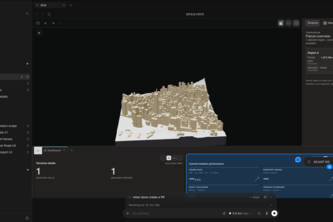
The company appears to be a solo project (1 person) named GRID, self-described as an AI city operating system. The author states that it is in early development, with a feature called "Terrarium" that allows rapid urban planning simulations using AI agents and geospatial data tools. The project was submitted to the OpenAI 2026 hackathon.
What changed
The author reports having built a working prototype of a city planning tool within one week, leveraging AI models (including GPT-5.6) and GIS technologies. This represents an initial proof-of-concept rather than a commercial product or service.
The single most important open question
Is there sufficient evidence that this project has traction, revenue, or customer adoption to warrant further due-diligence attention? The description contains no data on users, customers, sales, or market validation beyond the author's own claims.
What The Product Actually Is
The description states that GRID is an AI city operating system. It includes a feature called "Terrarium" which enables users to generate urban planning models and conduct comparative analyses of city areas in seconds, instead of weeks. This functionality is described as being powered by AI agents and geospatial technologies such as GIS, Mapbox, OpenStreetMap, and others.
The author describes building this with tools including Codex, Electron, React, Node.js, and various mapping libraries like MapLibre and Three.js. It appears to be a desktop or web-based application focused on urban planning simulation using AI.
Evidence The project description explicitly defines the product as an AI city operating system with a specific feature (Terrarium) and technical stack used in its construction.
Positioning & Claim Evolution
The author positions GRID as an AI-powered platform that transforms fragmented urban data into actionable insights for city planners. It claims to enable planners to ask questions, simulate tradeoffs, and make decisions based on evidence rather than guesswork.
The project's evolution seems to be from a conceptual idea (inspired by observations in Hong Kong) to a working prototype within a week. The author notes that the current version is "the beginning" and that they are working toward a vision of a city at one’s fingertips with full decision mapping and outcome simulation capabilities.
Evidence The description states the product's positioning as an AI city operating system and outlines its intended evolution from early prototype to a more comprehensive platform.
Target Customer & ICP
The author identifies urban planners, engineers, and city officials as potential users. The goal is to simplify their work by automating tasks that previously took weeks, such as creating city models for scale analysis and pattern recognition.
There is no explicit mention of specific customer segments beyond general urban planning roles. No evidence of segmentation or targeting within the urban planning profession is provided.
Evidence The description implies that the target audience includes urban planners and engineers who need to make decisions based on data and simulations, but does not elaborate on细分 or personas.
Business Model & Pricing Evidence
No business model or pricing information is provided in the description. The author mentions seeking feedback from city heads and hopes to find co-founders, suggesting a potential future path toward monetization or partnership models, but no concrete details are shared.
Evidence Not evidenced. No mention of revenue streams, pricing plans, or commercial arrangements.
Technical & Delivery Signals
The project uses a range of technologies including Codex, Electron, React, Node.js, GIS tools (Mapbox, OpenStreetMap), and AI models like GPT-5.6. It is built using JavaScript/TypeScript stack with 3D visualization capabilities via Three.js.
The author describes a development process involving AI agents that run overnight while he manages them manually during the day. The system includes features for generating visual representations of cities (e.g., terrariums) and comparing locations numerically.
Evidence The description lists technical components and describes how the system was built, including use of AI agents and geospatial tools.
Traction & Maturity Signals
The author reports completing a working prototype in one week, which they consider an accomplishment. However, there is no evidence of user adoption, customer feedback, revenue, or market traction beyond personal achievement.
There are no metrics on usage, retention, or performance beyond the author’s own account of development speed and satisfaction with results.
Evidence Not evidenced. No data on users, customers, or product adoption.
Competitive Context
No competitive landscape is described in the project write-up. The author does not reference existing platforms or competitors in the urban planning or AI city systems space.
Evidence Not evidenced. No mention of competition or market positioning relative to others.
Open Questions & Risks
- Single-person operation: The entire team consists of one person (Matyáš Vaščák), which raises concerns about scalability and long-term execution capability.
- Lack of traction or validation: There is no evidence of customers, users, or revenue; the project remains in early prototype stage.
- Unverified claims: All descriptions are self-reported without independent verification.
- Unclear monetization strategy: No indication of how the product will generate value or income.
- Highly speculative future vision: The author’s long-term goals (e.g., working in America, expanding with co-founders) are aspirational rather than realized.
Evidence These risks stem from the lack of any evidence of traction, revenue, or customer base, combined with the solo nature of the project and unverified claims.
Questions the description leaves open
- What specific urban planning challenges does GRID aim to solve, and how do you plan to validate these needs?
- How many hours per week are you dedicating to this project, and what is your timeline for reaching product-market fit?
- Have you conducted any interviews or feedback sessions with actual urban planners or city officials?
- What are the key assumptions underlying your AI agent-based approach, and how do you test them?
- Are there any existing partnerships or pilot programs with cities or government entities?
- How do you plan to scale beyond a single developer’s effort?
Inference These questions are based on the lack of evidence around traction, validation, and scalability in the provided description.
Overall Assessment
At this stage, there is no commercial due-diligence case for investment or partnership. The project is described as a solo-developer prototype with no evidence of revenue, customers, or market traction. It lacks any indication of a viable business model or validated demand.
The author’s claims about functionality and development speed are self-reported and unverified. While the idea has potential in the AI-powered urban planning space, there is insufficient evidence to assess whether it will become a commercially viable product or service.
Evidence Not evidenced. No data on commercial viability, revenue, or customer validation exists beyond the author’s own account.
User Stories BotA demo video on every pull request
Get a demo video on every new feature
GitHub App that watches your pull requests and records a narrated, captioned demo.
Save time on demo prep and make informed decisions faster with a video walkthrough of every new feature.
Source
Submitted to the OpenAI 2026 hackathon on Devpost. Project home on Devpost. Back to the full gallery on Devpost.
This competitive analysis was produced by top-founders.com (opens in a new tab)
Generated by a language model from this project's public Devpost page — its tagline, the author's own write-up and any built-with tags listed there — as captured in August 2026. Short quotations are the author's words. It is an opinion on the idea as a business, not on the people behind it, and it reflects the description as published then. If the project has moved on, request a correction below. The analysis is not independent research and contains no verified traction, revenue or customer data.
An independent guide by KFG International LLC — not affiliated with, endorsed by, or connected to Devpost or OpenAI.