

Archive position — measured, not model output
0 likes on Devpost
2,263 of the 7,850 archived projects have more likes, and 5,587 share exactly 0 — so this project's #6,359 place in the like-ranked listing is a tie-break inside that group, not a ranking.
Projects (log scale)
Likes on Devpost. ▲ marks this project's group.
Show the figures
| Likes | Projects | Share of archive |
|---|---|---|
| 0 | 5,587 | 71.2% |
| 1 | 1,758 | 22.4% |
| 2 | 284 | 3.6% |
| 3–4 | 132 | 1.7% |
| 5–9 | 75 | 1.0% |
| 10+ | 14 | 0.2% |
 User Stories BotA demo video on every pull request
Get a demo video on every new feature
GitHub App that watches your pull requests and records a narrated, captioned demo.
Save time on demo prep and make informed decisions faster with a video walkthrough of every new feature.
Executive Summary
RepoPath is a self-reported educational tool that aims to help users trace code in a GitHub repository and explain features back in their own words. The author describes it as a learning product that treats AI output as scaffolding, not proof of understanding. It is built by one person (alan Ho) and uses technologies like FastAPI, React, PostgreSQL, LangGraph, and GPT-5.6.
The project is described as being in early development, with checkpoints 1–4 implemented and 5–6 in progress. The core functionality involves importing a repository, choosing a feature, giving a baseline explanation, and receiving a structured lesson plan tied to code, tests, and documentation. It includes human checkpoints for accepting or rejecting AI proposals.
The author emphasizes that the goal is not to generate summaries but to support learners in explaining features independently. AI is used as a reasoning partner within a closed-loop system with bounded goals, explicit contracts, and deterministic validation.
Key commercial due-diligence questions include whether there is any evidence of traction, revenue, or customer adoption beyond the author's own use case; what the actual business model is; how the product differentiates from existing tools like GitHub Copilot or AI-powered learning platforms; and whether the described architecture can scale or be monetized.
The single most important open question is: Is there any evidence of real-world usage or demand for this type of educational tool, beyond the author's personal portfolio project?
What The Product Actually Is
The description states that RepoPath "turns a public GitHub repository into an evidence-grounded learning path." It allows learners to import a repository, choose a feature, provide a baseline explanation, and receive a structured lesson plan linked to code, tests, and documentation.
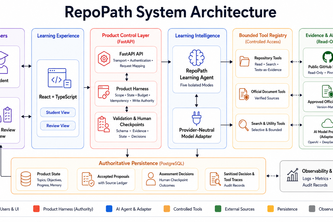
It uses AI (specifically GPT-5.6) as a reasoning partner within a closed-loop system with bounded goals, explicit contracts, and deterministic validation. The author describes the architecture as having an "Agent Harness" that isolates modes like repository analysis and curriculum planning, each with typed context, tool allowlists, budgets, output schemas, and stop conditions.
The product is built using:
- Frontend: React, TypeScript, Vite, TanStack Query
- Backend: FastAPI, Pydantic, PostgreSQL, SQLAlchemy, Alembic
- AI tools: LangGraph, GitHub REST API, OpenAI Codex, GPT-5.6
Not evidenced: The actual functionality beyond the described checkpoints, whether it works end-to-end, or if there are any user-facing interfaces or data flows beyond what's described.
Positioning & Claim Evolution
The author positions RepoPath as a learning product that treats AI output as scaffolding, not proof of understanding. It is described as aiming to help users trace one real feature through a repository and explain it without AI assistance.
The claim evolution shows:
- Initial inspiration: The author's earlier project "Kiwi Interview Agent" used Codex for rapid development but lacked the ability to convert AI output into personal understanding.
- Core shift: RepoPath is not about generating summaries or explanations, but about enabling learners to demonstrate understanding through their own evidence-backed explanations.
The positioning is self-reported and unverified. The author claims that the goal is not to generate another repository summary, but to support learners in tracing features and explaining them independently.
Not evidenced: Any market positioning beyond the author's personal narrative, or how this compares to existing educational tools or platforms.
Target Customer & ICP
The description states that RepoPath is designed for "learners" who want to trace code in a repository and explain features back in their own words. It targets individuals looking to improve technical knowledge through structured learning paths derived from real repositories.
It is implied that the primary users are developers or aspiring developers who want to understand how features work within open-source projects, but no specific customer segments or personas are defined.
Not evidenced: Specific target customer profiles, user research data, or any indication of who would pay for this product beyond the author's own use case.
Business Model & Pricing Evidence
The description does not provide any information about pricing, monetization strategy, or business model. It is unclear whether RepoPath is intended to be a paid service, a free tool, or if there is any revenue stream at all.
Not evidenced: Any details on how the product would generate revenue, pricing tiers, subscription models, or commercial partnerships.
Technical & Delivery Signals
The author describes RepoPath as built using:
- Frontend: React, TypeScript, Vite, TanStack Query
- Backend: FastAPI, Pydantic, PostgreSQL, SQLAlchemy, Alembic
- AI tools: LangGraph, GitHub REST API, OpenAI Codex, GPT-5.6
The system is described as using a closed-loop architecture with bounded goals, explicit contracts, deterministic validation, and human checkpoints. It uses "Agent Harness" to isolate modes like repository analysis and curriculum planning, each with typed context, tool allowlists, budgets, output schemas, and stop conditions.
Not evidenced: Actual technical performance metrics, scalability data, or evidence of the system functioning beyond the author's development environment.
Traction & Maturity Signals
The project is described as being in early development, with checkpoints 1–4 implemented and 5–6 in progress. The author notes that "Tutor sessions, final assessment, and learner memory are therefore not presented as completed features."
At Checkpoint 4, the repository recorded:
- Six launcher tests
- 200 backend tests
- 65 frontend tests
- Formatting, lint, strict backend and frontend type checks
- Frontend production build
However, no evidence of user adoption, customer feedback, or real-world usage is provided.
Not evidenced: Any traction signals such as active users, customer engagement, revenue, or market validation beyond the author’s own development work.
Competitive Context
The description does not mention any competitors. The author focuses on how RepoPath differs from their previous project (Kiwi Interview Agent) and emphasizes its closed-loop architecture and focus on learner understanding rather than AI-generated summaries.
Not evidenced: Any competitive analysis, market positioning relative to existing tools like GitHub Copilot, Coursera, Udemy, or other AI-powered learning platforms.
Open Questions & Risks
Key risks include:
- Lack of traction: No evidence of real-world usage or adoption beyond the author’s own development.
- Unproven market demand: The described product is a niche educational tool; no indication of whether there is sufficient demand for such a service.
- High technical complexity with limited resources: Built by one person (alan Ho), which raises questions about scalability and long-term maintenance.
- Unclear monetization strategy: No information on how the product would generate revenue or be commercialized.
- Dependency on AI model quality: Relies heavily on GPT-5.6, which may not be available or stable in production environments.
Open questions:
- The project is described as a portfolio piece and hackathon submission, suggesting it may not be intended for commercial use.
- No mention of any user base, feedback loops, or product-market fit validation.
Questions the description leaves open
- What specific problem are you solving, and how do you know there's real demand for this?
- Have you tested the product with actual users beyond yourself? If so, what were the results?
- How do you plan to monetize this tool? Is it a freemium model, subscription, or one-time purchase?
- What are your plans for scaling the platform beyond a single developer’s capacity?
- How does RepoPath differentiate from existing tools like GitHub Copilot, AI-powered learning platforms, or code documentation tools?
- Are there any legal or compliance concerns related to using third-party AI models like GPT-5.6 in a product?
- What is the long-term vision for RepoPath? Is it intended to be a standalone product or part of a larger ecosystem?
Overall Assessment
Based on the self-reported description, there is no evidence of traction, revenue, customers, or commercial viability beyond the author's own development work. The project appears to be an early-stage prototype built as a portfolio piece and hackathon submission.
The described functionality is niche and targeted toward developers seeking to improve their understanding of code repositories, but without any indication of market validation or user adoption.
Assessment: Not commercially viable at this stage.
There is insufficient evidence to support investment or partnership interest. The project lacks key signals such as user engagement, revenue generation, or clear monetization strategy. It remains a personal development effort with no demonstrated commercial potential.
User Stories BotA demo video on every pull request
Get a demo video on every new feature
GitHub App that watches your pull requests and records a narrated, captioned demo.
Save time on demo prep and make informed decisions faster with a video walkthrough of every new feature.
Source
Submitted to the OpenAI 2026 hackathon on Devpost. Project home on Devpost. Back to the full gallery on Devpost.
This competitive analysis was produced by top-founders.com (opens in a new tab)
Generated by a language model from this project's public Devpost page — its tagline, the author's own write-up and any built-with tags listed there — as captured in August 2026. Short quotations are the author's words. It is an opinion on the idea as a business, not on the people behind it, and it reflects the description as published then. If the project has moved on, request a correction below. The analysis is not independent research and contains no verified traction, revenue or customer data.
An independent guide by KFG International LLC — not affiliated with, endorsed by, or connected to Devpost or OpenAI.